
Science to the rescue: 1921–1970
This article is the third in this series summarising introduced pest animals and weeds in South Australia, summarising the events from 1921 to 1970.
In this period, scientific advancements had not yet revolutionised pest animal and weed control. The main response was by legislation, even though this method had very limited success. There were a significant number of Acts relating to pest animals but only a few for weed control. Legislation was enacted and repealed, and systems proposed, some being successful and many unsatisfactory. For a full list of all Acts relating to pest animal and weed control see Introduced pest animals and weeds in South Australia.
All Acts relating to agriculture in South Australia, including second reading speeches that explain the purpose of the Act are available in the section on legislation.
The material covered in this article pre-dates the introduction of metric measurements under the Metric Conversion Act 1970. Distance and weight measurements have been given in Imperial form (generally followed by metric equivalents). Also, it is an unnecessary and misleading exercise to adjust the currency from the pre-decimal pound (£), shilling (s) and pence (d). Today the value of £1 would be vastly different to the decimal equivalent of $2 when the currency was converted on 14 February 1966.
Agricultural events
Extremes of weather continued throughout this period with droughts and floods, high and low temperatures and the all too inevitable bushfires. The two significant droughts were the World War 2 drought of 1937 to 1945 and the 1965 to 1968 drought. The World War 2 drought set up the disastrous Black Friday bushfires of 1939. There were water shortages and dust storms during this drought culminating in the severe 1944 year. The Murray had stopped flowing and Adelaide faced water shortages. It wasn’t until 1947 that significant general rains ended the long drought. Intense drought returned to south-eastern Australia in 1967; in Adelaide, 1967 remains the driest year in more than 160 years of records. However, the drought began to break early in 1968. [1] As could be expected these conditions resulted in extensive livestock reductions and poor crop returns but also had a corresponding impact on pest animal numbers and the size of weed infestations.
The State enjoyed a post-war boom in the 1920s but the advent of the Depression soon had an overwhelming impact on all facets of life. In the first 20 years of this period there were five Royal Commissions relating to agriculture:
- 1923–25 Royal Commission on south-eastern drainage
- 1923–25 Irrigation Royal Commission under section 22 of Irrigation Act, 1922
- 1925–26 Royal Commission on rural settlement
- 1926–27 Royal Commission on the pastoral industry
- 1933 Royal Commission on dairy industry prices with a further Royal Commission convened in 1965 into grape growing. [2]
Parliamentary Committees were established on River Murray reclaimed swamp areas, soldier settlement and irrigation, agricultural settlement and debt adjustment in the agricultural and pastoral industries. In addition, a Parliamentary Standing Committee on Land Settlement was appointed in 1945 and continued to operate until after 1970.
As occurred 25 years earlier, during World War 2 agricultural production was initially affected as many experienced workers on the land volunteered to serve overseas with Australian forces. As the war progressed and food production needed to increase, additional workers were assigned for this work, e.g. Australian Women's Land Army. After the war, an assisted migration scheme brought 215,000 emigrants of all nationalities to South Australia between 1947 and 1973. During 1948, most Commonwealth wartime controls on economic life ended with price controls handed back to the States although petrol, butter and tea rationing didn’t end in South Australia until 1950. [3]
In 1951 wool prices reached a record high (mainly due to the Korean War) and the following year the first bulk-handling installation for cereals opened at Ardrossan. Large bulk handling storages followed in country towns and at ports throughout the State. But times were changing and in 1955, for the first time, factory production reached a higher value than primary production. [4] Then came the 1956 flood, the irrigation areas, agricultural properties and homes. [5]
During this period the State’s population rose from 495,000 in 1921 to 1,173,000 by 1970.
Pest animal control
The control of pest animals remained a difficult task for those on the land during the first 30 years of the period from 1921 to 1970. After about 1950, scientific advancements brought relief but in the most part these advancements were not taken to their full advantage. The principal Acts relating to pest animal control in South Australia during this period are highlighted throughout the text. Mention is also made of some associated amending Acts and a few Acts with a small related provision on pest animals (such as the State Bank Act) are also included.
Some Acts provided for control measures that dealt with native as well as introduced animals but this paper is restricted to introduced pest animals. Up until 1975 the word “vermin” was in general use for what we now refer to as pest animals. To avoid confusion, the term vermin has been used throughout the text below. Although certain native animals such as kangaroos, wallabies and wedge tail eagles were at various periods considered to be vermin, this article will just concentrate on those pest animals that were introduced to Australia, including the dingo which arrived in Australia from Southeast Asia about 3,500 years ago.
The story of pest animal control for the period 1921 to 1970 continues that from the previous period and again was influenced by the many Acts of Parliament which have been included under the various sub-headings below. Only the relevant provisions of these Acts that relate to the particular subject are included in that sub-heading. If legislation came into operation and it related to a specific pest animal, a summary of the legislative provisions is included under the respective species heading. Similarly, provisions relating to vermin fencing and vermin control boards are included under those headings.
Legislation overview
Legislation overview
Rabbits and wild dogs/dingoes, and to a lesser extent foxes, continued to have a significant impact for landowners, who were still restricted in what control activities that they could undertake – there were just no new methods available. Shooting, trapping and poisoning remained the main methods used. The Government did not have the technical expertise to develop new approaches and had to rely on external sources. While waiting for these, the Government continued to enact legislative provisions, their main emphasis continuing previous principles even though experience had shown they were less than effective without significantly more resources.
In 1921 the Vermin Act 1914 continued in force and provided for the destruction and control of rabbits, wild dogs and foxes (other animals could be proclaimed by the Governor to be vermin but none were at this time). The main objects of the Act were the establishment of vermin-fenced districts with a board. Boards were required to supress vermin, maintain pest animal fencing, raise rates and to ensure landowners destroyed all vermin on their land and half of all adjoining roads. For Crown lands outside of district councils and vermin districts, adjoining landowners were supplied by the Government with poison free of cost for them to use on adjoining Crown land. [6]
Almost each year of the 1920s resulted in an administrative amendment to the Vermin Act. In 1922, an amendment to the Act was necessary to lift the maximum levy rate that could be charged by boards because of the enormous increase in labour and material costs following World War 1. In addition, this amendment authorised the laying of poison on any Crown lands outside a vermin-fenced or district council district. [7] This was followed one year later to revise the period for the simultaneous destruction of vermin and to modify the legal procedure for prosecutions. [8]
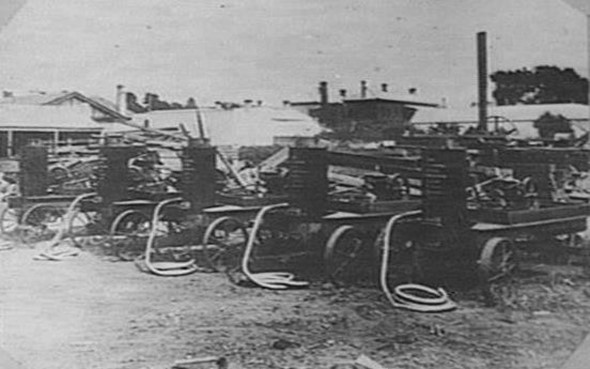
Government rabbit exterminators hired out to landowner, at rear of TH Varcoe, Ferres St Mount Gambier, 1925.
Image: SLSA
A further administrative amendment was made in 1924 so that the cost of barbed wire and netting to lessees of land outside vermin-fenced and council districts could be advanced for any fence, not just boundary fences. Further, the scope of the Act was extended so that landowners adjoining South-Eastern Drainage lands were responsible for destroying vermin on that land. [9] In 1925, with legislation to establish the State Bank of South Australia, consequential amendments were made to the Vermin Act so that all loans and advances previously made under that Act and all new loans would become due, owing and payable to the State Bank. [10]
This was followed in 1926 by an amendment to again increase the maximum levy rate that could be charged by boards, the reasons being the same as the 1922 amendment. [11] A 1928 amendment then included a new class of fence for the purposes of the Act, known as a dog-proof fence and to align interest rates for various loans to be the same as those under the Fences Act and under the Crown Lands and Pastoral Acts. [12] The late 1920s and early 1930s were difficult years for primary producers so that many landowners could not meet their fencing loan repayments. This was similar to the years around 1915 when the Government suspended loan repayments for a period. An amendment to the Act in 1930 provided for a measure of relief so that the State Bank could extend or suspend the time for the repayment of a loan (applications were limited to those made during the 1931 and 1932 years only and loans could only be suspended for two years). In addition, vermin trusts formed under the Act by several landowners for the purpose of applying for loans for vermin fencing, had, in practice, proved to be unsatisfactory and these provisions were repealed. However, those trusts established continued until their liabilities had been repaid. [13]
This stream of amendments to the Vermin Act, together with the significant length of the principal Act, necessitated the Government proposing that all these be consolidated into one new Act. This was achieved without the usual Parliamentary procedure after a guarantee was provided from Parliamentary Counsel that the new Act was a consolidation only. There were 10 Acts consolidated plus relevant provisions from the Crown Lands (Administration) Act 1930 (administrative name change) and the State Bank Act 1925 (see above for these provisions). [14]
By 1935 it had become necessary to again make a number of administrative amendments to the Vermin Act. These were mainly relating to specific instances in implementing the Act, such as boundary matters, cancelled leases, adjoining roads, abolition of vermin-fenced districts, etc. but a major provision was to again give relief to vermin boards and district councils and occupiers of land who had, in consequence of the adverse conditions which had prevailed in the agricultural and pastoral industries, fallen into arrears in respect of loans under both the Vermin and Loans for Fencing and Water Piping Acts. Like previous amendments, these provided that, for the period of the suspension, no instalments of the principal or interest would be required with an equal period being added to the term of the loan. A suspension could not exceed three years but was only available within two years after the passing of these provisions. [15]
In the 30 years from the mid-1930s there were 11 further amendments made, most of which again were of a minor administrative nature and related to specific instances in implementing the Act. [16] For example, these related to financial matters, board memberships, winding up of boards and disposal of assets and detailed control activities. It would appear that some of these amendments were ill-conceived and made in response to a single problem without thought to consequential impacts. As such further amendments were required.
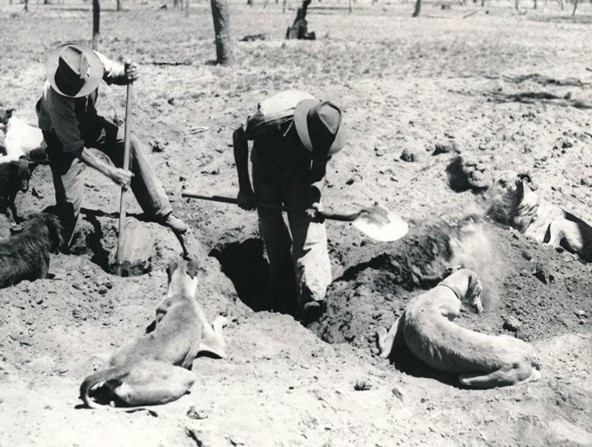
Digging out rabbit warrens, c1940s.
Image: PIRSA
However, a 1945 amendment was more substantive. It required landowners to not only destroy vermin but also to fill in or otherwise destroy rabbit warrens as well; to set a revised limit on the amount to be spent on board administration; to remit any interest or principal payable on a loan or postpone the payment of any instalments; and to prohibit the release or keeping of vermin on Kangaroo Island and other off-shore islands, in which case vermin would include hares. [17]
Meanwhile, in the mid 1960s, the Field Naturalists Society recorded that a number of feral species in the low rainfall pastoral districts of the State were a threat to native flora and fauna and it was thought that these species – feral goats, cats, donkeys and camels – would multiply to become as serious a pest as the rabbit. There was a push by the Society to have these species proclaimed as vermin so they could be destroyed or their numbers reduced. [18] However, the Fauna and Flora Board of South Australia, reflecting the new approach from Government to these types of requests, already had a considered position. The board argued that the depredations caused by such pests would not be reduced, or be any better controlled than was occurring at that time, merely by proclaiming them as vermin. What was more likely to eventuate, should they be proclaimed, was a series of appeals to the Government for funds to subsidise the destruction of the animals concerned. [19]
But a 1967 amendment was significant in a policy sense and this likely reflected the new approach being taken by the Vermin Branch. For the first time, the Government appreciated that there were similarities in administration between vermin control and weed control. Amendments were proposed based on experience learnt from operations under the Weeds Act, as it had been recognised that administrative problems associated with weed control were not dissimilar to the problems associated with vermin control. Advice had been sought from the authorities administering the weed control legislation. This recognition took another 20 years to come to fruition in one piece of legislation to administer both systems but it provides the first evidence of this policy direction. [20]
The 1967 amendment was more comprehensive than those that had preceded it. It established the Vermin Control Advisory Committee as a statutory body and provided it with formal powers and functions. It followed the principle set out in the Weeds Act of having a two-tier authorised officer system, Government authorised officers appointed by the Minister and local authorised officers appointed by councils or vermin boards. It introduced the concept of controlling or destroying vermin, rather than just destruction only, a much more practical approach. Further, provision was made for grants to councils or vermin boards for approved programmes for vermin control; this was a relatively new provision in relation to vermin and again was based on comparable provisions in the Weeds Act. In those areas of the State where there was no council or vermin board, the Minister was now vested with those powers. [21]
It further provided that the declaration of vermin could apply to the whole or part of the State, the declaration of poisons and provisions for their use and empowered a council or vermin board to make agreements with landowners for the control or destruction of vermin. Additionally, in a departure from all previous practice, a council or vermin board was responsible for controlling or destroying vermin on roadsides or certain Crown land and provisions were made for a council or vermin board to recover their expenses, either from the adjoining landowner for roadsides or the Crown. A council also had the power to impose a special rate on rural holdings to provide the necessary funds for it to ensure compliance with the provisions of the Act in relation the control or destruction of vermin. [22]
This series of amendments was a significant departure from the provisions that had existed for more than 30 years. They were more practicable and flexible and took into account the development of new poisons so that they could be better regulated for more widespread use. The similarity of provisions with the Weeds Act would have also greatly assisted council members and their staff in the administration of both Acts.
Pest animal fences
Pest animal fences
At the start of the 1920s the Vermin Act 1914 provided for the proclamation of vermin-fenced districts and the vermin fences associated with those districts. A critical component of the operations of the various boards was the inspection and maintenance of thousands of miles of vermin fencing. At this time, landowners were endeavouring to protect their properties by netting them. [23] By 1931, the number of vermin fenced districts proclaimed had reached 56. Government inspectors periodically inspected the fences in these districts and fences were generally in good condition. In addition, the NSW-SA border fence of more than 132 miles (212km) was also patrolled throughout the year by Government employees, who patrolled and maintained the fence in vermin-proof condition, with the expense borne equally by the two states. [24]
In 1921, the vermin fence known as the “Moolawatana and Yandama” vermin fence (from north of Lake Frome to the New South Wales border) had fallen into disrepair, after being built in 1905. The Government proposed to repair the fence but the lessees considered that, even if it were repaired, it would, owing to the nature of the country, soon be in as bad a state as before. This was because of the drifting nature of the sandy ground, which would result in the fence not remaining dog proof for any appreciable length of time and requiring a continual expense by lessees without sufficient recompense. Legislation was enacted to remove the fence materials and use them to repair the border fence. [25]
By 1935 dingoes were effectively controlled by fences within vermin districts. From 1891 to 1935 over £1,000,000 had been loaned for vermin proof fencing and £773,000 had been repaid. This had resulted in 34,400 miles (55,360km) of vermin proof fencing erected.26 But in some areas, wild dogs had not been seen for a number of years and the number of vermin-fenced districts were starting to reduce, down to 49 by 1941. [27] In addition, the financial climate in the decade of the Great Depression affected the upkeep of the fences and the installation of new fencing. This was followed by World War 2 where little work was possible for maintenance due to a shortage of material and lack of manpower. Fences consequently fell into poor condition. [28]
Both these factors resulted in many fences south of the vermin districts falling into disrepair, which could be tolerated with the low number of or no dingoes. However, the outer fences remained an important buffer against the wild dogs in the north. This increasing reliance on the outer districts throughout the mid to late 1930s and the early 1940s was to be one of the main drivers for a single barrier fence.
In 1938 the Stockowners’ Association sought assistance for the owners of the outside fences. Nothing further happened until June 1943 when the Vermin Districts Association recognised that the vermin fencing was, in many cases, in bad condition, and that inquiries should commence concerning a buffer fence to protect the pastoral industry. The Government agreed to the Association’s proposal that a committee of four persons be appointed to pursue the matter, comprising the Surveyor-General, and a representative of each of the following — the Vermin Districts Association, the Stockowners’ Association and the Stock Salesmen’s Association. [29]
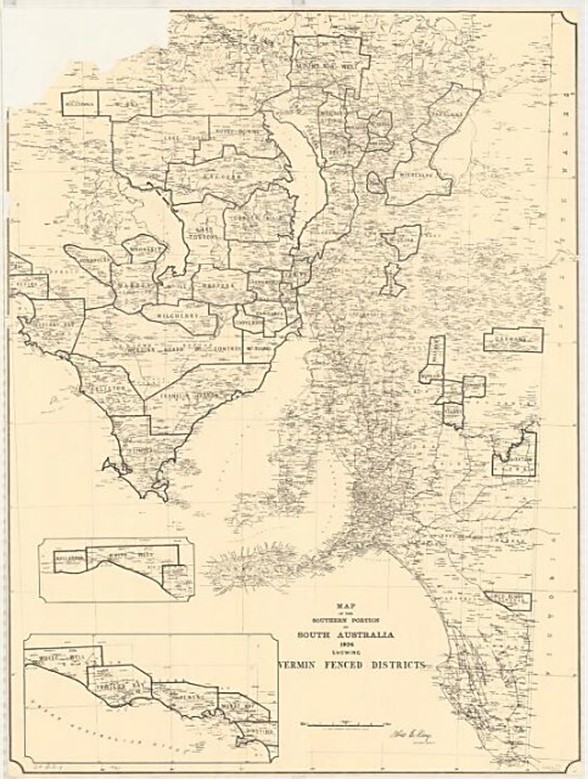
Map showing Vermin Fenced Districts, 1926
Image: PIRSA
The committee submitted and discussed various proposals with the Government and the associations they represented and finally submitted the scheme forming the basis of the proposed legislation, the Dog Fence Bill 1946. This Bill was aimed at enabling a continuous dog proof fence to be established across the northern area of the State thereby protecting against ingress of wild dogs to the pastoral and agricultural areas. The outside of the dog proof fence was some 1,350 miles (2,173km) long running from the New South Wales border, south and west of Lake Frome, around the Flinders Ranges, north of Lake Torrens, then generally westerly along the East-West railway line, down to the western end of the Gawler Ranges and westerly along the far west coast. [30] This effectively divided the pastoral zone into cattle and sheep production areas.
The legislation established a four-member Dog Fence Board, set out the procedure to be followed for the establishment and maintenance of the dog fence (with the first duty of the board to recommend the site of the dog fence, so far as possible using existing fences). The Board was given the power to set and collect a rate on land inside the Fence with the State Government to subsidise rates collected on a one-for-one basis. Significantly, the Act also established a basis of landholder ownership of the Fence and placed an obligation on owners and occupiers to maintain it. [31]
The line of the Fence was determined and an annual rate declared that applied to the rateable area — at that time effectively the unincorporated grazing areas of the State. The rate was declared at one shilling per square mile with an additional one shilling per square mile for those landowners situated within 10 miles (16km) of the dog fence and which adjoined the fence. [32] As stated, the inside vermin fences were in very poor condition and would require very high expenditure to make vermin proof. However, those responsible for maintenance of outside fences had kept them in dog-proof condition thereby protecting the inside districts. [33]
By 1949, an administrative amendment was required to the Act. The first was to allow the board to erect and maintain a fence on Crown land. The second related to fences with a common boundary between two properties and gave the board power to arrange with either one or both of the lessees to maintain the existing fence. [34]
More administrative amendments were made in 1953. These increased the maximum amount payable to the owners of the fence from £8 per mile to £16 per mile, an increase to the maximum rate from 1 shilling and 3 pence to 3 shillings per square mile while leaving the additional rate for those adjoining the fence unchanged but at the same time limiting the maximum Government subsidy for any financial year at the previous rate of 1 shilling and 3 pence per square mile. [35]
A further administrative amendment was made in 1959, necessitated because some fence owners had failed to meet their obligations to maintain the fence and destroy wild dogs in the vicinity of the fence. Although the Dog Fence Board could carry out the necessary work and recover the costs from the owner as a debt, this had proved insufficient and a stronger deterrent was required. An additional offence was included in the Act so that a fence owner was liable to a penalty of not less than £50 and not more than £100. [36]
The amendments continued. In 1960, the Act was amended to increase the penalties for damage to and unauthorised removal of any part of the dog fence, including damage by vehicles and that any gate or ramp be deemed to be part of the dog fence. Again in 1961, the maximum amount payable by the Dog Fence Board to owners of the fence was increased from £16 to £30, the maximum rate that could be imposed by the board was increased from 3 shillings a square mile to 6 shillings, the additional rate for land situated within 10 miles of the dog fence was abolished, and the limit imposed on the Government subsidy increased from 1 shilling and 3 pence to 2 shillings a square mile. [37]
1962 resulted in a further amendment to clarify the responsibility of owners of the various sections of the dog fence and to place the same responsibility on lessees of Crown land and was the consequence of a court case. [38] Another amendment in 1964 provided for a means for arbitration where, upon a variation in the site of the dog fence, the owner of a fence proposed to be made part of the Dog Fence and the owner of the fence ceasing to be part thereof failed to conclude a satisfactory financial arrangement. [39] Then in 1969, another administrative amendment removed the limitation on the subsidy payable by the government which reverted to the $1 for $1 subsidy. [40]
As a comparison, by 1955, the rate had increased to 2s 6d per sq mile of rateable land and fence owners were subsidised £13 per mile of fence. [41] This had increased to 3s 6d per square mile and a subsidy to fence owners to assist them meeting costs of fence maintenance was £17 per mile [42] and again in 1970 to 35 cents per square mile with the subsidy to $35 per mile. [43] In all these years, the fence was considered to be in a satisfactory condition.
A threat to retaining the fence in a dog proof condition, particularly on the Far West Coast, came from wombats. In country that suited them, wombats were proving to be capable of doing considerable damage to netting fences. In 1957, the Dog Fence Board took an interest in some experiments in the western Gawler Ranges to control wombats. Each board annual report from 1966 to 1970 included reference to the holes and damage caused by wombats in the far western section of the fence. This type of damage was later to be the principal catalyst for a major rethink of dog fence design along the far western lengths of the Dog Fence. [44]
As stated, the site of the fence was determined in 1947, but in 1961 and again in 1964, realignments were made for additional land for sheep. Together almost 6,000 additional square miles (15,540km2) were added and this extended the overall length of the fence in South Australia to 1,470 miles and 44 chains (2,365 km). [45]
Districts and boards
In the early 1920s there were 42 vermin districts proclaimed under the Vermin Act 1914. [46] By the end of that decade a further 14 districts were proclaimed, making a total of 56. [47] The number of districts then gradually declined so that by 1945 there were 44 vermin fenced districts. [48] Numbers continued to slowly decline, particularly in districts that were becoming more settled. The exception was in the outer pastoral areas where they continued until the Act was repealed in 1975. By the 1970s vermin boards, generally, had ceased to effectively enforce vermin control within their vermin fenced districts as they were primarily concerned with the maintenance of the dog fence within their districts, with other fences no longer requiring this level of maintenance. [49] There is no definitive list of vermin-fenced districts but there appears to have been 61 districts proclaimed, although not all were in existence at the same time. [50]
These boards consisted of four members and they shared staff including fence inspectors and secretaries. Boards continued to carry out all necessary works to suppress vermin by the erection of vermin fencing or dog-proof fencing. Boards had great difficulty over the years in carrying out their functions due to a number of factors, including drought conditions, sand drifts, labour shortages, fencing shortages, shortfalls in funding and pressures from other pest animals. The emphasis of local board activities was obviously dictated to a large extent by where they were geographically. Boards continued to struggle financially during this whole period and was the reason why some boards were dissolved. In 1931 a minor administrative amendment was made to the Vermin Act to provide some relief so that a board was no longer required to publish its half-yearly balance-sheet once in a newspaper and also once in the Government Gazette, just in the latter. [51]
Specific pest animals
Below is some information on those pest animals which had some significance for primary producer, other landowners and the Government during the period 1921 to 1970.
Birds
Birds
The control of sparrows by the councils under the Sparrow Destruction Act 1889 continued with limited success and the bounty on the birds and their eggs remained subject to abuse. In 1921 an amendment to the Act was proposed based on a failed amendment from two years previously and based on a request by the Western Australian Government. The amendment simply allowed Western Australian inspectors to come into South Australia for a distance of 50 miles (80km) in order to ensure the destruction of sparrows. At the time, this area was generally unoccupied. The amendment was passed as it was of a minor nature, there was no cost to the State and it was an act of grace to a neighbouring State. [52]
In 1934, the Sparrow Destruction Act was incorporated into the Local Government Act. This was because there were a number of activities administered by councils that were parts of other Acts. The Government decided to incorporate many of those activities under a revised Local Government Act for ease of administration. All these matters, including the provisions relating to sparrows, were included in the new Act without any material change. [53] The provisions relating to sparrows in the Local Government Act were repealed in 1985.
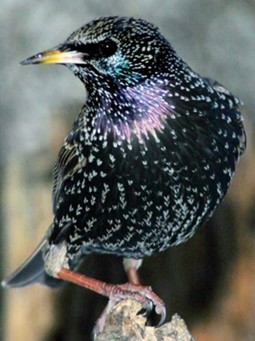 Common startling
Image: Agriculture WA
Starlings (Sturnus vulgaris) were introduced and became established in Australia in the mid 1880’s, both by acclimatisation societies and by others, in the vain hope that they might destroy insect pests. Starlings occur in agricultural areas, woodlands, feedlots and suburban areas where water is readily available. Invertebrates comprise over half their daily food intake, but they also consume fruit, berries, vegetables, meat and food scraps, and seeds of cultivated grains. Starlings congregate in large flocks and cause considerable damage to horticultural industries and cereal crops, with grain being susceptible when freshly sown and during ripening.
Grain from feedlots and storage areas is often consumed and starlings can also carry many parasites and diseases, which raise concern in food factories and industrial areas and are a potential risk to livestock industries. Environmental impacts centre round their aggressive competition for nest hollows which is potentially serious for some native species. [54] The spread of environmental weeds such as olives by starlings was becoming an emerging issue. [55] Despite the problems posed by starlings, no legislative controls were implemented in this period.
Camels
Camels
Camels were well suited to working in remote dry areas and were used for riding, carting goods and as draught animals in the early development of the arid areas of South Australia. From 1920 onwards, however, the numbers of domestic camels declined as the use of motor vehicles for freight haulage increased. The widespread establishment of feral camel populations was mainly due to the wholesale abandonment of domestic camels during the 1920s and 1930s. [56]
By the end of 1925 the Government was aware of the problem and of the increasing number of camels now in the pastoral areas (a report by the Surveyor-General showed that round Marree approximately 2,000 camels were running at large with only about 400 being worked, and those only for six months of the year). As there were no longer any owners responsible for these camels, pastoralists were seeking the power to destroy animals running at large. [57]
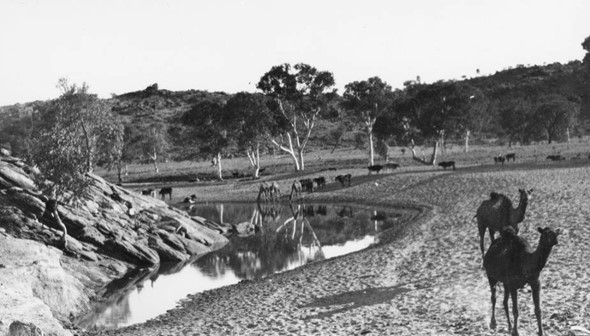
Camels and cattle at a water hole, Middle Park, 1921.
Image: SLSA
The Camels Destruction Act 1925 was passed providing landowners with the necessary powers to destroy feral camels on their land provided that public notice was first given as provided for in the Act. Most concern at that time centred on the economic losses caused by these camels, with vermin fences broken down and water infrastructure damaged thereby restricting the availability of water to livestock.
In addition, some camel owners had branded their camels and left them wandering for several years until they were ready for breaking in, but the owners of the land on which they run had no legal and effective method of dealing with them. The Impounding Act was ineffective over such large areas such as pastoral leases. [58] Members of Parliament regretted the passing of the camel, which had assisted in the development of the State, but noted that they were undoubtedly becoming a nuisance, along with the donkey. [59]
Only a year later, an amendment to the Camels Destruction Act was introduced and later passed. This amendment provided for the Commissioner of Crown Lands to destroy feral camels on reserves and it also exempted any camels licensed under the Crown Lands Act from being destroyed. This was because those remaining camel owners, finding the pastoral leases closed to them for the purpose of depasturing their camels, had driven their camels into the various Government reserves; the Act did not apply to these reserves and consequently the authorities were unable to take any effective steps to destroy camels concentrated thereon. As a result, these camels had eaten out the reserves and then pushed through fences onto adjoining leasehold land. The amendment set the same public notification requirements for the Commissioner of Crown Lands as other landowners.
An unfortunate consequence of the Act was that some camels still used for transporting goods had been destroyed. The amendment provided that where a camel was licensed and an authorised disc was attached round its neck, then there was no power under the Act to destroy the camel thereby giving some protection to camel owners with licences. [60] This legislation continued in force until repealed in 1985 but does not seem to have had a significant impact on feral camel numbers. In 1969 the first systematic attempt was made to assess the number of feral camels across outback Australia with the result that there were some estimated 20,000. [61]
Cats and foxes
Cats and foxes
Feral cats continued to kill native species, but the main interest seemed to be their effect on introduced birds and mammals, especially rabbits and house mice (in southern Australia). Cats rarely controlled populations of these introduced pests. High densities of rabbits and introduced rodents also allowed cats to reach high densities, which meant that even if those cats took only a small proportion of native animal species in their diet, the toll on native species would still be high. Cats would also switch prey types, so if management or weather conditions led to a rapid decline in the numbers of rabbits and introduced rodents, the large numbers of cats would then switch to consume mostly native animal species. As well as preying on wildlife, cats carried diseases that affected native animals, livestock, and people. [62]
Feral cats remained listed as unprotected under the Animals and Birds Protection Act. In rural areas they were difficult to control with the traditional use of poison baits often being ineffective. In fact, there were calls for cats to be protected. It was believed by graziers that feral cats killed significant numbers of vermin each year — cockroaches, spiders, centipedes, grasshoppers, snakes, and hares and, most importantly, rabbits being listed. The help that cats provided in keeping rabbits in check was considered enough to ensure their legal protection. Some believed that cats helped to balance Nature, but their value was not truly appreciated. [63]
Foxes continued to cause economic and environmental harm throughout this period. But it was recognised that there was a close relationship between fox and rabbit numbers. When rabbit populations crashed, due to drought or the introduction of the myxoma virus, there was a lag period until fox numbers also markedly declined, with a likely subsequent increase in predation of native wildlife. [52]
However, fox control programs were having an impact on fox numbers. This was noted at Roseworthy Agricultural College where foxes had been a problem for a number of years. In the early 1900s it was usual to locate 50 or 60 foxes killed by poisoning (in a period not disclosed), and with foxes so prevalent yards had to be erected for the protection of the sheep at night. By 1925, numbers had been so thinned by annual poisoning that only 15 to 20 foxes had now been located during the previous 12 months, with the College able to rear 90 per cent of its lambs. [53]
The Department of Lands annual reports during the 1930s show that, where figures were available, somewhere between 1,200 and 1,500 foxes were destroyed each year in vermin fenced districts [54] an average confirmed in the Department’s annual report ending 30 June 1941. [55] By 1949 though, probably as a result of the need to divert attention to the war effort, fox numbers had risen and were causing concern, taking a heavy toll on lambs. The irregular supply of ammunition was making control difficult for landowners. [56] This increase in numbers gave rise in 1950 to calls to reintroduce a bounty for foxes. The Government refused stating that it had no authority to pay a subsidy for the cost of destroying foxes in the country, it being the property owners' responsibility to control foxes on their land. District councils wanted the question of fox subsidies reconsidered. [57] This was supported by the Stockowners' Association, its members considering that foxes and wild dogs were one of the greatest problems facing pastoralists at that time. The imposition of a levy for the destruction of foxes was recommended with a request to urge the Commonwealth Scientific and Industrial Research Organisation (CSIRO) [58] to promote scientific means of exterminating foxes. [59] Neither request led to the hoped-for outcomes.
Goats and mice
Goats and mice
In rising numbers, feral goats continued to impact primary production and the environment by eating pastures, crops and native vegetation, spreading diseases and damaging fences. Dingoes, feral dogs and their hybrids, foxes, wedge-tailed eagles and feral pigs were all predators of feral goats, with dingoes and feral dogs being the main predators. They clearly affected feral goat distribution, as feral goats were rarely present unless dingoes or feral dogs were absent or regularly controlled to low densities.
Feral goats were present in the more rugged parts of the North Flinders Ranges since they escaped from miners in the late 1800s, but only became a major problem after dingoes were removed in the 1940s. Similarly, unmanaged semi-feral populations of goats persisted near station homesteads where they presumably gain some relief from dingoes and had better access to water. Goats were released in the Musgrave Ranges, but failed to persist, probably because of the presence of dingoes. [64]
In 1951, it was noted that goats were becoming almost as big a menace as rabbits. [65] The Field Naturalists Society in 1964 noted the devastation being caused by goats denuding vegetation in the Olary Ranges, particularly on Bimbowrie and Kalabity Stations. This was despite the fact that some years previous a whole trainload of goats was railed to Adelaide from Yunta; unfortunately this venture was not an economic success and it was not repeated. In early 1964 the Society reported that the Peterborough Meatworks processed 1,200 goats as a sideline a month. [66]
Pressure was building for something to be done but it was not until 1971 that a request was made by the Stockowners Association, supported by the Pastoral Board, that feral goats be declared vermin on all lands held under the Pastoral Act. [67]
As mentioned in the previous article in this series, the mouse plague of 1917 was severe and its implications lasted a number of years. The lack of available shipping during the war years resulted in grain been stored much longer than normally experienced and new methods of storage were devised to protect this grain from rodents. Stacks were mouse-proofed by erecting barriers in most storage centres, at country rail years and at coastal shipping centres. By 1921 and onwards the value of these barriers had been proved. While the mouse-proofing was simple, it was a different matter to convince the relevant authorities and some landowners of the necessity to maintain the infrastructure in a mouse-proof condition. [60]
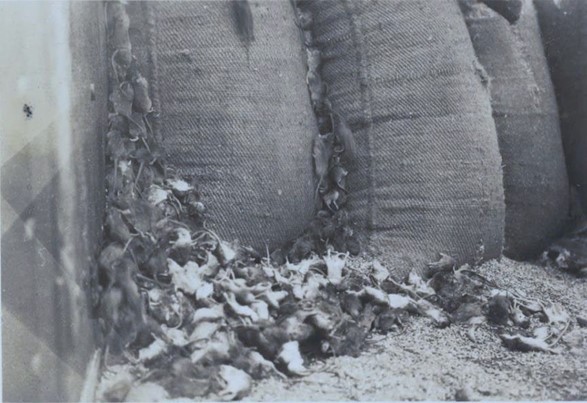
Gassed mice at a wheat stack during a mice plague, 1932.
Image: SLSA
Mouse plagues during the period of 1921 to 1970 varied in their extent and severity. Mouse plagues were characterised by extraordinary numbers of mice in cereal paddocks. During minor plagues, significant mouse damage generally occurred in autumn and early winter and was concentrated in and around houses, farm buildings, and grain and stockfeed stores. Severe plagues were characterised by a higher level of the above problems and by much higher numbers of mice in the paddocks causing significant crop damage prior to harvest and/or at sowing in early winter. Not all mouse plagues coincided with plagues recorded in other States, but plagues of varying degrees occurred in South Australia in 1922, 1931, 1932, 1943, 1947, 1953, 1956, 1962, 1965, 1969 and 1970. The plagues of 1932, 1953, 1956, 1962 and 1969-70, were more severe than most other plagues. [61]
Rabbits
Rabbits
By the start of the 1920s, there seemed to be no let up for landowners struggling to reduce rabbit numbers and improve the carrying capacity and productivity of their land. This was particularly so for those trying to make a living from the marginal country in the north of the State. Numerous methods had been put forward to the Department of Lands for dealing with rabbits but none had proved successful. Poison gas had been tried but was not as successful as hoped. The most effective means remained erecting vermin proof fences and using poison. Rabbits continued to be very troublesome with landowners adjoining Crown land outside of council areas with councils being responsible for destroying rabbits on Crown land within their districts. The Government assisted with supplying poison baits at cost and grants were available to councils to assist with their expenses. [103]
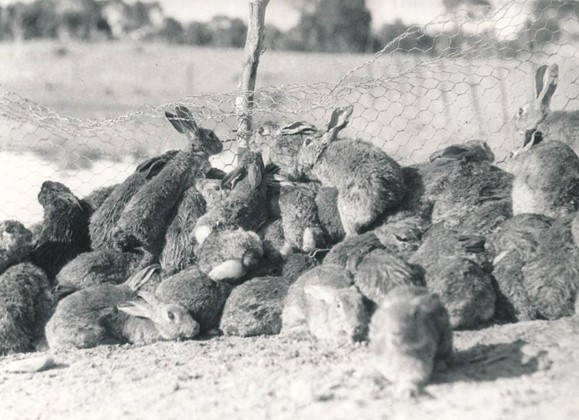
Rabbits mobbed against a vermin proof fence, c1940s.
Image: PIRSA
Despite the best efforts of landowners, poisoning continued but was limited. However, when added to the ripping of warrens some success was noted but this did not prove to be economical in the lighter carrying areas of the north. [104] By 1939 though, mobile freezers became available and these provided a boost for trappers in the pastoral areas with an increase in the numbers taken having a noticeable impact. [105] As an example, at Coorabie on the West Coast, trappers were each taking 500 rabbits a day. [106]
This demand for rabbit skins and the 1944-45 drought had decimated rabbit numbers in large areas of the northern and north-eastern part of the State. [107] But by 1950 rabbit numbers had again increased alarmingly. Methods being used by landowners included the ploughing out of warrens, fumigation and poisoning but these were not enough. A chief obstacle to complete success was the lack of co-operation by some landowners in each district. [108] The Journal of Agriculture in that year noted that there did not seem to be any answer to the rabbit problem other than well-directed hard work. Control measures needed to be universal and concerted so that control programs were effective. Trapping was accorded little value as a means of controlling rabbits because limited numbers could be taken with milky does and kittens having no commercial value. [109]
But help was at hand. CSIRO established a Wildlife Section to study and investigate the rabbit problem hoping to discover a method of control which was more effective than what was practised at that time. [110] This assisted in the release of myxomatosis as related below. Then in 1955 a new poison to control rabbits became available. This was 1080 (sodium fluoroacetate). Success interstate had shown its effectiveness but a relatively safe means of making it available to landowners in South Australia had to be determined quickly given the waning of the myxoma virus. The Department of Agriculture in conjunction with the Central Board of Health agreed that a landowner who farmed more than 10 acres (0.04km2) of land could purchase oats which had been coloured and treated with 1080 from commercial firms, upon the issue of a permit by the Central Board of Health. [111]
Again the Journal of Agriculture provided landowners with valuable information on this poison. It noted that prepared poisoned oats were quite safe to handle. Used correctly, these oats gave up to a 98% kill of rabbits and compared more than favourably with strychnine which could give up to 80% kill but closer to 50%. As the affected rabbits went away to die, there were no convulsive spasms as seen with strychnine and other rabbits were therefore not frightened away from the trail. 1080 poisoned oats retained their effectiveness until soaked sufficiently to germinate, when they became harmless. Most birds, except sparrows and starlings, were resistance to 1080. [112]
The use of 1080 poison increased substantially during 1958. At that time, oats poisoned with 1080 were brought under price control, resulting in an appreciably reduced retail price, which was anticipated to further encourage use. [113] But landowners were encouraged not to be complacent and to intensify rather than relax vermin control. [114] In this regard, the Department of Lands conducted experiments on rabbits designed to give information on the suitability of bait materials for poisoning, a method of control which was economical and, district wide, produced a continuing high level of control. [115] These trials were conducted on Yalkurri Station on Narrung Peninsula in 1963 and the end result was that oats proved to be a much more effective and cheaper bait material than the traditional carrots. [116] The trials work here also looked extensively at the behaviour of rabbits in that area, work that still underpins all of the recommendations that remain current for the control of rabbits. [117]
As a result of these trials and the knowledge gained, a scheme of training local government officers was introduced. The training school ran for a fortnight, and it was theory in the morning and then practical work in the afternoon, training officers to poison rabbits with the 1080 poison, handling poisons and fumigation.118 The first implementation of this training, a pilot scheme, was in the Tatiara Council area where the trained rabbit control officer carried out a poisoning program over several properties working through the district in a systematic way. The landowner supplied the bait materials and the operator carried out poisoning as well as supplying and mixing 1080 poison. [119] The scheme became very popular and was adopted by other councils and eventually became universal.
In 1962 many enquiries were received on the keeping and breeding of domestic rabbits for meat through commercial breeding centres with a permit system being introduced to limit numbers. [120] At the end of 1962, an amendment to the Vermin Act was introduced to go further. This was because the breeding of rabbits on a large scale was considered to be inconsistent with the policy of extermination underlying the Act. The commercial breeding of rabbits had been discouraged but could not be effectively prevented so long as the Act enabled rabbits to be kept on any land, in an unlimited number of enclosures of 600 square feet (56m2). The amendment effectively prevented such breeding centres by limiting the number of cages on any land to only one rabbit-proof cage which did not exceed 36 square feet (3.5m2) in area. [121]
Biological control of rabbits
The virus responsible for causing the disease myxomatosis was first isolated from European rabbits in Uruguay in 1898. In 1919 a Brazilian scientist, H.B. Aragão, proposed that the virus be used as a biological control for the wild European rabbit in Australia but the Australian Government rejected this. Subsequently, Dame Jean MacNamara was instrumental in getting the virus imported into Australia where it was trialled on 34 native and domesticated animals to ensure no susceptibility to the disease.
The first field trials were begun on Wardang Island in Spencer Gulf in November 1937 for scientific investigations into the capacity of the disease to control rabbit populations under natural conditions. [122] Warding Island was not the first choice, this being Clarke Island off Tasmania, but that State refused permission. Warding Island is 5 kilometres off the coast and an aboriginal reserve of some 4,900 acres (20km2). It was used for grazing for part of year but lack of water prevented stock being carried all year.
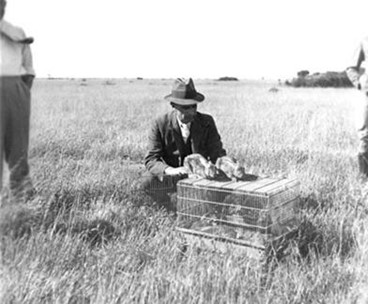
Lionel Bull, Chief of the CSIR Division of Animal Health and Nutrition, releasing the first rabbits infected with the Myxoma virus on the 16 November 1937 on Wardang Archives.
Image: CSIRO Archives
Broken Hill Associated Smelters had workers and their families living in 12 cottages on the north side of the Island to work mineral leases for flux. Rabbits had previously been taken to the Island and kept in an enclosure for food, but some escaped resulting in the Island being overrun at times. An area of about 90 acres (0.36km2) was selected on the southern end of the Island. [123] These trials, as well as several others conducted up to 1943, were unsuccessful, primarily because they were no biting insect vectors to transmit the disease.
MacNamara continued to agitate for further trials in higher rainfall areas and these eventually took place at five sites in the Murray Valley late in 1950. At first it was thought that these trials were also failures but, suddenly, reports of dead rabbits were received from over a wide area and the disease spread rapidly over south-eastern Australia. The sudden success was due to the unusually heavy rains which fell during 1950 resulting in a massive build-up of mosquito numbers, thus providing the necessary insect vector. [124]
During 1951, myxomatosis was identified as responsible for heavy mortality in rabbits in parts of South Australia. The Livestock Division of the Department of Agriculture, the Department of Lands and CSIRO worked together to set up centres for the infection in those parts of the State where mosquitoes and other insect vectors would transmit the disease. However, even though the disease was having spectacular effects, landowners were warned that myxomatosis would not solve their rabbit problem and that current control practices needed to continue. [125] When myxomatosis arrived in rabbit populations it did an extremely good job, so good that there were literally millions of rabbits dead and some people couldn’t walk outside for the smell. [126]
The following year supplies of the myxomatosis virus could be obtained from Department of Agriculture and even at that time it was noted that some rabbits had recovered after contracting the virus and these rabbits became immune to further infection. [127] To provide surety in the establishment of myxomatosis in the rabbit population, a veterinary officer from Department of Agriculture was detailed to inoculate rabbits at various centres throughout the settled areas of the State. Although there were some failures, the disease had now appeared to be established in many districts. [128] Throughout 1954 myxomatosis had been effective in keeping rabbit numbers low in the agricultural areas except for Eyre Peninsula. An interesting observation was that with the effect of myxomatosis now becoming apparent to landowners who, having experienced a season when the virus had been active and destroyed huge numbers of rabbits, found that production had substantially increased. As a consequent, when fresh rabbit populations started to build, they would be much more active in their efforts to control rabbits, being aware of the production losses to be experienced. [129]
By 1955, the Animal Health Branch of the Department of Agriculture was responsible for the distribution of myxomatosis and the new 1080 poison. During that year, approximately 30,000 doses of the myxoma virus were distributed to landowners. [130] Then in the following year, there was evidence that rabbits were building up some resistance to the field strains of myxomatosis as mortality rates were reducing. Further investigations into the virus and host resistance studies were being conducted by CSIRO and the Australian National University in an effort to improve its effectiveness. [131]
Overall though, myxomatosis had been of great benefit to Australia. The rabbit population in many areas has been reduced to such a low level that greatly increased pasture was available for livestock. This effectiveness would continue to fluctuate because of seasonal influence on insect vectors. However, there was reduced virulence of the disease and increased resistance in the rabbit population. As such, landowners were encouraged to make every effort to consolidate the gains already made. [132] By 1958 there was little evidence that myxomatosis had any appreciable effect on the rabbit population other than in the Murray Mallee and Lakes area. [133] This continued for several years. In 1962 the Department of Lands assumed responsibility for distributing the myxoma virus and that Department had made arrangements with the Institute of Medical and Veterinary Sciences to produce the Glenfield strain of the virus rather than the standard strain previously used. This conformed to CSIRO recommendations as the Glenfield strain increased the mortality rate amongst those rabbits which had acquired some immunity. [134]
In 1966 the European rabbit flea (Spilopsyllus cuniculi) was released to aid transmission in areas where mosquitoes were not common. It greatly improved the circulation of the virus and initiated protracted winter and spring outbreaks of the disease rather than the previous short, sharp early summer outbreaks. However, this flea did not survive in the arid zone and led to further research to find another insect vector that would be more effective.
Wild dogs and dingoes
Wild dogs and dingoes
Wild dogs, together with rabbits, continued to be the main focus of landowner’s attention and that of the Parliament. The bounty scheme in place for wild dogs/dingoes had continued with mixed success. For the year ending 30 June 1924 a record number of 37,705 wild dog tails and scalps were claimed but this had reduced to 2,685 by 30 June 1931. Since the inception of the Act in 1913, 350,748 tails and scalps had been claimed. The price per tails and scalp varied over those years from 4s to 12s 6d. [135]
In 1924, the Wild Dogs Act required further amendment because the number of wild dog scalps paid for was so excessive that the fund established for this purpose had become depleted. The amendment increased the subsidy amount contributed by the Government from £2,000 to £6,000 as a temporary measure until payments levied on landowners were sufficient to meet the needs of the fund. One reason noted for the increase was that dog scalps were finding their way into South Australia from the Northern Territory (and some from Western Australia) on account of the higher payment for them in this State plus some authorised officers were rorting the system. In this regard the Government had increased its vigilance regarding the issue of certificates for payment to try and stop the rort. [136] To administer the scheme, the State was divided into 28 dingo districts, with one or more authorised receiver of scalps in each.
Just four years later, the rorting had not been stopped and the Government was forced to amend the Act again. This was necessary as several authorised persons were caught abusing the scheme. The Government therefore proposed that in future authorised persons would certify that tails and scalps of wild dogs had been presented to them for payment, but the authorised person would then be required to forward the tails and scalps to the Secretary for Lands in Adelaide. The tails and scalps would then be counted and afterwards destroyed. Payment would only then be made. This and consequent amendments were soon approved. [137]
Then in 1929, the rate of interest charged for advances from the fund was increased from 3 per cent to 5 per cent. [138] A further minor administrative amendment was made early in 1931 relating to when rates became payable. [139] Later in 1931, an administrative decision was made to consolidate the original 1912 Wild Dogs Act together with the six amendment Acts made since that time and with relevant provisions of the Crown Lands (Administration) Act, 1930. This consolidation was effected without change to the intent of any provision. [140] By the start of the Great Depression, station-owners or managers were collecting scalps as an incidental activity to their main tasks and as an alternative source of income.
Despite previous attempts, rorting of the scheme continued and it was necessary to introduce further amendments to clamp down on claims. These changes were to delete the provision regarding the payment of the minimum amount and provide the Minister with authority to fix different amounts for grown dogs versus pups. This was in response to many pups being presented where there was a question of whether those pups were ever wild. The definition of wild dog was changed to cover dingoes or half-bred dingoes only – a bounty for other breeds of dogs, even if running wild, could no longer be paid. [141] In 1948, another amendment was made to increase the subsidy amount contributed by the Government from £2,000 to £4,000 per annum, to provide for a one off grant to the fund of £4,000 for the 1948 year only and to allow the Minister to make a payment for a scalp where the tail was not available. [142] Another financial amendment was made in 1953 to increase the maximum rate which could be imposed under the Act from 1s to 1s 6d per square mile of rateable land and to provide that the maximum amount which could be granted to the fund at any time was increased from £2,000 to £4,000. [143]
Administrative changes kept coming. In 1961 the Act was again amended to bring the rating provisions substantially into line with the rating provisions under the Dog Fence Act, thus rendering it possible to combine the accounts for rates under both Acts and to effect a saving in departmental administration expenses. [144] Following a national conference held in Adelaide in May, 1969, the appropriate authorities in each State recommended that bounty payments for wild dog scalps be increased to $6 so that the bounty would be the same across all states. South Australia increased from $2 to $6 that year but this soon put pressure on the viability of the fund. Not surprisingly, scalps submitted jumped 500% and the fund ended the 1969-70 financial year almost $40,000 in debt. The following year the bounty was reduced to $4 per scalp for a fully grown wild dog and $1 for the scalp of a wild dog not fully grown. In order to overcome this deficit, an amendment increased the maximum rate payable under the Act to 25c a square mile, the limitation upon the dollar for dollar subsidy payable by the Government to the fund was removed and the total amount of the loan that could be advanced to the fund was increased to $50,000. It was hoped that these measures would restore the fund to solvency within two years. [145]
In 1927 the Graziers' Federal Council requested that the Commonwealth prohibit the importation or breeding of Alsatian dogs [146] to protect the pastoral industry. The following year the Commonwealth considered that Alsatian dogs were a pest and approved a ban coming into force for a period of five years. When that ban expired it was continued but States sought to take their own action, concerned that Alsatian dogs would breed with dingoes. In 1934, the Alsatian Dogs Act was passed prohibiting the keeping of Alsatian dogs in areas outside of councils, in council areas adjoining those outside areas and council areas contiguous with those councils. It was considered that if Alsatian dogs bred with dingoes, they would become dangerous to humans and ruthless killers of cattle and sheep, and a greater pest than rabbits, foxes or prickly pear. [147] A further amendment in 1949 allowed for Kangaroo Island to be included in the prohibited area, and another in 1965 to align the registration fee for Alsatians to be the same as other dogs. [148] The Alsatian Dogs Act was repealed in 1983; it is open to conjecture whether the Act achieved its purpose or Alsatians were not the danger envisaged.
In the 1920s, pastoralists suggested that the Council for Scientific and Industrial Research (CSIR) carry out investigations on the dissemination of distemper or other diseases amongst dingoes while treating domestic dogs to render them immune. This was because legislation to build fences and destroy dingoes did not appear to make much of an impact on the pest. Enquiries were made with Distemper Research Committee in the United Kingdom which replied that this would not secure the desired result as it would likely be impossible to start a distemper epidemic nor was there any effective immunisation for domestic dogs. [149]
In early 1970, the Minister of Lands sought advice from the National Parks Commission regarding the Commission’s view on whether it wanted dingoes to be exterminated completely or reduced to a certain level and, if the latter, what effect would complete extermination likely have on the balance of nature. In reply, the Commission considered that dingoes should be kept to a level which would ensure their survival, but this was only because they apparently kept the rabbits under control north of the Dog Fence. [150]
By the end of the 1940-41 financial year, more than 400,000 wild dogs had been destroyed since scalp payments commenced. [151] By June 1960 the number destroyed had risen to 521,000 [95] and 10 years later was 572,000. [152] A huge amount of money had been spent but dingoes still remained a danger to livestock production.
Aerial baiting of wild dogs/dingoes
In 1950, the Vermin Districts Association, subsequently supported by the Stockowners Association, sought support from the Government for aerial baiting of wild dogs. The Queensland Government also suggested that South Australia cooperate with Queensland in an aerial campaign for wild dogs, which it was proposed be conducted in the north-eastern portion of South Australia (both Queensland and Western Australia first commenced aerial baiting campaigns in 1948). As such, an amendment was made to Wild Dogs Act to provide statutory authority to use funds raised by rates levied under the Act to carry out aerial baiting for wild dogs. The Minister was authorised to spend up to £2,000 per year during the calendar years 1952, 1953, and 1954 for this purpose. In addition, the amendment set out that the Minister could seek the advice of the Dog Fence Board as to the best means of carrying out this aerial baiting. [153]
The first aerial baiting was undertaken in late 1951 with aircraft chartered from Guinea Airways, 100,000 baits being dropped along Dog Fence and around waterholes, and the joint aerial operation with Queensland authorities commenced in September 1952. This was scaled up the following year with 120,000 baits dropped between Lake Everard and the NSW border and some 393,000 baits dropped in just 3 weeks between Lake Eyre and the Queensland border. [154]
Although it was difficult to assess the value of aerial baiting to control dingoes in the northeast of the State during these three years, the Dog Fence Board reported that there had been a reduction in the number of tails and scalps presented from that area. Based on this, an amendment to the Wild Dogs Act in 1954 removed the previous time limitation so that aerial baiting could be carried out in any year subject to the same £2,000 limitation. A further amendment provided that where the Minister conducted aerial baiting, poison laid signs were not required to be displayed on the land. [155] In 1961 a further change increased from £2,000 to £3,000 the maximum amount that could be expended each year on aerial baiting. [156]
Aerial baiting of a similar nature continued over the years, dependent on the availability of suitable aircraft. A delay in the 1959 baiting campaign resulted in baits being dropped during high temperatures and strong winds over areas outside and adjacent to dog fence with a total of 180,000 baits dropped. Concentrations of dogs were sighted, particularly around bores and springs, which were encircled. [157] In each year of the 1960s, aerial baiting continued with some 250,000 to 300,000 baits laid in known breeding grounds, inaccessible country and remote watering places outside the Dog Fence. [158]
Protection of introduced animals
Under the Animals and Birds Protection Act 1919 fallow deer were specifically listed as being protected from 1 July to 31 December and quail (native and introduced) from 1 August to 31 January in each year, together with a number of native animals and birds. All other animals and birds, whether indigenous or imported, except those specifically listed as unprotected, were protected from 1 July to 31 January. The list of animals and birds unprotected included:
| Animals | Birds |
|---|---|
| foxes | blackbird |
| hares | English chaffinch |
| domestic cats run wild | English house sparrow |
| wild dogs (dingoes) | English starling |
| rats | goldfinch |
| mice | greenfinch |
| rabbits |
In addition, all other animals and birds introduced into Australia were not protected, excepting those listed as wholly or partly protected. The differentiation between imported and introduced animals and birds was not explained but it would seem to be that those imported were being kept, e.g. in zoos.
In 1927, an amendment was passed to enable royalties to be charged on the skins and carcases of animals and birds taken in South Australia but only for animals or birds wholly or partly protected. [159] Other amendments relating to native animals and of an administrative nature were made. By 1938, fallow deer and quail remained partly protected. There was no change to the animals unprotected but the African lovebird, canary and myna, additional to those above, were added.
The Animals and Birds Protection Act was repealed in 1965 by the Fauna Conservation Act 1964. The Fauna Conservation Act provided for dingoes and all species of animals and birds not native to Australia to be unprotected.
The Homing Pigeon Act 1905 continued in force at the commencement of this period. A person was prevented from interfering with homing pigeons although they could be destroyed if they alighted on a farm or a garden. These provisions were incorporated into the Police Act 1936 and then into the Police Offences Act 1953. This latter Act was amended to the Summary Offences Act in 1986 and the provisions on homing pigeons remain in force to the present time.
Weed control
The 1920s began with three separate but related Acts for the destruction of noxious weeds. These were the Thistle and Bur Act 1862 to prevent the further spread of Scotch thistle, variegated thistle, and Bathurst burr, the Thistle and Bur Act 1887 to amend the 1862 Act and to prevent the further spread of star thistle, and the Noxious Weeds Destruction Act 1891 to allow for the control of proclaimed noxious weeds where local government authorities had failed to do so. As before, information on the principal and amending Acts relating to weed control in South Australia during this period are provided throughout the text. Up until 1976 the term “noxious weed” was in general use and this term has been used throughout the text below. In relation to each noxious weed, botanical names have been used to specify the species. Although botanical identification was much improved during this period, some names have since changed.
The loss of men enlisting for World War 1 from rural areas dramatically slowed the control of weeds throughout the state. Priorities had, of necessity, been on supporting the war effort. Despite the lessons learnt since colonisation, little had been done to stem the movement of weeds into the country or the State. The increase in trade had exacerbated the problem so that by 1921 the Department of Agriculture had identified the need to amend the Act to prevention the introduction of new weeds and allow for the taking of immediate action to control those just being introduced. [136] Two years later the Department reported that approximately 2% of imported seed inspected contained weed seeds. [137]
The Waite Agricultural Research Institute agreed and stated that if all new weeds were identified and reported immediately they could be destroyed, but it was now likely too late to destroy most of the proclaimed weeds in the State; they could merely be checked. Had those proclaimed weeds been identified and destroyed when they first appeared, the expenditure would have been minor compared to the annual losses then occurring. [138] At this time the Waite Agricultural Research Institute was responsible for identifying plants (including weeds) sent in by landowners.
Pest plant controls up to 1950
Pest plant controls up to 1950
At the beginning of 1921 there were 16 plants proclaimed for destruction and the number of plants of concern was growing. For example, the Department of Agriculture warned that St John’s Wort (Hypericum perforatum) was spreading quickly within Belair National Park and posed a danger to surrounding orchards. [139] Another weed of concern during the early 1920s was African boxthorn (Lycium ferocissimum). Although already proclaimed under the Act in 1918, boxthorn hedges had been planted widely across the State and accordingly the proclamation at the time allowed two exemptions. Boxthorns did not have to be destroyed if kept in trimmed hedges no wider than 4ft 6in (1.4m) or higher than 10ft (3m), or if they were providing shelter for livestock. Naturally, many landowners took full advantage of these exemptions enabling boxthorn to spread virtually unchecked. [140]
Following concerns from metropolitan councils, in November 1925 the Noxious Weeds (African Boxthorn) Bill was introduced to Parliament to proclaim African boxthorn only in the metropolitan area unless it was kept in a hedge of the same dimensions as then existed. This was because there was doubt on the legality of the 1918 proclamation in relation to differing conditions applying in different parts of the State. However, Parliament noted that there was widespread concern throughout the State at the continued spread of African boxthorn. [141] After considerable debate, when enacted, this legislation simply amended the 1862 Act to give local government the powers to prevent further hedges of boxthorn from being planted and removed the excuse for keeping scattered boxthorn for stock shelter. Hedges, still a serious source of spread, remained. [142]
African boxthorn remained a serious weed until effective control programs eventually commenced in the 1960s and the tide began to turn when substantial grants were made available for weed control on Crown lands and when the control programs were implemented by well-trained local government officers who had access to effective herbicides. [143]
The Noxious Weeds (African Boxthorn) Bill should have highlighted the deficiency of the current legislation but it was another two years before the Minister of Agriculture introduced more comprehensive weed control legislation. The aim of this Bill was ‘to make further and better provisions for the destruction of noxious weeds’. In summary, the proposed legislation would enable plants to be proclaimed as the occasion warranted and in such ‘portions’ of the State as desirable, a far more flexible arrangement than then existed.
The responsibility for enforcing the destruction of noxious weeds remained with councils. It proposed that landowners be responsible not only on their own land, but on adjoining roadsides as well. This requirement was later withdrawn leaving councils responsible for roadside control. In a far-sighted move, one member advocated for provision to be made in the Act requiring research on weed control. Unfortunately, the Bill lapsed. [144]
However, in 1926 the role of science in tackling the many problems facing agriculture was considered by the Council for Scientific and Industrial Research. This concerned initiating new research and supplementing, where necessary, the work being undertaken by state departments or universities, particularly where Commonwealth participation was deemed necessary, e.g. national in range or focus. A conference of Commonwealth and State officers was convened and agreed on a way forward. One recommendation implemented was the appointment of a Standing Committee on Agriculture comprising the permanent heads of State Departments of Agriculture and representatives of the Council to act as an advisory and consultative body on agricultural research undertaken by the Commonwealth. [145] This initiative was to be of great benefit.
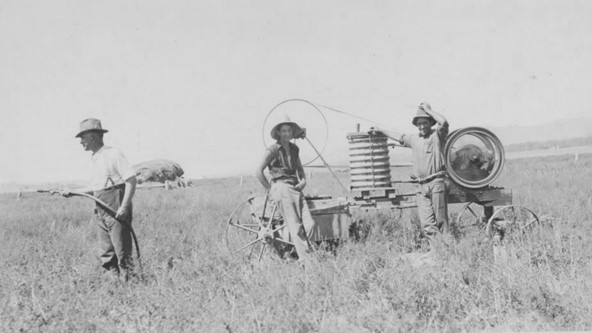
Spraying camel thorn 1930s
Image: PIRSA
It wasn’t until 1931 that the Minister of Agriculture returned to Parliament with a new Bill to replace the combination of three Acts then in force. The same arguments for change were put forward, that is that the provisions of these Acts were out of date and too rigid for effective administration and that plants should be declared noxious weeds as the occasion warrants and within such portions of the State as was considered desirable. The legislation continued the obligation on councils to destroy all noxious weeds on all land vested in the council except public roads, which were the responsibility of the adjoining landowner. In addition, landowners remained responsible for destroying weeds on their own land but were also required to destroy weeds on break wind reserves in the Pinnaroo Railways District and on drainage lands in the South East. Councils were to employ authorised officers for the purposes of the Act. Each council could impose a rate on the land within its district sufficient to provide funds for the purpose of complying with the above obligations. [146]
The list of noxious weeds proclaimed by April 1930 identified 20 species that were required to be destroyed. [147] When the Noxious Weeds Act 1931 came into operation in March 1932, the number of species was reduced to 18 with two annuals removed (Xanthium canadense and Chenopodium album, although the latter was added again within 4 months). Otherwise, the list remained unchanged except for the updating of scientific and common names. [148]
The increased flexibility of the Act to allow for the proclamation of noxious weeds was put to good use during the decade. By 3 August 1939 the number proclaimed had risen to 29 for the whole of the state and a further 7 for various parts of the State. [149] The increase in weeds proclaimed resulted from requests from councils [150] and observations from the identification service at the Waite Agricultural Research Institute. [151] Conversely, some in the community considered that dealing with noxious weeds should be left to the discretion of the landowner [152] while the SA Fruit Marketing Association feared that proclaiming blackberry for destruction would result in half the orchard owners of badly affected land becoming bankrupt. [153]
In 1935 it became necessary to make several amendments of a clarifying nature to the 1931 Act. These were administrative or of a legal nature. [154] Further amendments were made in 1938 to clarify legal matters raised by the Judiciary. [155] Again in 1939, amendments were made clarifying administrative matters but the exemption applying to African boxthorn grown as a hedge at the commencement of the 1931 Act could be removed by proclamation for individual areas of the State. This was because these hedges remained a seed source and negated much of the control work already carried out. [156]
The Depression caused a significant reduction in weed control for all landowners across the State, government and private. Little effect could be achieved where resources in both time and money were limited. Professor Richardson of the Waite Agricultural Research Institute noted in 1935 that the district councils of Australia had spent £260,000 a year in the enforcement of regulations to eradicate noxious weeds, of which there were more than 160 listed. [157] Weed control was generally by hand pulling or mechanical means, slashing, digging or ploughing but the Department of Agriculture was undertaking trials with chemicals and advising landowners of the results. The main chemicals in use had been arsenical solutions, sodium chlorate and common salt with their use being limited because of cost. Sodium chlorate was best because the soil was not rendered sterile for a long period as occurred with arsenic and common salt. [158] In 1930, Mr AL Warren, field officer in the department, had conducted a series of experiments in the destruction of various noxious weeds by the application of sodium chlorate and these were published. [159]
In 1939, the Government initiated a response to an outbreak of water hyacinth at Ramco Lagoon, one of the world's worst water weeds. Water hyacinth was proclaimed a noxious weed under the Act and an eradication campaign was commenced and was ultimately successful. For further information see Eradication of Water Hyacinth from the River Murray
World War 2 saw primary producers focus on meeting food production for the war effort and pest animal and weed control on farm had, by necessity, to be neglected. But the Government continued to assist landowners with the adoption of a system of pasture seed certification to ensure freedom from noxious the weeds [160] and research by the Waite Agricultural Research Institute on the control of cape tulip. [161] Further, in 1940 the Advisory Board of Agriculture recommended that a Royal Commission or a Committee of Inquiry be appointed to investigate the threat of noxious weeds but was advised that the expenditure involved could not be justified. However, the Government would give further consideration to the best means of controlling noxious weeds, but nothing resulted until after the war. [162]
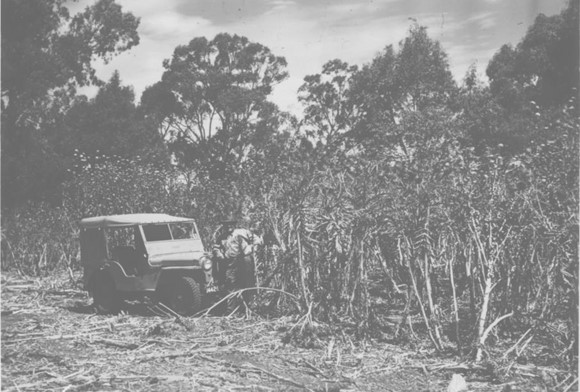
Wild artichoke at Booyoolie, Gladstone c1950.
Image: PIRSA
With little action being taken, weeds were aggressively competing with production. Roadsides and paddocks leading north through the State were choked with wild artichoke and saffron thistle. Horehound blocked travelling stock routes and infested sale yards. The drainage channels in the South East were blocked with waterweeds and the surrounding flats were covered with thistles. Lincoln weed was also gaining hold in marginal wheat growing areas where it had never been seen growing before. Orchards in the Adelaide Hills were swamped with blackberries and horticultural areas along the River Murray with innocent weed. New weeds seemed to be appearing everywhere. Skeleton weed had been found in the Murray Mallee and African daisy had brought the soldier settlement area at Wanilla to a halt. [163]
Immediate action was required to rectify the situation. Just after the end of World War 2, the number of weeds proclaimed remained at 29 for the whole of the State but had risen from 7 to 15 weeds for the various parts of the state. [164] Towards the end of 1945, the Advisory Board of Agriculture was so perturbed at the spread of noxious weeds that a deputation of members met with the Minister of Agriculture, who then urged local government authorities and farmers to make special efforts to eradicate noxious weeds. The Minister also pointed out that the Department of Agriculture had a Weeds Adviser (Mr PC Angove), and his services could be made available to local governing authorities and farmers. [165]
The Department was taking an alternate approach and set out two main principles for weed control in the Journal of Agriculture. Both these principles were to continue for the next 50 years:
- follow a more scientific approach, gathering the basic facts about each weed type and the environment in which they were growing and developing a simple sheet for weed control exactly fitted to each set of conditions
- cooperate with landowners and the relevant authorities to control weeds rather than resorting to coercion. The Department recognised that eradicating weeds would be no easy task and would take considerable time.
Accordingly, the Department assisted in the identification of weeds, visited agricultural bureaux to show pictures of serious weeds and advised landowners of the latest scientific methods of weed control. [166] These methods involved the building up of a strong body of knowledge that was both scientific and practical as well as economic. [167] At this time, weed researchers realised that, irrespective of the means of control to be adopted – be it a cultural, chemical, competitive cropping, mechanical or biological method – such control should be coupled with sound land use. [168]
In 1946, the Waite Agricultural Research Institute recommenced research on the control of cape tulip following suspension during the war years. This research aimed to determine the effect of the new chlorinated selective herbicide methoxone on the growth and regeneration of this weed (this research continued until 1952). [169] The Institute had also continued to identify weeds submitted during the war years. [170]
The Director of Agriculture, Walter Spafford, followed this up by recommending that the Government should try to gain control by upgrading the legislation. In 1948, a draft Bill was prepared by Hector Orchard, recently appointed as the Weeds Adviser, which contained many innovative clauses. Under this proposal, there would be an Advisory Committee for noxious weed control and seven boards, based on the counties, would be established throughout the agricultural areas of the State. These boards were to be equipped with vehicles and machinery to carry out weed control with the assistance of authorised officers and the appointment of local landowner committees. The operations were to be funded by Treasury. In addition, there would be an overhaul of the scope of weed proclamations so that weeds would not only be proclaimed for the whole State or particular areas of the State, but also for particular circumstances, such as in fodder or travelling stock.
This Bill proved too radical for the local government sector, the majority of councils objecting to losing control of weed management and so the Bill did not proceed. However, the Minister decided to strengthen the noxious weeds advisory service in the Department by appointing a number of field officers. [171] At the same time, a publicity campaign was instigated to highlight the problems and costs caused by agricultural weeds. An estimate of the costs to SA farmers of weeds (nearly £5m per year) was publicised. Further, Hector Orchard organised an exhibit of model demonstrations showing how these losses occurred and the latest methods of controlling weeds. This was set up in the Agricultural Hall at the 1950 Royal Adelaide Show. [172]
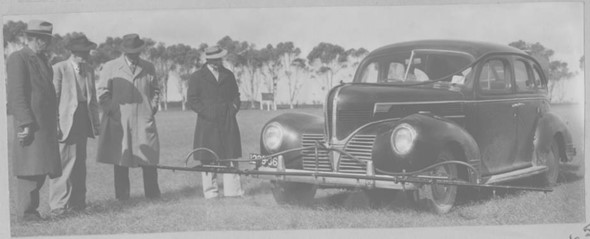
A boom spray used for weed control, mounted on an early 1950 model Dodge c1950.
Image: PIRSA
Pest plant controls after 1950
Pest plant controls after 1950
A number of initiatives were enacted over the next five years. Due to a lack of space in the Education Building and that various branches of the Department of Agriculture were scattered over a number of buildings throughout Adelaide, the Department moved into the Simpson Building from July 1950 through to May 1951. [173]
Arrangements were put in place between CSIRO, the Waite Agricultural Research Institute and the Department of Agriculture to ensure there was no overlap in agricultural research. Field trials with newer weedicides and modern machinery for their application were undertaken [174] taking over from a number of major weed control projects which were completed during 1951-52. [175] Screening tests began on a number of weeds. [176] Weed control field officers had now been located in the Upper North, Murray Mallee and Central Districts with further officers to be appointed in the South East and on Eyre Peninsula. These officers were to give councils and landowners a more complete and speedy weed control information service. [177] In addition, plant identifications were now undertaken at Departmental offices [178] State Cabinet approved the establishment of the State herbarium, one of the chief functions of which was to help in the identification of potentially noxious weeds. [179]
The weeds section developed close liaison with research organisations, kindred departments in other states and overseas and in other countries, notably Germany, Canada, USA, England and New Zealand. [180] All these and other initiatives greatly improved the standing of the Department and the successes the Department achieved were published in the Journal of Agriculture in 1953 and could be summarised as:
'Mechanical control was gradually being replaced with chemical treatment. Research work was continuing to determine the most suitable types of implements to use in various situations. Weed burners were effective in some situations, particularly for innocent weed in vineyards. The possibility of applying biological control measures was being constantly examined. Studies in plant competition control had been very useful in determining the types of weeds that were susceptible to competition. The use of highly productive plants, combined with sound management practices had been found to be the most economical and effective methods of controlling weeds in pastures. All this research was improving efficiency in weed control but still required landowners to continue normal good practices.' [181]
But the weeds advisers had many and varied duties, including convincing Murray Mallee farmers that the increasing skeleton weed infestation was not being brought about through seed dropping from passing aircraft [182] and defending the Government from complaints that it should first control weeds on its own land before taking action against other landowners for not controlling their weeds. [183]
Soon after Dr Allan Callaghan was appointed Director of Agriculture in 1949, he realised that weed science should be better supported and that further staff should be appointed. In addition, Callaghan championed new legislation, although not introduced to Parliament until 1955, which took into account lessons learnt from the 1948 attempt.
In general, the Bill continued with councils being primarily responsible for securing the destruction of noxious weeds with the Minister being responsible for land outside of council areas. A Weeds Advisory Committee was appointed by the Minister to advise on the administration of the Act including being a tribunal to which landowners could appeal against notices of councils requiring them to destroy weeds. The Bill introduced the concept of proclaiming a plant a dangerous weed throughout the whole State or a noxious weed for either the whole or any part of the State. Dangerous weeds were defined as newly introduced weeds, known to be serious to agriculture, but not widely established. A stricter measure of control was proposed for dangerous weeds than for noxious weeds.
Every council had the duty of destroying all dangerous weeds and of destroying or controlling all noxious weeds upon council land and upon all public roads, travelling stock reserves and some Crown lands in its area. A council could impose a special rate on weed infested land in order to fund some weed control activities. In certain circumstances the Minister could reimburse councils for the expense they incurred in controlling weeds on Crown land. Councils could also be reimbursed by the adjoining landowners for the control of weeds on road reserves. The Minister could enforce provisions within the council’s area should a council default in carrying out its responsibilities. A council continued to be able to serve a notice on a landowner to destroy or control proclaimed weeds. [184]
The Minister emphasised that the primary duty of control would remain with local government, that State government revenue would be available to support local control work and that technical advice would be provided by a newly appointed team in the Department of Agriculture. This team would use modern extension methods, which had demonstrated that much could be gained from community involvement in weed control provided that technical information could be injected in a socially acceptable manner. After regulations were drawn up the Weeds Act became effective on 1 July 1957. [185] At the same time, the responsibility for paying councils for the control of noxious weeds on travelling stock routes and unoccupied Crown lands was transferred from the Department of Lands to the Department of Agriculture. [186]
Prior to the repeal of the Noxious Weeds Act by the Weeds Act 1956, the number of weeds proclaimed had risen to 34 for the whole of the State with a further 23 weeds proclaimed for various parts of the state. [187] Generally these continued to be proclaimed under the new legislation but were divided into dangerous weeds (9), noxious weeds (38) for the whole State and 10 for portions of the State. [188]
The Weeds Advisory Committee set about increasing the pace for weed control across the State, encouraged by the significant advances in the science of weed control, particularly the development of a wide range of new herbicides. The policies adopted by the Weeds Advisory Committee covering the proclamation of weeds was still largely unscientific. [189] Advisory work with councils and their weeds officers were expanded and intensified during 1960. Surveys and control programs were carried out on serious weeds such as skeleton weed, colocynth, cape tulip, khaki weed, Noogoora burr and California burr. During that year, there had been widespread threat from Noogoora burr seed on livestock imported from interstate with between 30,000 and 40,000 sheep and cattle inspected on average each week. [190]
The start of the 1960s saw a broad scale extension program commence covering all major weeds aimed at individuals through the Journal of Agriculture, field days, the press and on the radio together with an expansion of the weed identification service. [191] A colour film was made on cape tulip, skeleton weed and Noogoora burr control. [192] The appointment of a full-time research officer to the Weeds Section enabled long term trials to commence and 15 were in progress by the end of 1961. [193] It was proudly reported that by 1963 most councils were providing an inspection service for weed control. During 1962-63 financial year twice as much money had been spent by councils on weed control than in 1961-62. [194]
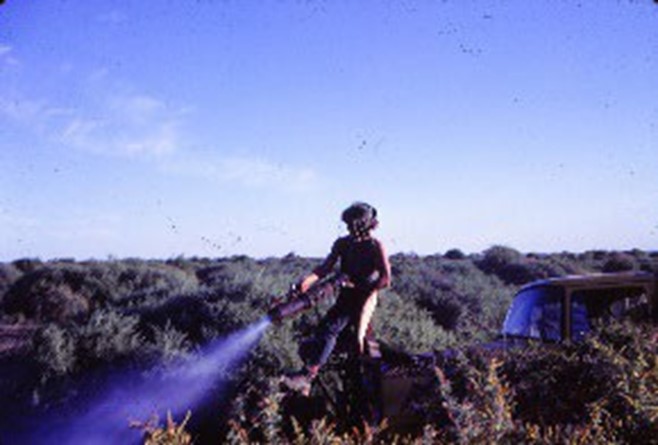
Noogoora burr control using 2,4-D herbicide at Kallioota Swamp, 100kms north of Pt Augusta 1968.
Image: PIRSA
But the initiative that was to shape weed control for at least the next 50 years was the need to have the local weeds officers properly trained. It had been proposed by Arthur Tideman, head of the Weeds Unit, so that authorised officers employed by councils had appropriate qualifications to advise landowners in an age of rapidly evolving technology. This proposal was supported and during May and June in 1961, weeds instruction schools were held in Adelaide to familiarise officers with the legislation and the identification and control of serious weeds. These were continued and in different council districts. [195] Then during the following financial year nine weed control training schools were undertaken with some 300 local government officers attending. In addition, Departmental officers had been in contact with the Highways Dept, SA Railways, Electricity Trust of SA (ETSA) and councils to ensure the proper technique was implemented with new chemicals. [196] Commencing in June 1964, a more formalised Weed Control Training Course began comprising 20 lectures of 1.5 hours duration and two field days. This course became the most popular and successful course offered by the Adult Education Branch of the Education Department and was attended not only by those administrating the Weeds Act, but also by agricultural chemical salesmen, park rangers, landscape gardeners, horticulturalists, graziers, farmers and home gardeners. After 10 years some 370 students had enrolled. [197]
To complement the training courses, Tideman argued that field officers would not become trained unless there were adequate incentives which he suggested could best be given by subsidising the salaries of local government employed authorised officers where they could demonstrate they held a relevant qualification. [198] Therefore the Act was amended during November 1963, allowing the Minister to pay subsidies to councils that employed local authorised officers for the purposes of weed control inspections and of enforcing the provisions of the Act. The subsidy could not exceed 50% of the remuneration paid by a council. The subsidy could only be paid if an authorised officer was employed for at least 60 days or for at least one day in each week of the relevant financial year. In addition, no subsidy would be paid after a period of five years should an authorised officer not be qualified. A further amendment allowed councils to be reimbursed for the cost of weed control on roadsides adjoining Crown land. [199]
By 1965 Departmental officers were working on more than 30 weed control projects across the State. Information continued to be updated and extension programs developed. During 1964-65, nine field days were held with practical demonstrations with care and calibration of boom spray equipment given particular attention. Five groups of approximately. 20 councils had formed and within these areas an attempt was made to provide councils with technical assistance for weed control problems. Weed control notes were prepared dealing with 25 weed problems.
But not all work was centred only on weed control in isolation. Trials for integrated vegetation control techniques for noxious weed control and bushfire protection, particularly on roadsides, were completed and recommendations were made to landowners, local government and Government departments. Chemical control was integrated with competition from ground cover species plus mowing and burning. [200] Outcomes from some research programs demonstrated that the control of a wide range of hard to kill broadleaf weeds could be achieved with costs at 70 cents per acre compared to the then current herbicides costing $2.50 per acre. On a more practical note, weed control officers had managed to keep the pastoral areas of the State free from Noogoora burr for 10 years by inspecting stock entering the State from infested areas with 950,000 sheep and 45,000 cattle being inspected. [201] At the beginning of the 1970s, the Department could argue that it had the best weed science group in Australia with its research closely aligned to its extension and regulatory programs. [202]
In 1969 further amendments were made to the Act. These provided for the Act to apply in all council areas and for the Minister to have control over the number of authorised officers employed by councils, thereby restricting the funds available for the 50% subsidy. [203] These changes became necessary as, for the first time, subsidies for noxious weed control annually granted to councils exceeded $100,000. Half the money was used to aid councils to employ well trained inspectors. [204]
Biological control of weeds
The release of biological control agents to limit a plant’s growth, reproduction and spread has been practised in Australia for more than 100 years. The agent is specific to one species and affects various parts of that plant and/or different stages of its lifecycle: Successful biological control reduces the vigour and abundance of the targeted weed. [205]
The first recorded biological control agent release in Australia was cochineal scale insect in 1921 followed by the Cactoblastis moth in 1926, both targeting prickly pear (Opuntia and Cylindropuntia species). [206] Boosted by its success in the biological control of prickly pear species, by 1935 the CSIR had imported into quarantine in Canberra a number of insect pest species to target weeds including St. John's wort, Noogoora burr and ragwort. [207]
By 1939, it was reported in the Journal of Agriculture that the cochineal scale insect had been effective. [208] Further releases of cochineal scale insect were made in 1952. [209] Also in 1939, the first release in Australia of seed weevil targeting gorse (Ulex europaeus) occurred but when this weevil was released in South Australia is not recorded. [210] The next release was targeting St John’s wort (Hypericum perforatum) with a leaf beetle. This occurred in 1944 in Belair National Park and was followed by further releases made in 1945 at Yankalilla and Penwortham, where large infestations were present and then later at Pt Lincoln. The effects varied considerably with a high degree of reduction in Yankalilla and Pt Lincoln but only local reduction at Penwortham and Belair. [211] Further releases of this leaf beetle were made in 1952. [212]
Given the success of biological control programs around Australia, at an Australian Agricultural Council meeting in 1956, it was agreed that the possibilities of biological weed control should be further researched. The Council allocated resources to the Entomology Division of CSIRO, which enabled preliminary feasibility studies over a wide range of weeds. As part of this program, the CSIRO established a research centre at Montpellier in France to look at the biological control of various weeds. This enabled evaluation of a wide range of weed problems without the need to bring possible predators through the rigid Australian quarantine procedures before assessment. It was not until the late 1960s that a gall midge, rust fungus and gall mite were approved for release to target skeleton weed (Chondrilla juncea). Releases were made in South Australia in 1971. [213]
Specific weeds
Below is some information on certain weeds which were proclaimed and had some significance for primary producers, other landholders and the Government during the period 1921 to 1970. Original and current botanical and common names are provided.
Weeds (A-C)
Weeds (A-C)
African feathergrass
African feathergrass (Pennisetum macrourum), now with a revised botanical name of Cenchrus macrourus, was probably introduced in South Australia as either an ornamental grass about 1912 or accidentally in fodder brought back with horses from the Boer War. It was established in the Casterton area of Western Victoria in 1908 and by the 1950s had spread over several square miles along the Glenelg River and other streams in the area. In 1965 it was spread over several square kilometres in the Aldgate-Mylor area with dense stands from a few square metres to several thousand square metres at Happy Valley Reservoir, Clarendon and the Onkaparinga Valley.
 African feathergrass
Image: ANBG
After publicity, it was found in the Southeast. By 1969, African feathergrass had spread along the Onkaparinga Valley as far as Noarlunga. African feathergrass is a large perennial grass forming large tussocks of rough, densely growing leaves with slender seed heads on stems to 2m tall. It invades perennial pasture and some native vegetation communities in the high rainfall regions, competes with pasture and is a fire hazard. It also occurs on roadsides and neglected waste places. Seeds are capable clinging to clothing and to the wool and hair of animals and is also spread readily by water. It was proclaimed by regulation as a noxious weed in 1968.
African feathergrass does not spread rapidly, however it is hard to control when established. Where a dense infestation occurs in pastures, the land use would likely need to be changed. African feathergrass is predominantly a weed of pasture, but not of crops as cultivation is effective in controlling the plant. African feathergrass could potentially grow in permanent grass pastures throughout the agricultural zones of South Australia but experience suggests it is only a serious weed in the higher rainfall regions. [214]
African rue
 African rue
Image: ANBG
African rue is not considered a major problem but is difficult to control once established. It is not grazed by livestock or rabbits as it is unpalatable. It can also compete with pastures and natural areas for soil moisture and nutrients and displays allelopathic properties. African rue survives in low, unreliable rainfall due to its deep roots and tolerates a wide range of soils. It is able to grow each year on the previous season’s rainfall and prefers depressions or watercourses where there is higher soil moisture. African rue is a bushy perennial with a bitter smell and is prolific seeder but not many seedlings survive. The seed is heavy and therefore probably only dispersed by humans on machinery and vehicles and possibly in water. [215] It was proclaimed by regulation as a noxious weed in 1968.
Blackberry
Blackberry bramble (Rubus fruticosus), now known as European blackberry (Rubus fruticosus aggregate) is a spiny perennial subshrub that forms large impenetrable thickets invading bushland and pasture. It was widely planted in colonial times as a food plant and were deliberately naturalised in forested gullies, on roadsides and along creeks. European blackberry infestations occur close to sites where it was formerly planted for fruit production. The clonal infestations spread rapidly by vegetative growth, with stems forming new roots where they touch the ground.
 European blackberry
Image: CSIRO
European blackberry is naturalised in the higher rainfall areas and form dense permanent thickets that can completely exclude other vegetation and progressively encroach on pasture. These thickets provide shelter for a range of feral animals including rabbits, feral pigs, starlings and blackbirds and can become a significant fire hazard. However, thickets also have some value as shelter for native animals, such as bandicoots. Blackberry fruit is a food source for native and exotic animals, which disperse the seed over wide distances. Germination depends on adequate rainfall, and few seedlings get established. Blackberry is a threat to permanent pasture in the southern part of the State. [216] It was proclaimed by regulation as a noxious weed in 1947.
Caltrop
Caltrop (Tribulus terrestris) is a rapidly-growing summer annual that causes problems with its sharp-spined burrs. It was introduced from southern Europe sometime in the late 19th century. The species is a complex found throughout the tropics and subtropics of the world, and caltrop populations in inland South Australia are likely to include native forms that have been present in northern Australia for thousands of years.
Caltrop
Image: PIRSA
The burrs are a major contaminant of produce, such as dried fruit and wool, can damage the feet of animals and injure humans. They are a particular nuisance in amenity areas like parks. Caltrop is toxic to stock. In dryland cropping areas caltrop grows on fallows and headlands after summer rain and especially on sandy soils. It can block seeding machinery. Distribution of caltrop is limited by the availability of water in summer and the seeds germinate in several batches throughout the summer, which makes control very difficult. Caltrop is mainly spread by seed, which gets moved when the fruits attach to animals, humans and machinery. [217] It was proclaimed by regulation as a noxious weed in 1936.
Creeping knapweed
Originally proclaimed as Russian Knapweed (Centaurea repens), then shortly after changed to creeping knapweed, now with a revised botanical name of Rhaponticum repens, it is a deep-rooted perennial with extensive rhizomes and is a weed of broad acre agriculture in most temperate regions of the world. Creeping knapweed was first found in South Australia in 1929, apparently after having entered Australia as a contaminant of lucerne seed from Turkestan.
Creeping knapweed
Image: PIRSA
Creeping knapweed was rapidly targeted under weed legislation and extension programs due to its reputation as a weed overseas. It spreads by root and rhizome extension, forming slowly widening round patches around an initial point infestation. Fragments of this root system very readily produce new plants and spread within paddocks by cultivation and between properties by movement of vehicles and machinery. It may also spread as seed, dispersed by water, contaminated seed and machinery, and animals (both internally and externally). Creeping knapweed is a strong competitor with crops for water and nutrients due to its root system. It is grazed in pastures but is known to be toxic to livestock. [218] It was proclaimed by regulation as a noxious weed in 1947.
Weeds (G-I)
Weeds (G-I)
Gorse or furze
Gorse (Ulex europaeus), also called furze, is a spiny leguminous shrub to 2 metres tall that forms dense thickets. It impacts on permanent pasture and remnant native vegetation when opened up by bushfires or partial clearing. Gorse was introduced as a hedge plant around 1840 and deliberately dispersed through most of its present range for this purpose. Its distribution is restricted to areas where it was formerly used for hedges and it provides harbour for vermin.
Gorse
Image: Brisbane City Council
Gorse is a major problem in native vegetation and forestry where plants compete strongly with young trees and thickets, increasing the fire hazard along the edges of plantations. It will also grow in pasture paddocks, resulting in lower carrying capacity and forms dense monocultures. Although the gorse root system is dense, the plant depends on seed for reproduction. Flowering occurs during autumn and spring, giving two seed crops per year. Seeds may be moved by ants, birds, earthworks and vehicles. Seed can remain dormant but viable for 75 years or longer. [219] It was proclaimed by regulation as a noxious weed in 1939.
Hoary cress
Hoary cress (Lepidium draba) was first detected in this State in 1904, and by the 1930s was considered a major threat to agriculture. In the period 1950 to 1975 it almost disappeared as a problem due to the use of phenoxy-acid herbicides and less frequent summer fallowing. However, since 1970 it has become more abundant at some sites due to the switch to pre-emergent herbicides that control the major annual weeds but not hoary cress, and the decline in pasture phases in rotation.
Hoary cress
Image: PIRSA
Hoary cress is a perennial herb with an extensive, deep horizontal root system. Infestations are difficult to control. Although already present in most agricultural regions, it has a major potential to spread further and cause losses in the better cereal growing areas. It is relatively slow-spreading if left unaided, and produces few viable seeds. Hoary cress will readily form new populations from broken pieces of lateral roots and shoots and by seeds in contaminated goods or produce. Cereal crops may experience significant yield losses where dense infestations of hoary cress are present. Once established, hoary cress forms dense pure stands and is very difficult to eradicate. [220] It was proclaimed by regulation as a noxious weed in 1933.
Horehound
Horehound (Marrubium vulgare) is an unpalatable perennial herb widespread across South Australia and carried with livestock to its limits. It is native to the Mediterranean region, temperate Eurasia, and the Middle East. It was introduced as a medicinal plant by the first settlers and naturalised by 1848. In Australia, horehound grows into larger plants with higher seed production than in its native range, producing up to 10,000 seeds annually per square metre. Its small burrs are well adapted to attach to wool, fur, clothing and similar materials. Sheep, rabbits, kangaroos and emus can easily spread the burrs, which also adhere to vehicles and disburses through water.
Horehound
Image: Agriculture, Victoria
Horehound is an opportunistic germinator and is unpalatable to stock. It forms dense populations and the burrs contaminate wool, reducing the value of fleeces, and catch on clothing and socks. The meat of animals that are forced to eat horehound is tainted by its strong flavour. The losses directly due to horehound are low or zero in most farming systems, but the costs of enforced control and restrictions in movement and sale of contaminated livestock and fodder may be large. [221] It was proclaimed by regulation as a noxious weed in 1932.
Innocent weed
Innocent weed (Cenchrus tribuloides) now 2 species with a revised botanical name of Cenchrus longispinus and Cenchrus spinifex, are fast-growing annual grasses that produce spiny burrs, causing problems in the wool and dried fruit industries. They are widespread across South Australia. Most innocent weed infestations are Cenchrus longispinus, which entered South Australia along the River Murray in the early 20th century but had also been introduced through Adelaide as an ornamental grass some decades earlier. Innocent weed is present in every region of South Australia. It is most significant as a weed in the Riverland, where the irrigation areas provide ideal conditions for its growth, and in the northern Murray Mallee.
Innocent weed
Image: SEW
New incursions of innocent weed are generally due to the introduction of contaminated stock, vehicles, or soil products. It may rapidly invade degraded areas with little competition, but intact pastures are less vulnerable to invasion. Seeds may remain viable in the soil for up to 5 years. Innocent weed is a wool contaminant that can cause injury to shearers and wool handlers. It also impacts upon the dried vine fruit industry by making handling more difficult and downgrading fruit contaminated by burrs. As it is spring-summer growing, innocent weed is not a competitor with the major broad acre crops. Although easily controlled in lucerne, burr contamination can reduce the value of lucerne hay. [222] It was proclaimed by regulation as a noxious weed in 1922.
Weeds (K-M)
Weeds (K-M)
Khaki weed
Khaki weed (Alternanthera repens) now with a revised botanical name of Alternanthera pungens, was first recorded in South Australia in 1957 and infestations remain scattered and localised. However, khaki weed was recognised as a potential noxious weed in 1939 when it was proclaimed as a prohibited noxious seed under the Agricultural Seeds Act. Khaki weed is a prostrate summer-growing perennial with spiny burrs and is native to tropical and subtropical regions of Central and South America. In Australia it is recorded as a weed in similar climates and mainly on light soils. However, khaki weed can establish anywhere across the agricultural zone of South Australia and in the Adelaide area.
Khaki weed
Image: ANBG
Its seed is carried in prickly burrs that attach to livestock, clothing, machinery and vehicle tyres. Seeds may also be spread by water and as a contaminant in wool, hay and grain. This weed colonises bare or disturbed areas and occasionally establishes in unsown dryland pastures. The major problems currently caused by khaki weed are due to its spiny burrs. It establishes in parks, lawns and ovals especially if these are watered in summer, reducing their amenity value and have been associated with dermatitis in humans. The land use at greatest risk is irrigated pasture. Khaki weed is a competitor in pasture, and has the potential to become a more significant weed under irrigation than in dryland permanent pasture. It is suspected of poisoning livestock and causing a skin ailment in cattle. Records of khaki weed infestations are scattered in the Eyre Peninsula, Northern and Yorke, Kangaroo Island, Limestone Coast, and Murraylands and Riverland regions, extending as far north as Marla in the pastoral zone. It was proclaimed by regulation as a dangerous weed in 1957. [220]
Lincoln weed
Lincoln weed (Diplotaxis tenuifolia) is a perennial crucifer native to coastal dunes in Europe and western Asia. It reached South Australia before 1879 as ballast in ships arriving from Europe and was recognised as a hardy perennial forage species that grows on poor limestone soils and manganese-deficient soils, producing reasonable stock feed even though it is unpalatable when fresh. Although of some use in marginal country, it is a competitive weed in cropping and improved pastures. Its leaves are used in salads as wild rocket. Most spread is by seed although cultivation and soil carried on earthmoving equipment may spread root fragments in the soil.
Lincoln weed
Image: PIRSA
Seed is probably spread in soil, fodder and cereal screenings; spread by livestock may also occur. Lincoln weed reduces the value of fallows by using nutrients and moisture reducing their availability to the crop, even if its density is reduced by herbicides. It can impede cultivation, especially in minimum tillage management. It competes with more valuable forage in pastures, especially irrigated pasture, and reduces the value of meat by tainting with its strong taste. Its potential range extends across the agricultural zone of South Australia but not beyond the southern edges of the pastoral zone. It was still being sown as fodder as recently as 1964 on Eyre Peninsula. [221] It was proclaimed by regulation as a noxious weed in 1961.
Mesquite
Mesquite (several species of the genus Prosopis including Prosopis juliflora) are large thorny shrubs or small trees with the potential to form extensive, impenetrable thickets. They are present in South Australia only as small, scattered patches in the pastoral zone. Mesquites were introduced into South Australia as fodder, amenity and shade trees around 1900. They were planted at towns and stations in the pastoral zone, where escapes followed surface water along drains, creeks and dune swales.
 Mesquite
Image: Qld Govt
Destruction programs have largely eliminated mesquites from the State. Domestic and feral animals were effective in dispersing mesquite seeds but the seedlings are not highly competitive with grasses, and their invasion of plant communities with a grassy ground layer appears to depend on gaps such as caused by disturbance, grazing or previous drought conditions. Established mesquites have been shown to reduce the density of perennial grasses in the range by competition, with a consequent increase in water runoff and erosion. They also produce alkaloids that inhibit pasture regeneration under their canopy. [222] It was proclaimed by regulation as a dangerous weed in 1963.
Weeds (P-T)
Weeds (P-T)
Prickly pear
Prickly pear (Opuntia spp.), now more commonly referred to as opuntioid cacti and including species known as prickly pears (Opuntia and Tephrocactus spp.) are succulent perennials that may encroach on rangeland and native vegetation in the drier parts of South Australia. Wheel cactus (Opuntia robusta) and common prickly pear (Opuntia stricta) are the most prominent species. It is not recorded when prickly pear was introduced to South Australia but plantings were being promoted for fencing and fruit as early as 1840. [223] By 1872 metropolitan councils were grubbing out prickly pear plants on roads. [224]
 Prickly pear
Image: PIRSA
Prickly pears are mainly established as a weed close to localities where they were formerly planted. The fruit are eaten by birds and some mammals, which effectively disperse the seed over wider areas. Infestations can also start when pads are dumped with garden waste. The plants disperse down watercourses when detached pads and whole small plants are carried in runoff water. Infestations become progressively larger and denser under grazing pressure as prickly pears are too spiny to be eaten by livestock. Species such as wheel cactus can displace desirable vegetation, and form dense infestations that limit access by stock, humans and vehicles. When in fruit they can also act as hosts for fruit fly. [225] It was proclaimed by regulation as a noxious weed in 1937.
Silver-leaf nightshade
Silverleaf nightshade (Solanum elaeagnifolium) is a deep-rooted perennial weed introduced from tropical America. It forms large clonal infestations of many stems connected by the root system underground. It was first introduced to South Australia from contaminated hay imported from North America during the 1914 drought and first recorded at North Adelaide in 1918. Silverleaf nightshade was scattered across the Adelaide Plains prior to World War 2. Silverleaf nightshade competes with winter growing crops and pastures by taking water and nutrients from soil and can cause up to 50% reduction in wheat yield. In pasture paddocks, silverleaf nightshade competes effectively with perennial grasses, is unpalatable, and occasionally causes poisoning of stock.
 Silver-leaf nightshade
Image: PIRSA
By the 1950s it was recorded across much of the agricultural zone and between 1972 and 1993 silverleaf nightshade distribution had almost doubled. Once established, silverleaf nightshade is very difficult to eradicate. It regenerates from dormant buds on established roots, even buried up to 20cm deep, and from seeds, which may last up to 10 years in the soil. [226] It was proclaimed by regulation as a noxious weed in 1960.
Skeleton Weed
Skeleton weed (Chondrilla juncea) is a deep-rooted perennial weed native to south-western Asia and the Mediterranean area. It is not easily controlled by herbicides, especially in broadleaf crops. Skeleton weed was introduced to New South Wales by 1897 and had spread to South Australia by 1947. It had spread through the agricultural areas by 1965. Skeleton weed competes strongly with crops so that the crops do not reach maturity. It can also block up harvest machinery and cause moisture level problems in grain storage silos. It is poor fodder for cattle and can out-compete other pasture plants. Skeleton weed seed is mostly spread by wind, but can also be carried on produce, vehicles, clothing or livestock. Cultivation can spread an infestation across a paddock by moving root fragments. [227] It was proclaimed by regulation as a noxious weed in 1936.
 Skeleton weed
Image: PIRSA
Three-corner garlic
Three-corner garlic (Allium triquetrum), now referred to as three-cornered garlic, occurs in South Australia mainly as a garden weed. Larger infestations are restricted to high rainfall areas, where it forms colonies in neglected perennial pastures, along streams and on shaded roadsides. It is known to establish in minor disturbed ecosystems and pastures but does not compete strongly with crops or improved pastures. Three- cornered garlic produces viable seed, which is spread for a few metres by ants, and sometimes over longer distances by water.
 Three-corner garlic
Image: PIRSA
Bulbs were spread when garden waste was dumped on roadsides and in gullies, and may be moved in soil, hay or other agricultural produce. Three-cornered garlic has little effect on agricultural yields, however it imparts a strong onion flavour and an unpleasant odour to dairy products and meat, making them unfit for sale. [228] It was proclaimed by regulation as a noxious weed in 1939.
Weeds (W-Y)
Weeds (W-Y)
Water hyacinth
Water hyacinth (Eichhornia crassipes) is an aquatic perennial with floating rosettes of leaves. It originated in South America and is no longer established in South Australia but still occurs in cultivation. Water hyacinth was established by 1939 in the River Murray with a large infestation over 16ha at Ramco. The infestation was destroyed by the late 1950s. Small plantings are found at the rate of a few each year in home gardens and ponds. Water hyacinth forms dense mats that increase loss of water through transpiration, degrade habitat for aquatic fauna by reducing light levels, temperature and oxygen, and reduce water quality as they decay.
 Water hyacinth
Image: ANBG
Infestations may also restrict access to water for livestock and native animals, impede control of mosquitoes, and block small boat access or irrigation intakes. Plants reproduce vegetatively, spreading to form mats from which broken pieces can drift downstream and start new colonies. Growth from a single plant can cover 60 square metres in a season in warm climates. Reproduction by seed has also been observed with the seeds dispersed along waterways by water movement, birds or boats, and germinate on fringing mud. [229] It was proclaimed by regulation as a noxious weed in 1939.
Wild artichoke
Wild artichoke (Cynara cardunculus) is a native of southern Europe and North Africa, introduced to South Australia as a vegetable by 1839. Its primary dispersal was due to cultivation, but before 1903 it had established as a wild plant. It occurs across most of the agricultural zone. It is a crop plant gone wild, a large perennial thistle conspicuous by its size. It is rarely a weed of arable land but may encroach on neglected pastures in high rainfall. Wild artichoke has a heavy seed which falls close to the parent plant. Seeds can be dispersed further by small seed- eating birds and flood waters. Cut pieces of the perennial taproot can produce new plants.
Wild artichoke
Image: PIRSA
Wild artichoke can come to dominate permanent pastures, where it reduces yields by competing for space with more palatable plants and competing for moisture. Its spines deter sheep and cattle from grazing on heavy infestations but, when hungry, animals will eat the leaves and survive on them. Wild artichoke may invade native grasslands, grassy woodlands, and riparian vegetation where it forms large dense stands in disturbed areas. In parts of the mid-north it is a weed of lucerne. Cultivars of artichoke are grown commercially and in home gardens for their flower heads which are eaten as the vegetable "globe artichoke" and sometimes for its leaf bases which are the vegetable "cardoon". [230] It was proclaimed by regulation as a noxious weed in 1940.
Yellow burweed
Yellow burweed (Amsinckia hispida) now referred to as yellow burweed and a revised botanical name of Amsinckia spp., is an annual herb introduced from America. It consists of a group of very closely related species that have probably interbred since arriving in Australia. Similar to silverleaf nightshade, yellow burweed was likely introduced in hay from North America, although no date is recorded. Yellow burweed is a highly competitive weed in cereal crops and can drastically reduce crop yield.
Yellow burwood
Image: PIRSA
Yellow burweed is found in isolated infestations throughout the agricultural areas of the State. Its seeds also contaminate grain, and bristly fragments of the plant cause vegetable fault in wool. It may be poisonous to stock, containing similar alkaloids to Salvation Jane. It is tolerant of some herbicides and is difficult to control by cultivation prior to cropping due to staggered germinations. It may also hinder lucerne establishment. Fodder is also important as a means of spread and it is commonly spread in pasture and crop seeds. Seed may also be carried in the gut of sheep and on fleece, and via contaminated machinery and can taint and discolour flour. It was proclaimed by regulation as a noxious weed in 1950. [231]
Combined government support structures
With the establishment of the vermin districts, a Vermin Branch was created in 1898 in the [Crown] Lands Department to administer the relevant legislation. [235] The Branch handled all rates from vermin boards, wild dog rates and loan applications for wire netting. It sent notices to councils and boards indicating the start of simultaneous destruction periods and overviewed the scalp bounty schemes. By 1931, the Branch administered the legislation and regulated the control of vermin in South Australia: by now its staff numbers had grown to have an Officer-in-Charge, two Fence Inspectors and two part-time clerks. In 1946, when the Dog Fence Board was appointed, the Vermin Branch took over the administrative responsibility for the board’s activities.
In 1955, with the advent of 1080 poison mixed with carrots or oats as bait, there was pressure for increased assistance to landowners showing the need for a technical service in vermin control. [236] An investigation revealed that the staff of the Vermin Branch were not equipped to handle the situation and neither the Department of Lands nor the Department of Agriculture had the technical facilities nor the staff to react promptly. [237] As a result, the Government attempted to appoint a research officer and an extension officer in vermin control [238] who were to be employed by the Department of Agriculture. But the Department failed to attract qualified applicants to its advertised positions and lost interest in the field of vermin control.
All was not lost. In 1962, an advisory officer was appointed to the Vermin Branch of the Department of Lands with the joint roles of research and extension, to liaise with research organisations and provide factual information on the latest developments and techniques in vermin control. [239] This was John Bromell, who had a Bachelor of Agricultural Science and was instrumental in revolutionising vermin control in South Australia over the next 25 years.
In 1964 the Vermin Branch was reorganised and renamed, with the Advisory Officer as the Senior Vermin Control Officer and head of the Branch. At the same time, the administration of the Wild Dogs and Dog Fence Acts was transferred to the Pastoral Board, restricting the activities of the Vermin Control Branch to rabbits and foxes.
Vermin Control Branch officers at that time were busy on extension work with district councils, agricultural bureaux and landowner organisations; schooling for rabbit control officers and undertaking regular and frequent liaison work with rabbit control operators working in the field. [240] By 1970, Bromell had diversified functions of the Branch and appointed better qualified staff to carry out these functions including an extension officer and three officers supervising council staff.
For some years the Australian Wool Board had been granting money for rabbit control research, being in the interest of the wool industry to have fewer rabbits and more wool. With this funding, in 1966 a small research group was formed within the Branch to work on rabbit biology in relation to control techniques. This was led by Dr Brian Cooke, who became Australia’s leading expert on rabbit control.
In 1963 a Vermin Control Advisory Committee was established informally to advise the Minister on vermin control matters. The Committee consisted of six members, the Director of Lands, two officers of that Department, two landowners and one officer from CSIRO. [241] The Committee oversaw trial work on poisons and implemented a scheme whereby a Council rabbit control officer, trained by Branch staff, carried out a poisoning program on properties, working through the district in a systematic way. [242] The Committee promoted this initiative and it was adopted by many councils throughout the State. In 1967, the Committee, its membership and functions were formalised and inserted into legislation as part of the Vermin Act. [243] The functions of the Committee were now to make recommendations on the animals to be declared vermin, on matters relating to the administration of the Act and on research for the control or destruction of vermin. [244]
Much of the weed science work up until the end of World War 2 was undertaken by the University of Adelaide, Waite Agricultural Research Institute, Urrbrae, particularly weed identification. [245] Then in 1946, the Department of Agriculture appointed a Weeds Adviser and most requests for weed control were now referred from the Institute to that officer. [246] This officer was Hector Orchard, another significant identity, who shaped weed control operations for many years to come. This coincided with the beginning of weed control with chemicals and Orchard had a Roseworthy Diploma of Agriculture positioning him well to take advantage of this new technology. [247]
The Weeds Unit remained just a small number of officers until 1950. Following the failure to pass new weed’s legislation developed by Orchard, the Government was determined to do something about the increasing menace of weeds in South Australia by providing for the existing legislation to be properly enforced. New field staff were appointed to assist district councils with weed problems and to advise them on control measures. In addition, a principal task for the Weeds Unit was undertaking field trials with newer weedicides and modern machinery for their application. However, arrangements were instigated between CSIRO, the Waite Agricultural Research Institute and the Department of Agriculture to ensure that there was no overlap in this and other agricultural research. [248]
Major weed control projects continued during the 1950s, including the release of biological control agents. The five weed control field officers based in regional areas provided assistance on correct chemical and equipment use and were in great demand for lecturing. [249] However, tragedy struck in October 1957 when Hector Orchard, the driving force behind weed control, died when his vehicle overturned on his way to address an Agricultural Bureau meeting. [250] The following year, Arthur Tideman was appointed to head the Weeds Unit. Tideman, with a Bachelor of Agricultural Science, was to further develop weed science and control operations over the next 25 years.
Under Tideman’s leadership, the Weeds Unit expanded and intensified its advisory work with councils and carried out surveys and control programs on the most serious weeds. The Unit also produced several colour films on weed control, initiated weed conferences for Departmental officers and expanded the weed identification service. The appointment of full-time research officers to the now renamed Weeds Section enabled long term trials resulting in the release of annual publications, such as Weed Control Recommendations and Herbicide Spraying Charts to be issued. A further significant initiative by the Weeds Section was the running weed control training schools, as outlined on page 37 above. [251]
Sometime in the early 1930s, it would appear that the Government established the Noxious Weeds Advisory Committee to provide advice to the Minister on weed control in South Australia. This Committee continued until it was replaced with a statutory committee established under the Weeds Act in 1956. The role of the Committee was to receive reports from local government and agricultural advisers regarding the eradication of noxious weeds and to make recommendations to the Minister for the proclamation of noxious weeds. [252] In 1956, the Weeds Advisory Committee was established under the Weeds Act with the functions to advise the Minister on matters relating to the control and destruction of proclaimed weeds, to make recommendations to the Minister for the proclamation of dangerous or noxious weeds, to advise the Minister on the administration of the Act and to hear appeals against notices to destroy or control proclaimed weeds.
The Committee comprised up to seven members including the Director of Agriculture as Chair, a member of the Pastoral Board and five primary producers from various agricultural districts in the State. In 1963, an amendment to the Act increased the membership to eight, with an additional primary producer member. [253]
Provisions in force in 1970
Provisions in force in 1970
There were five principal Acts related to pest animal control in force at the end of 1970. These were the Camels Destruction Act 1925, the Wild Dogs Act 1931, the Vermin Act 1931, the Alsatian Dogs Act 1934 and the Dog Fence Act 1946.
The Camels Destruction Act 1925 allowed landowners to destroy camels trespassing on their land after giving public notice of their intention to do so.
The Vermin Act 1931 continued many provisions from the previous Act for the destruction and control of rabbits, wild dogs and foxes, and any other animals proclaimed by the Governor to be vermin (hares on Kangaroo Island and other off- shore islands). A few vermin-fenced districts and boards continued to exist. Boards were required to supress vermin, fence in water supplies and fence or contribute to the cost of fencing the district boundary. Boards and councils could levy landholders.
Every owner and occupier of land was required to control or destroy all vermin, including rabbit warrens, on their land within a designated simultaneous destruction
period with a council or vermin board responsible for vermin control on roadsides and certain Crown land; a council or vermin board could recover their expenses for this work. Notices requiring owners to carry out their responsibilities could be issued. Poison could be used for the destruction of vermin; the keeping (without approval) or release of vermin was prohibited. The Vermin Control Advisory Committee was established as a statutory body and provided with formal powers and functions.
The Wild Dogs Act 1931 continued the same principles espoused in the Act of 1912. A wild dog included a dingo and any cross of a dingo plus a dog run wild. A rate could be levied on certain lands, this being paid into the Wild Dogs Fund and was subsidised one for one by the Government. The Treasurer was required to pay out of the Wild Dogs Fund a bonus for the scalp of any wild dog killed on rateable land. By 1970, there were 25 dingo districts with the total number of dingoes destroyed since the inception of the scheme was 572,153.
The Alsatian Dogs Act 1934 provided for the keeping of Alsatian dogs to be prohibited in certain parts of the State. Any Alsatian dog found in a prohibited area could be destroyed. Alsatian dogs kept legally were required to be licensed under the Registration of Dogs Act 1924. The prohibited areas of the State were generally limited to Kangaroo Island and land outside of council areas.
The Dog Fence Act 1946 introduced a new scheme of dog-proof fencing in the northern areas of the State with a board of skilled members responsible for the establishing and ensuring that the fence was maintained in a dog-proof condition. However, the owners of the fence were required to regularly inspect and maintain their part of the fence and destroy dogs in the vicinity – fence owners were paid a subsidy to assist. The board had staff to ensure that the fence owners carried out their responsibilities. To assist the owners of the fence, the board paid a subsidy each year of an amount per mile of fence, in 1970 this being $35 per mile. Funds were raised for this purpose by rating certain lands south of the fence and were paid into the Dog Fence Fund, which was subsidised one for one by the Government. In 1970, the rate was 35 cents per square mile with $34,576 collected per year.
By the end of 1970 the Weeds Act 1956 was the only Act in force related to weed control. The provisions of this Act were similar to those related Acts that preceded it. These were that owners or occupiers of land were required to destroy all noxious weeds on their land including on one half of the adjacent road reserve, authorised officers were appointed to search for noxious weeds and notices requiring owners to carry out their responsibilities could be issued and, in the incorporated areas, councils were responsible for ensuring the provisions of the Act were carried out. In addition, new provisions provided for a Weeds Advisory Committee as a statutory committee to advise the Minister, there were controls on movement of animals, machinery, produce and vehicles contaminated with weeds and there were prohibitions on import of certain weeds into the State.
Conclusion
Primary producers must have felt some degree of hopelessness for their livelihoods during the 1920s and up to the beginnings of the 1950s. It was just more of the same. The impact on farming enterprises from pest animals and weeds remained significant with little change to control methods – unsuitable poisons and ineffective/ongoing hard labour.
Government intervention to support primary production in pest animal and weed control during the period 1921 to 1970 again continued what had occurred previously. There were a staggering 64 Acts or Amendment Acts passed by Parliament in just 50 years, although many were of an administrative nature. Of these, 50 Acts or Amendment Acts were passed specifically aimed at pest animal control with another 6 Acts or Amendment Acts that contained provisions that also related to pest animal control; there were 8 Acts or Amendment Acts passed specifically aimed at weed control. There was at least one proposal for weed control legislation that was not supported.
Generally, the legislative response was ineffective as the problem was too big and widespread and legislation was not the whole answer – legislation needed to be supported by efficient control methods. An exception to the ineffectiveness of legislation was the Dog Fence Act, itself being a rationalisation of existing legislation, concentrating widespread vermin fencing requirements to a specific, well administered and supported barrier fence.
The legislation over the period became easier for individual species to come within the purview of the Acts. Apart from species specific legislation, camels, sparrows, African boxthorn (some of which were later incorporated into more general legislation), few animal species were proclaimed, these being rabbits, foxes, dingoes and hares, the latter on off-shore islands only. However, at the beginning of 1921 there were 16 weeds proclaimed but by the end of this period 65 weeds were proclaimed by regulation.
Two systems to administer the various pieces of legislation locally were tried and neither were initially effective for different reasons. The vermin boards were a good idea in theory but were poorly resourced and too local, relying on neighbours to enforce the legislation on neighbours – there were too few landowners in most vermin-fenced districts. The other system was using local government councils to enforce the legislation. Again, this was ineffective as councils had many more important policies and legislation to administer than pest animals and weeds and consequently these programs were slowly relegated further down the priority list, particularly as councils were provided with additional responsibilities over the years. Three are examples though where individuals acted differently.
The period from the late 1940s onwards was transforming for the control of pest animals and weeds. At last efficient control methods were available to landowners.
The introduction of selective herbicides for the control of many weeds, and over a much greater range as the technology developed, was revolutionary. The development of a much more suitable poison in the form of 1080 for the control of vermin was a breakthrough. The approved release of biological control agents to target pricky pear species, St. John's wort and gorse and of myxomatosis for rabbits were a saviour to primary producers, especially the latter. These scientific technologies arrived just in time.
With the arrival of these technologies, it is to the credit of the Government of the day and departmental directors that resources were made available at the same time to support and develop these technologies and arrange for them to be integrated into ongoing farming operations. The employment in Government departments of suitably qualified staff, led by experts in their respective fields ensured that pest animal and weed control had turned the corner and gave such hope for the future. In addition, the Government was ably supported with advice it received from its well-appointed, statutory advisory committees.
Prepared by Kevin Gogler based on an original text by Bernie O’Neil, September 2022.
Sources
Sources
[1] http://www.bom.gov.au/climate/drought/knowledge-centre/previous-droughts.shtml
[2] https://en.wikipedia.org/wiki/List_of_South_Australian_royal_commissions accessed 7 August 2022
[3] https://en.wikipedia.org/wiki/History_of_South_Australia accessed 21 July 2022
[4] Ibid.
[5] https://www.samemory.sa.gov.au/site/page.cfm?u=1416 accessed 14 August 2022
[6] Parliamentary Papers 1923 Dept of Lands Annual Report Year ending 30 June 1923.
[7] Hansard, Vermin Act Further Amendment Bill 1922, House of Assembly, 6 December 1922, pages 2019-20.
[8] Hansard, Vermin Act Further Amendment Bill 1923, House of Assembly, 28 August 1923, pages 397-9.
[9] Hansard, Vermin Act Further Amendment Bill 1924, House of Assembly, 3 December 1924, pages 2102-4.
[10] Hansard, Agricultural and General Bank Bill 1925, Legislative Assembly, 6 October 1925, pages 1058-1063 (later renamed the State Bank Act 1925).
[11] Hansard, Vermin Act Further Amendment Bill 1926, House of Assembly, 28 October 1926, pages 1145-6.
[12] Hansard, Vermin Act Further Amendment Bill 1928, House of Assembly, 2 October 1928, pages 1149-50.
[13] Hansard, Vermin Act Amendment Bill 1930, House of Assembly, 12 August 1930, pages 594-6.
[14] Hansard, Vermin Bill 1931 House of Assembly, 11 November 1931, page 2435 and 17November 1931, page 2551.
[15] Hansard, Vermin Act Amendment Bill 1935, House of Assembly, 28 November 1935, pages 1800-5.
[16] For details of these amendments, see:
Hansard, Vermin Act Amendment Bill 1936, Legislative Assembly, 3 November 1936, page 2128
Hansard, Vermin Act Amendment Bill 1939, Legislative Assembly, 31 October 1939, page 1573
Hansard, Vermin Act Amendment Bill 1942, Legislative Council, 22 September 1942, page 296
Hansard, Vermin Act Amendment Bill 1943, House of Assembly, 10 October 1942, pages 699-700
Hansard, Vermin Act Amendment Bill 1944, Legislative Assembly, 23 November 1944, pages 1102-3
Hansard, Vermin Act Amendment Bill 1953, Legislative Assembly, 12 August 1953, pages 339-40
Hansard, Vermin Act Amendment Bill 1954, Legislative Assembly, 5 October 1954, pages 874-5
Hansard, Vermin Act Amendment Bill 1957, House of Assembly, 8 October 1957, pages 966-7
Hansard, Vermin Act Amendment Bill 1959, House of Assembly, 11 November 1959, page 1559
Hansard, Vermin Act Amendment Bill 1960, House of Assembly, 12 October 1960, pages 1324-5
Hansard, Vermin Act Amendment Bill 1962, House of Assembly, 18 October 1962, pages 1567-8.
[17] Hansard, Vermin Act Amendment Bill 1945, House of Assembly, 23 October 1945, pages 582-3.
[18] Letter from the President, Field Naturalists Society of SA to Minister of Lands, 10 November 1964.
[19] Parliamentary Papers 1964, Fauna and Flora Board of South Australia, Annual Report Year ending 30 June 1964.
[20] Hansard, Vermin Act Amendment Bill 1967, House of Assembly, 26 October 1967, pages 3093-5.
[21] Ibid.
[22] Hansard, Vermin Act Amendment Bill 1967, House of Assembly, 26 October 1967, pages 3093-5.
[23] Parliamentary Papers 1923 Dept of Lands Annual Report Year ending 30 June 1923.
[24] Parliamentary Papers 1931 Dept of Lands Annual Report Year ending 30 June 1931.
[25] Hansard, Moolawatana and Yandama Fence (Removal) Bill 1921, House of Assembly, 6 October 1921, pages 892-4.
[26] Parliamentary Papers 1935 Dept of Lands Annual Report Year ending 30 June 1935.
[27] Parliamentary Papers 1941 Dept of Lands Annual Report Year ending 30 June 1941.
[28] Parliamentary Papers 1945 Dept of Lands Annual Report Year ending 30 June 1945.
[29] Hansard, Dog Fence Bill 1946, Legislative Council, 3 December 1946, page 1281.
[30] Ibid.
[31] Ibid.
[32] South Australian Government Gazette 19 June, 1947 Pg 1706.
[33] Parliamentary Papers 1946 Dept of Lands Annual Report Year ending 30 June 1946.
[34] Hansard, Dog Fence Act Amendment Bill 1949 Legislative Council, 22 November, 1949, Page 1477.
[35] Hansard, Dog Fence Act Amendment Bill 1953 Legislative Council, 23 September, 1953, Page 757.
[36] Hansard, Dog Fence Act Amendment Bill 1959 House of Assembly, 16 September 1958, page 718.
[37] Hansard, Dog Fence Act Amendment Bill 1961 House of Assembly, 10 October 1961, page 1128.
[38] Hansard, Dog Fence Act Amendment Bill 1962 Legislative Council, 30 October 1962, page 1781.
[39] Hansard, Statutes Amendment (Dog Fence and Vermin) Bill 1964 Legislative Council, 1 September 1964, page 658.
[40] Hansard, Dog Fence Act Amendment Bill 1969 Legislative Council, 6 November 1969, page 2791.
[41] Parliamentary Papers 1955 Dept of Lands Annual Report Year ending 30 June 1955.
[42] Parliamentary Papers 1964 Dept of Lands Annual Report Year ending 30 June 1964.
[43] Parliamentary Papers 1970 Dept of Lands Annual Report Year ending 30 June 1970.
[44] Yelland, L., 2012. Holding the line: A history of the South Australian Dog Fence Board, 1947 to 2012. South Australia. Primary Industries and Resources South Australia.
[45] Ibid.
[46] Parliamentary Papers 1921 Dept of Lands Annual Report Year ending 30 June 1921.
[47] Parliamentary Papers 1930 Dept of Lands Annual Report Year ending 30 June 1930.
[48] Parliamentary Papers 1945 Dept of Lands Annual Report Year ending 30 June 1945.
[49] State Records of SA, Series: GRG35/175, Records of District Vermin Boards.
[50] The following list was obtained from various sources annual reports, State Records of SA, etc and is considered close: Angepena, Ango, Angorichina, Arcoona, Arkaroola, Beltana, Bila Kalina, Bora, Box Flat, Braemar, Bulgunnia, Carriewerloo, Chuka Bend, Cooyerdoo, Elliston, Fowlers Bay, Franklin Harbour, Kokatha, Kondoolka, Koomooloo, Lake Torrens, Lake Torrens East, Lincoln Gap, Loxton, McDougall Peak, Millers Creek, Minburra, Moolooloo, Moonaree, Mount Eba, Mount Ive, Mount Nor’West, Mount Serle, Mount Young, Murat Bay, Murkaby, Myrtle Springs, North East, Nullarbor, Oakbank, Oakden Hills, Old Koomooloo, Pandura, Paralana, Parcoola, Penong, Petina, Red Bluff, Roxby Downs, Streaky Bay, Stuart, Umberatana, Wartaka, Weedina, Wilcherry, White Well, Willippa, Wirrealpa, Wirrulla, Yardea and Yarely.
[51] Hansard, Vermin Act Amendment Bill 1931, Legislative Assembly, 21 October 1931, pages 2005-6.
[52] Hansard, Sparrow Destruction Act Amendment Bill 1921, House of Assembly, 11 August 1921, page 207.
[53] Hansard, Local Government Bill 1934, House of Assembly, 30 August 1934, pages 864-70.
[54] https://pestsmart.org.au/toolkit-resource/overview-of-the-common-starling/ accessed 18 July 2022
[55] https://www.dpi.nsw.gov.au/biosecurity/vertebrate-pests/pest-animals-in-nsw/pest- birds/starlings accessed 18 July 2022
[56] National Feral Camel Action Plan, 2010: A national strategy for the management of feral camels in Australia, Natural Resource Management Ministerial Council, Developed by the Vertebrate Pests Committee.
[57] Advertiser (Adelaide, SA: 1889 - 1931), Friday 4 December 1925, page 13.
[58] Hansard, Camels Destruction Bill 1925 Legislative Council, 17 December 1925, pages 2320-2321.
[59] Advertiser (Adelaide, SA: 1889 - 1931), Wednesday 16 December 1925, page 7.
[60] Hansard, Camels Destruction Act Amendment Bill 1926, House of Assembly, 25 November 1926, pages 1888-9.
[61] National Feral Camel Action Plan, 2010: A national strategy for the management of feral camels in Australia, Natural Resource Management Ministerial Council, Developed by the Vertebrate Pests Committee.
[62] The impact of cats in Australia, Science for Saving Species Research findings factsheet, Threatened Species Recovery Hub, Project 1.1.2.
[63] Advertiser (Adelaide, SA: 1931 - 1954), Thursday 17 January 1935, page 18.
[64] Parkes, J., Henzell, R. and Pickles, G. (1996) Managing Vertebrate Pests: Feral Goats. Australian Government Publishing Service, Canberra.
[65] Advertiser (Adelaide, SA: 1931 - 1954), Saturday 21 July 1951, page 3.
[66] A. Cockington, President, Field Naturalists Society of SA to PH Quirke, Minister of Lands, 10.11.1964.
[67] Pastoral Board to Director of Lands, 11 March 1971.
[68] Parliamentary Papers 1949 Dept of Lands Annual Report Year ending 30 June 1949.
[69] Advertiser (Adelaide, SA: 1931 - 1954), Wednesday 25 October 1950, page 7.
[70] From 1926 to 1948 the CSIRO was the Council for Scientific and Industrial Research (CSIR).
[71] Advertiser (Adelaide, SA: 1931 - 1954), Friday 7 July 1950, page 7.
[72] DC Winterbottom, (1922): Storage of Grain in Bags: A Record of Australian Experience During the War Period (1915 to 1919).
[73] Mouse Plagues in South Australian Cereal-Growing Areas .1. Occurrence and Distribution of Plagues From 1900 to 1984, Article in Wildlife Research, January 1989, Gregory Mutze.
[74] Saunders, G., Coman, B., Kinnear, J. and Braysher, M. (1995) Managing Vertebrate Pests: Foxes. Australian Government Publishing Service, Canberra.
[75] Advertiser (Adelaide, SA: 1889 - 1931), Thursday 12 March 1925, page 16.
[76] Parliamentary Papers 1931 Dept of Lands Annual Report Year ending 30 June 1931 and Parliamentary Papers 1935 Dept of Lands Annual Report Year ending 30 June 1935.
[77] Parliamentary Papers 1941 Dept of Lands Annual Report Year ending 30 June 1941.
[78] Hansard, Animals and Birds Protection Act Amendment Bill 1927 House of Assembly, 20 December 1927, pages 2372 to 3273.
[79] Parliamentary Papers 1921 Dept of Agriculture Annual Report Year ending 30 June 1921.
[80] Parliamentary Papers 1923 Dept of Agriculture Annual Report Year ending 30 June 1923.
[81] Parliamentary Papers 1923 Waite Agricultural Research Institute Annual Report Year ending 30 June 1923.
[82] Parliamentary Papers 1922 Dept of Agriculture Annual Report Year ending 30 June 1922.
[83] A.F. Tideman, (2007): Ten Acts for Weed Control, The history of weed control legislation in South Australia, 1850–1990.
[84] Hansard, Legislative Council, 5 November 1925, pages 1534-6.
[85] A.F. Tideman, (2007): Ten Acts for Weed Control, The history of weed control legislation in South Australia, 1850–1990.
[86] Ibid.
[87] Ibid.
[88] Annual Report of the Council for Scientific and Industrial Research, 1927.
[89] Hansard, Noxious Weeds Bill 1931 Legislative Council, 15 July 1931, pages 722-3.
[90] South Australian Government Gazette, 24 April 1930, Pg 793.
[91] South Australian Government Gazette, 17 March, 1932, Pg 512.
[92] South Australian Government Gazette, 3 August 1939, Pg 314.
[93] For example, see Advertiser (Adelaide, SA: 1931 - 1954), Saturday 20 September 1930, page 20, Tuesday 12 February 1935, page 12 and Thursday 12 September 1935, page 11.
[94] For example, see Parliamentary Papers 1939 Waite Agricultural Research Institute Annual Report Year ending 31 March 1939.
[95] Parliamentary Papers 1960 Dept of Lands Annual Report Year ending 30 June 1960.
[96] Advertiser (Adelaide, SA: 1931 - 1954), Wednesday 9 October 1935, page 12.
[97] Advertiser (Adelaide, SA: 1931 - 1954), Saturday 27 July 1935, page 14.
[98] Hansard, Noxious Weeds Act Amendment Bill 1935, House of Assembly, 27 August 1935, pages 426-7.
[99] Hansard, Noxious Weeds Act Amendment Bill 1939, Legislative Council, 20 July 1939, pages 245-6.
[100] Ibid.
[101] Advertiser (Adelaide, SA: 1931 - 1954), Friday 26 July 1935, page 25.
[102] Journal of Agriculture, May 1939.
[103] Parliamentary Papers 1921 Dept of Lands Annual Report Year ending 30 June 1921.
[104] Parliamentary Papers 1938 Report of the Soil Conservation Committee 11 October 1938.
[105] Parliamentary Papers 1939 Dept of Lands Annual Report Year ending 30 June 1939.
[106] Advertiser (Adelaide, SA: 1931 - 1954), Tuesday 12 March 1940, page 19.
[107] Advertiser (Adelaide, SA: 1931 - 1954), Friday 26 October 1945, page 12.
[108] Advertiser (Adelaide, SA: 1931 - 1954), Wednesday 8 March 1950, page 5.
[109] Journal of Agriculture April 1950.
[110] Parliamentary Papers 1950 Dept of Lands Annual Report Year ending 30 June 1950.
[111] Parliamentary Papers 1955 Dept of Lands Annual Report Year ending 30 June 1955.
[112] Journal of Agriculture June 1955.
[113] Parliamentary Papers 1958 Dept of Lands Annual Report Year ending 30 June 1958.
[114] Parliamentary Papers 1960 Dept of Lands Annual Report Year ending 30 June 1960.
[115] Parliamentary Papers 1963 Dept of Lands Annual Report Year ending 30 June 1963.
[116] Interview conducted by Bernard O’Neil with Mr Richard Harvey on 28 October 2004.
[117] Interview conducted by Bernard O’Neil with Mr Richard Downward between 27 November and 4 December 2008.
[118] Ibid.
[119] Parliamentary Papers 1964 Dept of Lands Annual Report Year ending 30 June 1964.
[120] Parliamentary Papers Dept of Lands Annual Reports for the Years ending 30 June 1962 and 1963.
[121] Vermin Act Amendment Bill 1962, House of Assembly, 18 October 1962, pages 1567-8.
[122] Achievements: Myxomatosis to control rabbits https://csiropedia.csiro.au/myxomatosis-to- control-rabbits/ accessed 2 June 2022.
[123] NAA: B6192, A31/17: Correspondence with Premier of South Australia re Myxomatosis - Field trial on Wardang Island.
[124] Achievements: Myxomatosis to control rabbits https://csiropedia.csiro.au/myxomatosis-to- control-rabbits/ accessed 2 June 2022.
[125] Parliamentary Papers 1951 Dept of Lands Annual Report Year ending 30 June 1951.
[126] Interview conducted by Bernard O’Neil with Mr Don Nicolson on 2 November 2005.
[127] Parliamentary Papers 1952 Dept of Lands Annual Report Year ending 30 June 1952.
[128] Ibid.
[129] Parliamentary Papers 1954 Dept of Lands Annual Report Year ending 30 June 1954.
[130] Parliamentary Papers 1955 Dept of Agriculture Annual Report Year ending 30 June 1955.
[131] Parliamentary Papers 1956 Dept of Lands Annual Report Year ending 30 June 1956.
[132] Parliamentary Papers 1957 Dept of Agriculture Annual Report Year ending 30 June 1957.
[133] Parliamentary Papers 1958 Dept of Lands Annual Report Year ending 30 June 1958.
[134] Parliamentary Papers 1962 Dept of Lands Annual Report Year ending 30 June 1962.
[135] Advertiser (Adelaide, SA: 1889 - 1931), Tuesday 11 February 1930, page 20.
[136] Hansard, Wild Dogs Act Amendment Bill 1924, Legislative Assembly, 1 October 1924, pages 843-6.
[137] Hansard, Wild Dogs Act Amendment Bill 1928, House of Assembly, 2 October 1928, page 1149.
[138] Hansard, Wild Dogs Act Amendment Bill 1929 House of Assembly, 6 August 1929, page 624.
[139] Hansard, Wild Dogs Act Amendment Bill 1931, House of Assembly, 9 July 1931, page 656.
[140] Hansard, Wild Dogs Bill 1931, 11 November 1931, page 2435 and 17 November 1931, page 2552.
[141] Hansard, Wild Dogs Act Amendment Bill 1938, Legislative Assembly, 27 July 1938, pages 639-42.
[142] Hansard, Wild Dogs Act Amendment Bill 1948, House of Assembly, 25 November 1948, page 1535.
[143] Hansard, Wild Dogs Act Amendment Bill 1953, Legislative Assembly, 12 August 1953, page 339.
[144] Hansard, Wild Dogs Act Amendment Bill 1961, House of Assembly, 18 October 1961, page 1392.
[145] Hansard, Wild Dogs Act Amendment Bill 1970, Legislative Assembly, 12 August 1970, pages 677-8.
[146] German Shepherds were used by both sides to fight during the Great War [1914-1918]. But the British didn’t want to call their dogs German, so they decided on the name Alsatian. The original name is German shepherd Dog. During the Great War Britain (and Australia) named it Alsatian, after the German French border area of Alsace-Lorraine. See Michael Wohltmann, undated, Anti German Sentiments towards German Shepherd Dogs.
[147] Hansard, Alsatian Dogs Bill 1934, House of Assembly, 12 September 1934, pages 1042-1051.
[148] Hansard, Alsatian Dogs Act Amendment Bill 1949 House of Assembly, 16 November 1949, pages 1408-9 and Alsatian Dogs Act Amendment Bill 1965 Legislative Council, 14 September 1965, page 1433.
[149] First Annual Report of the Council for Scientific and Industrial Research for period 13 April 1926 to 30 June 1927: https://nla.gov.au:443/tarkine/nla.obj-2769290671.
[150] Minute from Chairman, National Parks Commission to Minister of Lands, 24 February 1970.
[151] Parliamentary Papers 1941 Dept of Lands Annual Report Year ending 30 June 1941.
[152] Parliamentary Papers 1970 Dept of Lands Annual Report Year ending 30 June 1970.
[153] Hansard, Wild Dogs Act Amendment Bill 1951 House of Assembly, 27 November 1951, pages 1475-6.
[154] See Parliamentary Papers, Dept of Lands Annual Reports for Years ending 30 June 1952 and 30 June 1953.
[155] Hansard, Wild Dogs Act Amendment Bill 1954, Legislative Assembly, 12 August 1954, pages 375-6.
[156] Hansard, Wild Dogs Act Amendment Bill 1961, House of Assembly, 18 October 1961, page 1392.
[157] Parliamentary Papers 1960 Dept of Lands Annual Report Year ending 30 June 1960.
[158] See Parliamentary Papers, Dept of Lands Annual Reports for this period.
[159] Parliamentary Papers 1931 Dept of Lands Annual Report Year ending 30 June 1931.
[160] Advertiser (Adelaide, SA: 1931 - 1954), Wednesday 28 February 1940, page 13.
[161] Advertiser (Adelaide, SA: 1931 - 1954), Tuesday 30 April 1940, page 14.
[162] Parliamentary Papers 1940 Dept of Agriculture Annual Report Year ending 30 June 1940.
[163] AF Tideman, (2007): Ten Acts for Weed Control, The history of weed control legislation in South Australia, 1850–1990.
[164] South Australian Government Gazette 2 May 1946, Pg 836.
[165] Advertiser (Adelaide, SA: 1931 - 1954), Friday 7 December 1945, page 7.
[166] Journal of Agriculture November 1945.
[167] Journal of Agriculture October 1947.
[168] Journal of Agriculture June 1948.
[169] Parliamentary Papers 1952 Waite Agricultural Research Institute Annual Report Year ending 31 March 1952.
[170] Parliamentary Papers 1947 Waite Agricultural Research Institute Annual Report Year ending 31 March 1947.
[171] Advertiser (Adelaide, SA: 1931 - 1954), Thursday 7 September 1950, page 5.
[172] Advertiser (Adelaide, SA: 1931 - 1954), Wednesday 16 August 1950, page 7.
[173] Parliamentary Papers 1951 Dept of Agriculture Annual Report Year ending 30 June 1951.
[174] Parliamentary Papers 1950 Dept of Agriculture Annual Report Year ending 30 June 1950.
[175] Parliamentary Papers 1952 Dept of Agriculture Annual Report Year ending 30 June 1952.
[176] Parliamentary Papers 1953 Dept of Agriculture Annual Report Year ending 30 June 1953.
[177] Parliamentary Papers 1952 Dept of Agriculture Annual Report Year ending 30 June 1952.
[178] Parliamentary Papers 1955 Dept of Agriculture Annual Report Year ending 30 June 1955.
[179] Advertiser (Adelaide, SA: 1931 - 1954), Wednesday 13 January 1954, page 4.
[180] Parliamentary Papers 1954 Dept of Agriculture Annual Report Year ending 30 June 1954.
[181] Journal of Agriculture September 1953.
[182] Advertiser (Adelaide, SA: 1931 - 1954), Saturday 28 January 1950, page 12.
[183] Advertiser (Adelaide, SA: 1931 - 1954), Monday 11 September 1950, page 4.
[184] Hansard, Weeds Bill 1956, Legislative Council, 6 November 1956, Page 1371.
[185] AF Tideman, (2007): Ten Acts for Weed Control, The history of weed control legislation in South Australia, 1850–1990.
[186] Parliamentary Papers 1957 Dept of Lands Annual Report Year ending 30 June 1957.
[187] South Australian Government Gazettes 16 December 1954 Pg 1470 and 18 August 1955 Pg 350.
[188] South Australian Government Gazette, 3 October, 1957 Pg 754.
[189] AF Tideman, (2007): Ten Acts for Weed Control, The history of weed control legislation in South Australia, 1850–1990.
[190] Parliamentary Papers 1960 Dept of Agriculture Annual Report Year ending 30 June 1960.
[191] Parliamentary Papers 1961 Dept of Agriculture Annual Report Year ending 30 June 1961.
[192] Parliamentary Papers 1960 and 1962: Dept of Agriculture Annual Reports for Years ending 30 June 1960 and 1962.
[193] Parliamentary Papers 1961 Dept of Agriculture Annual Report Year ending 30 June 1961.
[194] Parliamentary Papers 1963 Dept of Agriculture Annual Report Year ending 30 June 1963.
[195] Parliamentary Papers 1960 Dept of Agriculture Annual Report Year ending 30 June 1960.
[196] Parliamentary Papers 1962 Dept of Agriculture Annual Report Year ending 30 June 1962.
[197] Ten Acts for Weed Control, The history of weed control legislation in South Australia, 1850– 1990, A.F. Tideman, 2007.
[198] Ibid.
[199] Hansard, House of Assembly, 6 November 1963, page 1512.
[200] Parliamentary Papers 1965 Dept of Agriculture Annual Report Year ending 30 June 1965.
[201] Parliamentary Papers 1970 Dept of Agriculture Annual Report Year ending 30 June 1970.
[202] Ten Acts for Weed Control, The history of weed control legislation in South Australia, 1850– 1990, A.F. Tideman, 2007.
[203] Hansard, House of Assembly, 19 February 1969, page 3718.
[204] Parliamentary Papers 1970 Dept of Agriculture Annual Report Year ending 30 June 1970.
[205] https://pir.sa.gov.au/biosecurity/weeds/managing_weeds/biological_control_of_weeds
[206] Guide to weed biological control in South Australia: https://pir.sa.gov.au/biosecurity/weeds/managing_weeds/biological_control_of_weeds
[207] Advertiser (Adelaide, SA: 1931 - 1954), Monday 15 April 1935, page 16.
[208] Journal of Agriculture May 1939.
[209] Parliamentary Papers 1952 Dept of Agriculture Annual Report Year ending 30 June 1952.
[210] Guide to weed biological control in South Australia: https://pir.sa.gov.au/biosecurity/weeds/managing_weeds/biological_control_of_weeds
[211] Parliamentary Papers 1954 Waite Agricultural Research Institute Annual Report Year ending 31 March 1954.
[212] Parliamentary Papers 1952 Dept of Agriculture Annual Report Year ending 30 June 1952.
[213] AF Tideman; The Skeleton Weed Control Campaign (Chondrilla juncea L.) 1947–1990, South Australian Department of Agriculture https://www.pir.sa.gov.au/aghistory/natural_resources/pest-animals-weed- management/pest_weeds/skeleton_weed
[214] Weed Control Handbook for Declared Plants in South Australia, July 2018, PIRSA and African Feathergrass Declared Plant Policy 28 March 2021.
[215] Weed Control Handbook for Declared Plants in South Australia, July 2018, PIRSA and Weed Identification Notes – African rue, 2001, PIRSA.
[216] Weed Control Handbook for Declared Plants in South Australia, July 2018, PIRSA and European Blackberry Declared Plant Policy 28 March 2021.
[217] Weed Control Handbook for Declared Plants in South Australia, July 2018, PIRSA and Hoary Cress Declared Plant Policy 28 March 2021.
[218] Creeping Knapweed Declared Plant Policy 28 March 2021 and Weed Control Handbook for Declared Plants in South Australia, July 2018, PIRSA.
[219] Weed Identification Notes – Gorse, 2001, PIRSA, Weed Control Handbook for Declared Plants in South Australia, July 2018, PIRSA and Gorse Declared Plant Policy 28 March 2021.
[220] Weed Identification Notes – Caltrop, 2001, PIRSA, Caltrop Declared Plant Policy 28 March 2021 and Weed Control Handbook for Declared Plants in South Australia, July 2018, PIRSA.
[221] Weed Control Handbook for Declared Plants in South Australia, July 2018, PIRSA and Lincoln Weed Declared Plant Policy 28 March 2021.
[222] Mesquite Declared Plant Policy 28 March 2021 and Weed Control Handbook for Declared Plants in South Australia, July 2018, PIRSA.
[223] Adelaide Chronicle and South Australian Advertiser (SA: 1839 - 1840), Tuesday 14 April 1840, page 3.
[224] South Australian Advertiser (Adelaide, SA: 1858 - 1889), Saturday 15 June 1872, page 3.
[225] Prickly Pears Declared Plant Policy 28 March 2021 and Managing Opuntioid Cacti in Australia Western Australian Agriculture Authority, 2017.
[226] Weed Identification Notes – Yellow Burrweed, 2001, PIRSA and Yellow Burrweed Declared Plant Policy 28 March 2021.
[227] Weed Identification Notes – Skeleton Weed, 2001, PIRSA and Skeleton Weed Declared Plant Policy 28 March 2021.
[228] Three Cornered Garlic Declared Plant Policy 28 March 2021.
[229] Water Hyacinth Declared Plant Policy 28 March 2021 and Weed Identification Notes – Water Hyacinth, 2001, PIRSA.
[230] Wild Artichoke Declared Plant Policy 28 March 2021.
[231] Weed Control Handbook for Declared Plants in South Australia, July 2018, PIRSA and Innocent Weed Declared Plant Policy 28 March 2021.
[232] Weed Control Handbook for Declared Plants in South Australia, July 2018, PIRSA and Khaki Weed Declared Plant Policy 28 March 2021.
[233] Horehound Declared Plant Policy 28 March 2021 and Weed Control Handbook for Declared Plants in South Australia, July 2018, PIRSA.
[234] Management plan for Silverleaf Nightshade (Solanum elaeagnifolium) in South Australia, NRM Biosecurity, PIRSA, 2010 and Silver-leaf Nightshade Declared Plant Policy 28 March 2021.
[235] N.P. Newland, ‘Vermin control in South Australia: an historical account of legislative efforts to control animals defined as ‘vermin’, 1971.
[236] Vermin Act file 17/1955.
[237] DA file 660/1954.
[238] DL file 7538/1955.
[239] Parliamentary Papers 1962 Dept of Lands Annual Report Year ending 30 June 1962.
[240] Parliamentary Papers 1965 Dept of Lands Annual Report Year ending 30 June 1965.
[241] Parliamentary Papers 1963 Dept of Lands Annual Report Year ending 30 June 1963.
[242] Parliamentary Papers 1964 Dept of Lands Annual Report Year ending 30 June 1964.
[243] Hansard, Vermin Act Amendment Bill 1967, House of Assembly, 26 October 1967, pages 3093-5.
[244] See Vermin Act Amendment Act, 1967.
[245] See Parliamentary Papers Waite Agricultural Research Institute Annual Report for Years 1923 -1946.
[246] Parliamentary Papers 1946 Waite Agricultural Research Institute Annual Report Year ending 31 March 1946.
[247] Interview conducted by Bernard O’Neil with Mr Max O’Neil on 14 October 2004.
[248] Parliamentary Papers 1950 Dept of Agriculture Annual Report Year ending 30 June 1950.
[249] See Parliamentary Papers, Dept of Agriculture Annual Reports 1952 to 1957.
[250] Interview conducted by Bernard O’Neil with Arthur Tideman on 28 October 2003.
[251] See Parliamentary Papers, Department of Agriculture Annual Reports Years 1960 to 1970.
[252] State Records of South Australia, Series GRS/14047: GRG35/175, Minutes of the Noxious Weeds Advisory Committee.
[253] Hansard, Weeds Act Amendment Bill 1963, House of Assembly, 6 November 1963, page 1512.