
Snapper management
Snapper is an iconic fish in South Australia and important for commercial, recreational, charter boat, and Aboriginal traditional fishers. The decline of Snapper stocks has been noted for several years and is supported by the latest science.
In 2019, management measures were announced to secure the long-term sustainability of our Snapper stocks.
The Marine Scalefish Fishery Management Advisory Committee (MSFMAC) has recommended that the Snapper closure continue until 30 June 2027.
Snapper fishing restrictions
To support the recovery of Snapper stocks, fishing remains closed in the:
- West Coast fishing zone
- Spencer Gulf fishing zone
- Gulf St Vincent and Kangaroo Island fishing zone.
Until 30 June 2027, Snapper may only be taken in the South-East fishing zone.
The South-East region is managed under a total allowable catch (TAC) divided among the sectors.
When fishing for Snapper, you must:
- Comply with the daily size, bag, and boat limits for Snapper catches.
- Report all Snapper catches via the Fishwatch 24-hour hotline, or the free SA Fishing app.
- Follow the below Snapper handling practices to help protect the species.
Snapper closure map
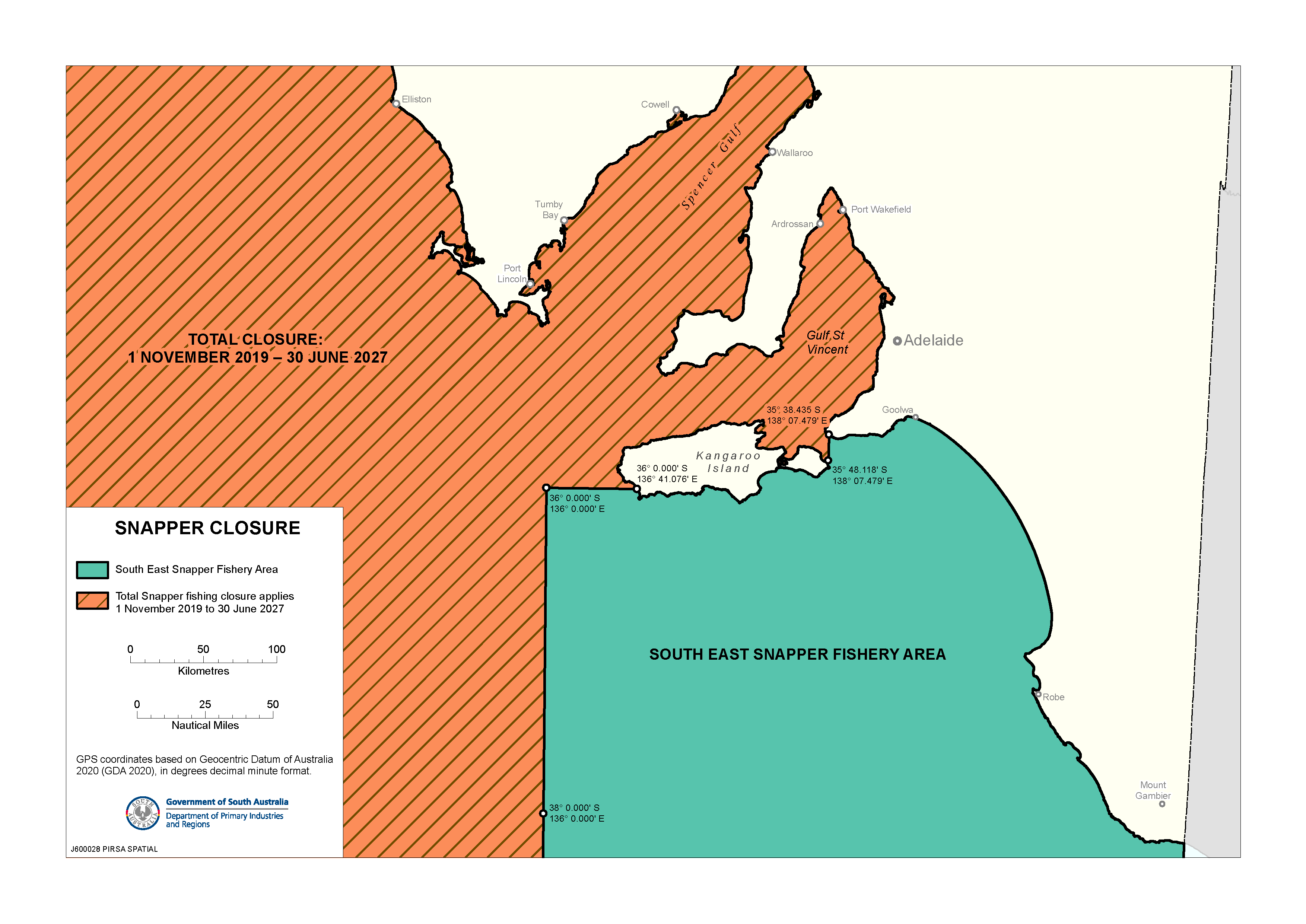
Download the Snapper closure map ( )
Future reopening
To support the recovery of Snapper stocks and the potential reopening of the fishery beyond 30 June 2027, PIRSA has developed a Snapper rebuilding plan.
The plan establishes clear decision rules to guide future management decisions.
Any future reopening of Snapper fishing in currently closed areas will depend on:
- stock biomass levels
- evidence of successful recruitment (young fish entering the population)
- outcomes of future stock assessments
- scientific advice and management recommendations.
The rebuilding plan does not guarantee fishing will reopen by a particular date. Decisions will be based on scientific evidence of stock recovery.
See Snapper recovery for more information about research and recovery efforts.
How fishers can help
As Snapper populations recover, recreational fishers may encounter more Snapper while targeting other species.
You can help support rebuilding efforts by:
- using best-practice fish handling and release techniques
- minimising time out of the water
- using release weights where appropriate – see Releasing fish and barotrauma
- moving on from areas where Snapper are being regularly encountered
- voluntarily reporting released Snapper to assist ongoing monitoring and research.
Snapper handling and release
[Jamie Crawford] There are a number of things that fishers can do to optimise the survival of released Snapper.
Firstly, fishing for Snapper in shallow water is the best option to reduce barotrauma and improve survival.
[Courtney Cheesman] When landing and handling a fish intended for release, it is considered best practice to be prepared before the fish is hooked by having the necessary tools and equipment readily available, such as a landing net, wet towel and pliers.
Reducing handling time and air exposure will optimise the probability of survival.
It is also recommended to use a knotless or silicon landing net to support the weight of the fish when bringing it to the vessel and placing the fish onto a cool, wet surface and handling with wet hands or gloves to minimise the removal of protective mucus.
[Jamie Crawford] By making small changes to the way that we handle and release Snapper, we can all optimise their probability of survival when released and contribute to the recovery of this iconic fish species.