
Varroa mite
Identification and impact
Varroa mite (Varroa destructor) is the most serious pest affecting honey bees worldwide. It remains a key threat to Australia’s honey and honey bee pollination plant industries.
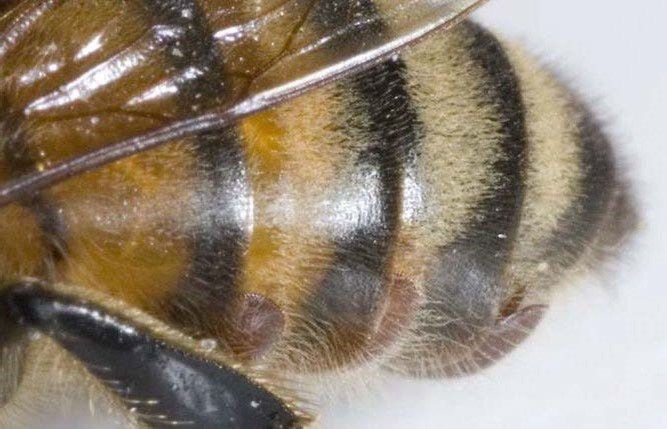
Varroa mites are tiny reddish-brown external parasites of honey bees. Individual mites can be easily seen on brood, but they are difficult to identify on adult bees.
If left untreated, varroa mites will kill any beehive or colony they infect.
Varroa mites are agile, they move into hives quickly and transfer through contact between bees. Adult bees can carry this pest between hives and even between apiaries when drifting, swarming and absconding.
Mites can also spread via the beekeeper and equipment shared between hives and apiaries.
Learn more in the notifiable honey bee pests and diseases factsheet ( ).


Detection in South Australia
Varroa mite was first detected in South Australia in September 2025 at Pooginook in the Riverland. All impacted hives associated with the Pooginook detection were moved out of the state by their interstate owner in compliance with their SA entry permit conditions.
On 20 November 2025, a detection was confirmed in beehives in the Limestone Coast region near Salt Creek. To date there is no evidence that this detection is related to the detection in the Riverland in September. A source for this incursion is not currently known.
On 26 November 2025, further detections were confirmed at Taratap on the Limestone Coast and at Sellicks Hill in the upper Fleurieu Peninsula. This detection is linked through both beekeepers operating on the same property at Gumeracha in the Adelaide Hills.
Detections have been confirmed across multiple regions including Adelaide Hillls, Riverland, mid and upper North, southern Flinders, upper and lower Limestone Coast, Fleurieu, lower Yorke and lower Eyre Peninsulas.
Where required, movement control orders have been applied to the affected sites to ensure bees, hives and associated equipment cannot be moved; this will allow for a traceback assessment, surveillance, and development of a management plan.
All beekeepers with positive detections are working with PIRSA to undertake surveillance at all linked sites, where additional sampling and tracing will be carried out to establish the extent of the incursion.
PIRSA urges all beekeepers who have or have had hives within 25 km of detection sites to shorten their monitoring intervals to every 3 to 4 weeks – see Monitor for varroa mite.
Check the map below to see if you are in a surveillance buffer area.
If you suspect you've detected varroa mite, please contact the PIRSA Biosecurity Apiary Unit or phone the Exotic Plant Pest Hotline on 1800 084 881.
Varroa surveillance map
Beekeepers and industry can assess risk and make informed decisions by knowing not only where varroa is present but also where it is absent.
You can report both positive and negative results using the hive inspection result form which will contribute to the map. The map is updated every 24 hours.
Providing results using the hive inspection result form is voluntary.
Positive tests for varroa must still be reported to the Exotic Plant Pest Hotline or by emailing pirsa.beebiosecurity@sa.gov.au. Use of the the hive inspection result form does not constitute notification.
For heat maps and reporting outside South Australia, go to Reporting varroa.
Open the Varroa mite heat map in a new window.
Download the South Australia varroa detection map ( ).
FaB Mentors are there to assist primary producers when things get tough. They are independent, and experienced in dealing with difficult situations. Contact your local FaB Mentor for a free confidential chat by phone or in person.
Find out moreResponse in South Australia
PIRSA is using border control measures to help prevent varroa mites entering the state. This relies on beekeepers monitoring their hives, maintaining records, and submitting sampling results.
We are working with industry groups to promote awareness of risks and preventative measures.
PIRSA is committed to providing education, training, and awareness packages free to all beekeepers.
Varroa Development Officers (VDO)
PIRSA apiary staff can assist commercial and hobbyist beekeepers to help you manage varroa mite. PIRSA work with the beekeeping industry, offering advice on preparation strategies, varroa monitoring, education, hive management, and biosecurity measures.
These services are free and available to all apiarists across the state. Support will be delivered by:
- phone or email
- face-to-face meetings
- attendance at small group and association meetings
- short information sessions or larger group workshops.
Contact the Apiary team for more information or to arrange a group session.
Actions following detection
As new detections of varroa mites are confirmed in SA, we will notify registered beekeepers, including the approximate location. Updates will be provided on this webpage, biosecurity notice emails and SMS, and social media posts.
PIRSA will assist with distributing acaricides and surveillance materials when detections occur. Eventually, individual beekeepers will be responsible for managing varroa mites.
The South Australian Government will not conduct enforced euthanasia of hives. Varroa mites will remain a notifiable pest and affected hives must be managed.
Acaricides
Acaricides are only one aspect of a successful management program and should be used in conjunction with other management options to keep mite numbers as low as possible to reduce impact.
Our apiary unit staff can assist you with developing a management plan that suits your operation.
At present PIRSA has a stock of Bayvarol to assist beekeeper with initial treatments once you reach thresholds in your hives.
PIRSA are sourcing additional organic and synthetic treatment options to aid beekeepers with their initial treatments.
If applying acaricides as part of your management program:
- always follow the label directions of the product, including the potential withholding period before extraction, or residue testing
- monitor for economic threshold levels of mites prior to application
- monitor post application to assess effectiveness of the management tool.
It is estimated the annual cost of acaricide treatments could be around $50 to $60 per hive, based on 4 treatments per year.
All products listed on AHBIC's varroa chemical treatment table can be used by South Australian beekeepers and are available from various suppliers.
Industry updates and information
T2M webinars
Education resources
- Introduction to managing varroa mites – Tocal College (completing this free course is required for entry permits into SA)
- Hive management options – NSW DPI: Primefact
- Varroa mites – Plant Heath Australia
- Varroa mites – Bee Aware
Biosecurity notices
- 12 June 2026
- 1 June 2026
- 22 May 2026
- 16 April 2026
- 20 March 2026
- 20 February 2026
- 23 January 2026
- 9 January 2026
- 19 December 2025
- 12 December 2025
- 5 December 2025
- 28 November 2025
- 21 November 2025
- 7 November 2025
- 24 October 2025
- 10 October 2025
- 3 October 2025
- 26 September 2025
- 19 September 2025
- 12 September 2025
- 3 September 2025
Advisory committee
The South Australian Varroa Industry Advisory Committee (SAVIAC) was established to manage varroa mite, in support of the bee industry. It includes expert representatives from:
- Beekeepers Society of South Australia
- South Australian Apiarists Association
- Australian Honey Bee Industry Council (AHBIC)
- large commercial beekeepers
- pollination dependant industries.
PIRSA works closely with this committee in developing plans and policies.

The plan helps apiary and pollination industries prevent varroa from entering SA and minimise the impact once detected. It offers a risk-based approach to business continuity.
Download plan (PDF)Beekeeper responsibilities
It is critical to maintain bee biosecurity measures, including record keeping and registration.
Register your hives
New and ongoing beekeepers must register their hive details to protect the industry from possible outbreaks of varroa mite.
Learn how to sample
Beekeepers should continue sampling a representative number of hives and send suspicious samples to PIRSA for analysis.
Reduce the risk of varroa mites
As a beekeeper or almond pollinator, you need to monitor and control the health of your hives.
Bee movement restrictions
Learn your requirements and restrictions for moving bees, hives, apiary products, and beekeeping property.
Outbreak in Australia
Varroa mite was detected in June 2022 and an emergency response was initiated, supported by the Australian Government, state and territory governments, and pollination-dependent agricultural industries.
Initial eradication efforts were led by the NSW Department of Primary Industries, being the state most affected by the pest. It was the largest agricultural biosecurity response in Australia to date, but it was ultimately unsuccessful. In September 2023, the National Management Group agreed it was not feasible to eradicate varroa mite.
A 24-month Transition to Management (T2M) plan was approved in February 2024 to assist industry bodies and the community – read the National Varroa Mite Response Plan T2M ( ).
National management program
The National Varroa Mite Management Program (NVMMP) minimises the effects of varroa mite naturalisation and slows the spread. It focuses on:
- maintaining business continuity for pollination-dependent industries
- training beekeepers to manage varroa mite and keep hives healthy
- advising about monitoring and reporting requirements
- providing a reliable webinar series relevant to best practices in an Australian context.
Biosecurity assistance will be available through updates to the Australian Honey Bee Industry Biosecurity Code of Practice and the Bee Biosecurity Manual. This will help beekeepers with pest and disease prevention and control.
Varroa Development Officers will engage with beekeepers to resolve problems and coordinate a voluntary hive monitoring program. Industry concerns, knowledge gaps, and future needs will also be addressed.
Interstate diagnostic laboratories will detect varroa mite and associated exotic viruses quickly, initiating efficient responses. Research into improved bee genetics and breeding behaviour traits to help manage varroa mite is also being examined in Australia and internationally.
Contact
PIRSA Apiary Unit
Phone: (08) 8207 7900
Email: pirsa.beebiosecurity@sa.gov.au
Josh D'Ambrosio – Industry Engagement and Capability Officer
Phone: 0477 960 435
Email: joshua.d'ambrosio@sa.gov.au
Emma Aspin – Industry Engagement and Capability Officer
Phone: 0419 761 063
Email: emma.aspin@sa.gov.au
Davide Stella – Bee Biosecurity Officer
Phone: 0408 244 091
Email: davide.stella@sa.gov.au
SA Varroa Industry Advisory Committee
Email: pirsa.saviac@sa.gov.au