
Bird flu rapid response ready
Sunday 28 June 2026 BiosecurityMedia release
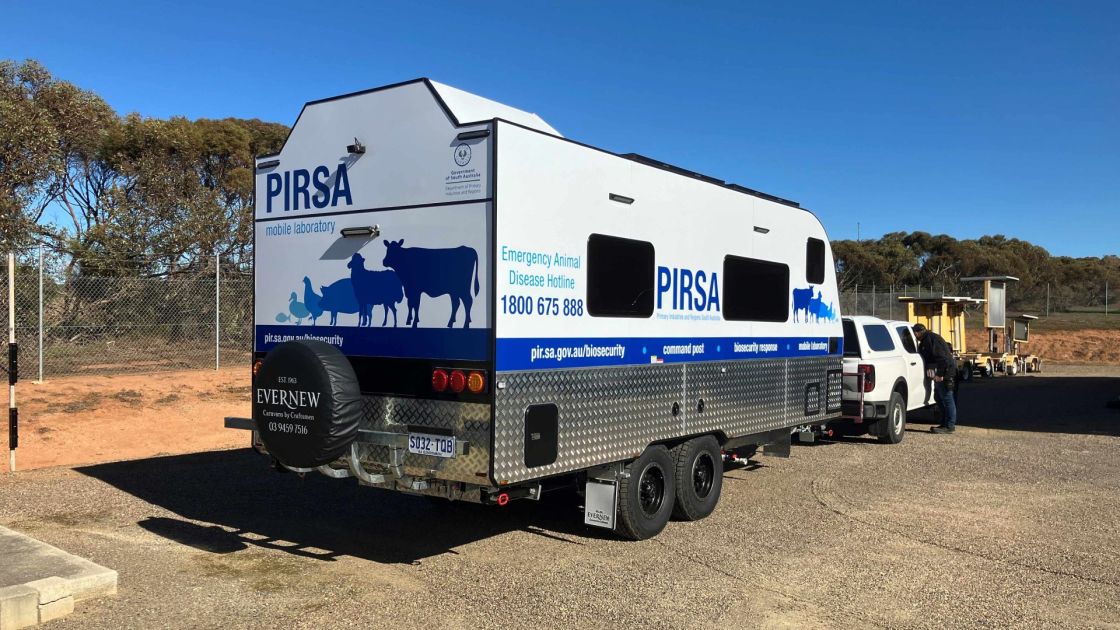
The Malinauskas Government stands ready to respond to any potential H5 bird flu outbreak, backed by an arsenal of specialised resources including a mobile diagnostic laboratory, rapid response units and decontamination facilities.
These resources each play a crucial role in the delivery of an efficient and integrated emergency management response in the event of an outbreak of H5 bird flu.
This equipment includes:
- a mobile diagnostic laboratory to support rapid testing
- rapid response units carrying equipment used for decontamination, sampling and other bird flu response activities
- portable decontamination units to clean vehicles and equipment on infected properties.
To date, there has been only one detection of H5 bird flu in a wild migratory bird in SA.
Importantly, bird flu has not been detected in commercial poultry flocks, captive birds or any other birds in South Australia, nor has it become established in any part of Australia.
But this is no reason to stop preparing for the risk that further detections could eventually lead to an outbreak.
It’s the first time this strain has been detected in South Australia. Since 1 January 2026, more than 780 samples from birds have been tested in SA.
South Australia has been preparing for H5 bird flu for the past few years, with the State and Federal Governments investing a combined $8.1 million into PIRSA to boost its emergency response capabilities, surveillance, diagnostics, workforce capability and overall readiness.
Other preparedness efforts have included training and simulation exercises, and other targeted environmental and wildlife activities.
A further $3.5 million has been invested into the Department for Environment and Water from the Federal Government to support activities to prepare for, build on-ground resilience in, and support response efforts for the environment and our wildlife, including:
- management and response planning in key areas such as Seal Bay Conservation Park, Coorong National Park, Adelaide International Bird Sanctuary National Park, and Adelaide International Dolphin Sanctuary
- habitat restoration and feral bird control on offshore islands of Fleurieu Peninsula
- predator control and habitat restoration to safeguard migratory and threatened birds on the Limestone Coast
- fox and feral cat control to protect bird species’ breeding, nesting and roosting sites along the metropolitan coast
- feral pig control at the Coongie Lakes Ramsar site in the Far North
- treating sea lion pups for parasites, and installing pup shelters for exposure protection
- feral cat control around Seal Bay, noting that feral cats are potential vectors for H5 bird flu.
Federal funding has also been allocated to the Zoo and Aquarium Association to help safeguard threatened native species at Cleland Wildlife Park, Adelaide Zoo and Monarto Safari Park.
The community is urged to be vigilant and report any dead or sick birds or wildlife showing signs of bird flu. Possible signs of bird flu in birds include:
- multiple sick or dead birds in one location
- weakness, inability to stand or fly
- neurological signs or abnormal behaviour
- swelling or discolouration
- respiratory distress.
If you see sick or dead birds or other wildlife, do not touch them. Avoid contact. Record what you see. Report it to the Emergency Animal Disease Hotline on 1800 675 888 from anywhere in Australia.
For more information visit birdflu.gov.au. For more information on bird flu preparedness in SA, see avian influenza.