

Project background
In South Australia, Murray cod are the focus of fishery and natural resource management that aims to reverse past declines. This includes the delivery of water for the environment, water level manipulation, fishway construction and physical habitat restoration. Understanding of Murray cod biology, including habitat use and movement, is critical to inform this management.
The project is being delivered in collaboration with SARDI and CSIRO scientists as part of the Sustaining Riverland Environments (SRE) Program and the Department for Environment and Water’s (DEW) Weir Pool Manipulation Program. SRE is a $37.6 million initiative funded by the Australian Government through the Murray–Darling Basin Authority and delivered by the Government of South Australia through DEW.
Objectives
The project aims to investigate the movement and habitat use of Murray cod in the lower River Murray in response to river flow and specific management actions. Specific aims include investigating:
- Movement in response to delivery of environmental water;
- Movement among the river main channel and key anabranch habitats at Chowilla, Pike, Bookmark Creek and Katarapko;
- Movement in response to weirpool manipulation; and
- Whether flow regulating structures are acting as barriers to movement.
Project methodology and approach
The project is using acoustic telemetry to monitor Murray cod movement. An array of >80 acoustic receivers (‘listening stations’) has been deployed throughout the South Australian River Murray. This includes receivers at regular intervals in the main river channel, at junctions between the river and specific anabranch creeks, and near key flow regulating structures (e.g. weirs). If tagged fish swim within the vicinity of receivers (approx. 300 m), their unique ID is recorded.
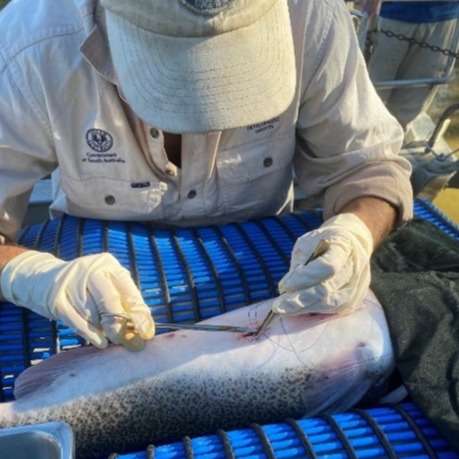
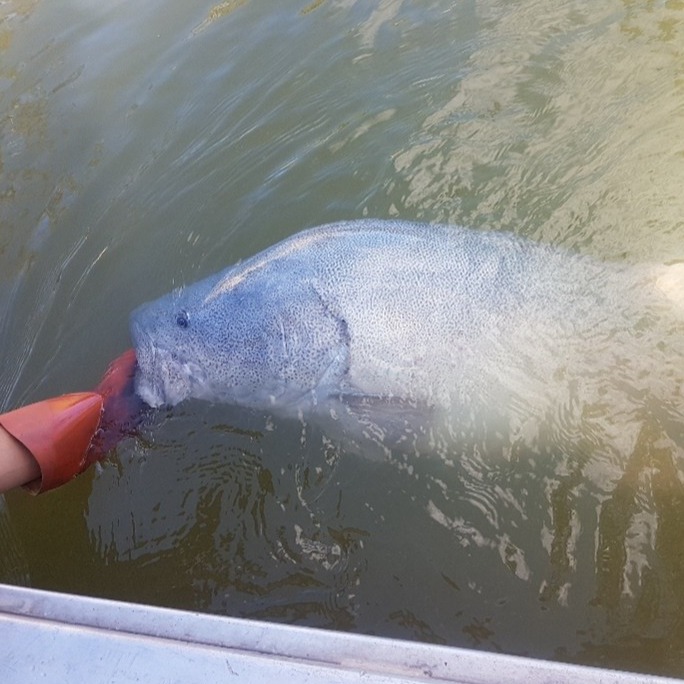
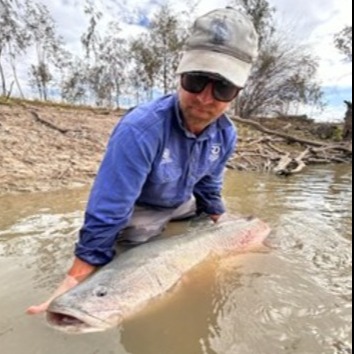
In autumn 2025, 50 Murray cod were captured and implanted with acoustic tags between Locks 3 (Overland Corner) and 6 (Murtho). A further 50 will be tagged in autumn 2026. The tags are 70 mm long by 16 mm wide and are inserted into the fish’s gut cavity under anaesthesia before release at the capture location. The movements of these fish will be monitored for a period of at least three years.
Outcomes
- Improved understanding of Murray cod general movement ecology and habitat use in the South Australian River Murray.
- Improved understanding of movement responses to river flow and water level variability, particularly the delivery of water for the environment.
- Improved understanding of Murray cod interaction among main channel and key anabranch habitats, including those that have recently undergone habitat restoration activities.
- Identifying key barriers to Murray cod movement.
Collectively, the above outcomes will provide water, natural resource and fishery managers with the knowledge to better support Murray cod in the South Australian River Murray into the future.
