
Opuntia cacti (prickly pear/wheel cactus)
Opuntia spp. except O. ficus-indica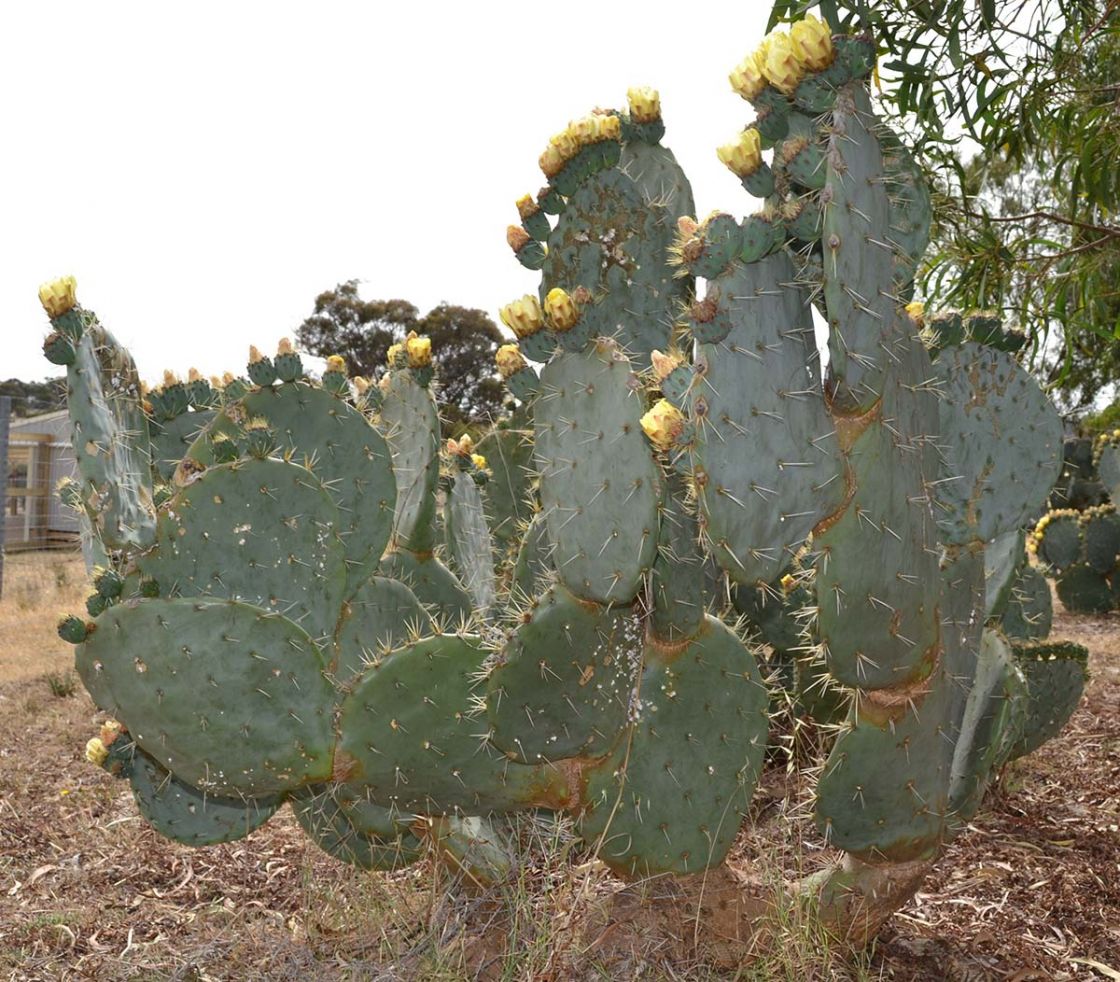

Weed profile
 Perennial
 Cactus/Succulent
 Shrub
Shrub Weeds of National Significance (WoNS)
 Hinders movement
 Injures animals
- Habitat: native vegetation, pastures
Impact
Compete with native vegetation. Forms prickly thickets. Can injure animals.
Description
- Succulent, shrubby perennials.
- Stems flattened into pad-shaped segments, dotted with large spines.
- Leaves absent.
- Flowers large with numerous petals in various colours.
- Most produce red, fleshy fruits.
Control options
glyphosate (450g/L)
Application Method: Stem injection
Application Rate: Inject 2 to 4mL undiluted into 4th pad
Product Name: Titan Glyphosate 450 Herbicide®
Herbicide Group: 9
Situation: Non-arable and pastoral land
Timing: Stem injection, while actively growing.
Comments: Suitable for wheel cactus (Opuntia robusta). Inject a measured dose of herbicide into the pad using a sheep drenching needle (or similar).
Legal Status: PER 84519 (exp. 2022)
glyphosate (450g/L)
Application Method: Stem injection
Application Rate: Undiluted
Product Name: Roundup CT®
Herbicide Group: 9
Situation: Conservation areas, bushland and other non-crop areas.
Timing: Stem injection, while actively growing.
Comments: Suitable for wheel cactus (Opuntia robusta) and other opuntioid cacti. Inject a measured dose of herbicide into the pad using a drill, drenching needle (or similar).
Legal Status: PER 13371 (exp. 2027)
MSMA (720g/L)
Application Method: Stem injection
Application Rate: Inject 2 to 4mL undiluted into 4th pad
Product Name: Daconate 720®
Herbicide Group: 0
Situation: Non-arable and pastoral land
Timing: Stem injection, summer
Comments: Suitable for wheel cactus (Opuntia robusta). Inject a measured dose of herbicide into the pad using a sheep drenching needle (or similar).
Legal Status: PER 84519 (exp. 2022)
triclopyr (600g/L)
Application Method: Basal bark
Application Rate: 800mL/60L biodiesel or diesel
Product Name: Garlon 600®
Herbicide Group: 4
Situation: Native vegetation, rangeland, pasture and other non-crop areas.
Timing: Basal bark, while actively growing.
Comments: Plants up to 10cm basal diameter; also cover all pads with spray.
Legal Status: Registered
triclopyr (600g/L)
Application Method: Spot spray
Application Rate: 3L/100L water
Product Name: Garlon 600®
Herbicide Group: 4
Situation: Native vegetation, rangeland, pasture and other non-crop areas.
Timing: Spot spray, while actively growing.
Legal Status: Registered
triclopyr (300g/L) + picloram (100g/L) + aminopyralid (8g/L)
Application Method: Spot spray
Application Rate: 500mL/100L
Product Name: Grazon Extra®
Herbicide Group: 4
Situation: Native vegetation, rangeland, pasture and other non-crop areas.
Timing: Spot spray, while actively growing.
Comments: Apply a thorough spray over pads; follow-up may be needed to treat regrowth.
Legal Status: Registered
triclopyr (240g/L) + picloram (120g/L)
Application Method: Spot spray
Application Rate: 1L/60L biodiesel or diesel
Product Name: Access®
Herbicide Group: 4
Situation: Fencelines, forestry, pasture, commercial, industrial and other non-crop areas.
Timing: Spot spray, while actively growing.
Comments: Apply as an over all spray, wetting all parts of the plant to ground level. Do not allow herbicide to contact non-target species.
Legal Status: Registered for this use on woody weeds in general.
MSMA (720g/L)
Application Method: Spot spray
Application Rate: 1.1L/40L
Product Name: Daconate 720®
Herbicide Group: 0
Situation: Native vegetation, rangeland, pasture and other non-crop areas.
Timing: Spot spray, summer
Comments: Apply using a power sprayer when air temp is above 30ºC. Thoroughly cover all pad surfaces. Re-spray any regrowth.
Legal Status: Registered
Manual removal
Situation: Native vegetation, rangeland, pasture and other non-crop areas.
Timing: Any time
Comments: Remove, collect and bury all fragments under at least 1m of soil. Any that are left or dropped during transport to the burial site will regrow.
Legal requirements in each region

Land owners in this region to take reasonable steps to kill plants and prevent their spread. Enforceable by the Alinytjara Wiluṟara Landscape Board.

Must not be sold or traded in any way, including as a contaminant of anything.

Must not be transported on a public road, including as a contaminant of anything.

Must not be imported into the region.
Land owners in this region to take reasonable steps to kill plants and prevent their spread. Enforceable by the Eyre Peninsula Landscape Board.
Must not be sold or traded in any way, including as a contaminant of anything.
Must not be transported on a public road, including as a contaminant of anything.
Must not be imported into the region.
Land owners in this region to take reasonable steps to kill plants and prevent their spread. Enforceable by the Green Adelaide Board.
Must not be sold or traded in any way, including as a contaminant of anything.
Must not be transported on a public road, including as a contaminant of anything.
Must not be imported into the region.
Land owners in this region to take reasonable steps to kill plants and prevent their spread. Enforceable by the Hills and Fleurieu Landscape Board.
Must not be sold or traded in any way, including as a contaminant of anything.
Must not be transported on a public road, including as a contaminant of anything.
Must not be imported into the region.
Land owners in this region to take reasonable steps to kill plants and prevent their spread. Enforceable by the Kangaroo Island Landscape Board.
Must not be sold or traded in any way, including as a contaminant of anything.
Must not be transported on a public road, including as a contaminant of anything.
Must not be imported into the region.
Land owners in this region to take reasonable steps to kill plants and prevent their spread. Enforceable by the Limestone Coast Landscape Board.
Must not be sold or traded in any way, including as a contaminant of anything.
Must not be transported on a public road, including as a contaminant of anything.
Must not be imported into the region.
Land owners in this region to take reasonable steps to kill plants and prevent their spread. Enforceable by the Murraylands and Riverland Landscape Board.
Must not be sold or traded in any way, including as a contaminant of anything.
Must not be transported on a public road, including as a contaminant of anything.
Must not be imported into the region.
Land owners in this region to take reasonable steps to kill plants and prevent their spread. Enforceable by the Northern and Yorke Landscape Board.
Must not be sold or traded in any way, including as a contaminant of anything.
Must not be transported on a public road, including as a contaminant of anything.
Land owners in this region to take reasonable steps to kill plants and prevent their spread. Enforceable by the South Australian Arid Lands Landscape Board.
Must not be sold or traded in any way, including as a contaminant of anything.
Must not be transported on a public road, including as a contaminant of anything.
More Information
- Managing Opuntioid Cacti in Australia manual ( )
- Opuntioid Cacti Management Guide ( ) – 12 page summary of the manual.
- State Opuntioid Cacti Management Plan ( )
Find out how to:
- benefit from the early intervention of new and emerging weeds - handbook
- best manage your use and storage of agricultural and veterinary chemicals.
Control advice
For further help and advice managing this weed contact your regional landscape board: