
From paddock to protein: How SARDI helps local manufacturers succeed in new markets
Wednesday 5 August 2026 SARDI
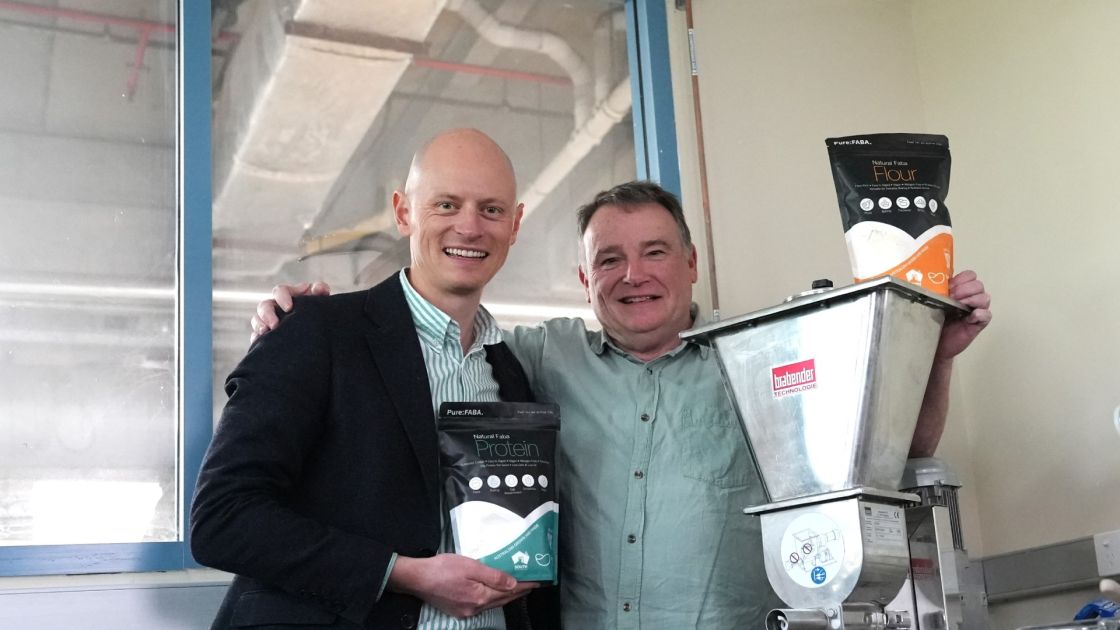
What happens when cutting-edge food science meets a plentiful South Australian crop? A new generation of plant-based protein products is born, opening doors to global markets and delivering value and benefits across the supply chain.
South Australia produces some of Australia's largest share of faba bean crops yet most are exported overseas in their raw form.
For Integra Foods, that represented an opportunity.
Integra Foods, a subsidiary of the Australian Grain Export Group (AGE), set out to answer a simple question: how could more value be created from a crop already grown extensively by South Australian farmers?
The answer lay in developing high-value plant-based protein from locally grown faba beans, a product which experienced strong growth globally during 2019 as consumers sought sustainable, nutritious and non-animal protein alternatives.
Turning that vision into reality required research expertise, technical knowledge and access to specialised equipment.
That's where SARDI came in.
Turning research into commercial opportunity
Through Food South Australia (Food SA), Integra Foods connected with SARDI Food Sciences Senior Consultant John Carragher.
What began as a research collaboration developed into a long-term partnership focused on solving a common challenge: how to unlock greater value from South Australia's faba bean crop.
"We saw an opportunity to create greater value from faba beans grown by local farmers," says Integra Foods CEO Tom Reddecliffe.
"We wanted to combine agriculture, food innovation and advanced processing to develop products that could compete in local and international markets."
John brought extensive experience in pulse processing and value-adding technologies, while SARDI provided access to specialised research facilities and equipment, including its $500,000 dry fractionation technology at the Waite campus.
Together, they explored how South Australian-grown faba beans could be processed into protein concentrates suitable for local and international markets.
Creating a new market from an existing crop
South Australia already produces around 25% of Australia's pulses, with faba beans accounting for a significant share of that production.
Historically, much of this crop has been sold as a commodity and exported with limited local processing.
By developing faba bean protein powders and flours, Integra Foods has helped create a new, higher-value market for an existing South Australian product.
Rather than simply exporting raw beans, the crop can now be transformed into premium ingredients used in food manufacturing, creating additional value within South Australia and potentially beyond.
This not only diversifies market opportunities for growers but also strengthens the state's food manufacturing sector.
"John's work on value-adding pulses caught our attention," Tom says.
"He helped us understand how South Australian faba beans behaved in processing systems originally designed for European crops and helped us adapt the technology to suit local conditions."
Research delivering real-world outcomes
At the centre of the collaboration is dry fractionation, an innovative process that separates protein, starch and fibre from pulses without using water or chemicals.
The technology enables faba beans to be converted into protein-rich ingredients while preserving the natural state of the proteins.
For SARDI, the project demonstrates how research can support industry innovation and help businesses commercialise new products.
For Integra Foods, it provided the confidence and technical capability to invest in large-scale processing.
In 2021, the company invested $20 million in a commercial dry fractionation facility at Dublin, north of Adelaide, creating what is now the largest faba bean protein production facility of its kind in the Southern Hemisphere.
John played a key role in helping commission and optimise the facility to suit local bean varieties.
A win across the supply chain
The success of the partnership extends well beyond one company.
For growers, it creates stronger demand and additional pathways for a crop already widely grown in South Australia.
For regional communities, it supports local jobs, investment and economic activity.
For consumers, it increases access to nutritious plant-based protein products made from South Australian-grown ingredients.
For Integra Foods, it has enabled the development of innovative products with strong domestic and international market potential.
And for SARDI, it is an example of research delivering tangible outcomes that benefit industry and the wider community.
Today, Integra Foods is leading Australia's production of plant-based protein ingredients derived from locally grown faba beans, while SARDI continues to help businesses translate science into commercial success.
For John the reward is witnessing local businesses attain new levels of commercial success.
"Food isn’t just fuel; there’s a story behind it."
As South Australia looks to grow its food manufacturing sector and expand export opportunities, the partnership between SARDI and Integra Foods demonstrates what's possible when research and industry work hand-in-hand.
Support local
John’s take home message, as part of Buy SA Week, which is running from 1–9 August, is this: "Support local growers, local food manufacturers and regional communities."
To learn more about SARDI’s Food Sciences division, see Food sciences.
Go to the Integra Foods website to learn more about faba bean protein powders and flours.
Photo: Integra Foods Chief Executive Officer Tom Reddecliffe (left) with SARDI's John Carragher (right).