Keeping cows fed during summer with Pasture 365
Wednesday 2 September 2026 Primary industriesSARDI
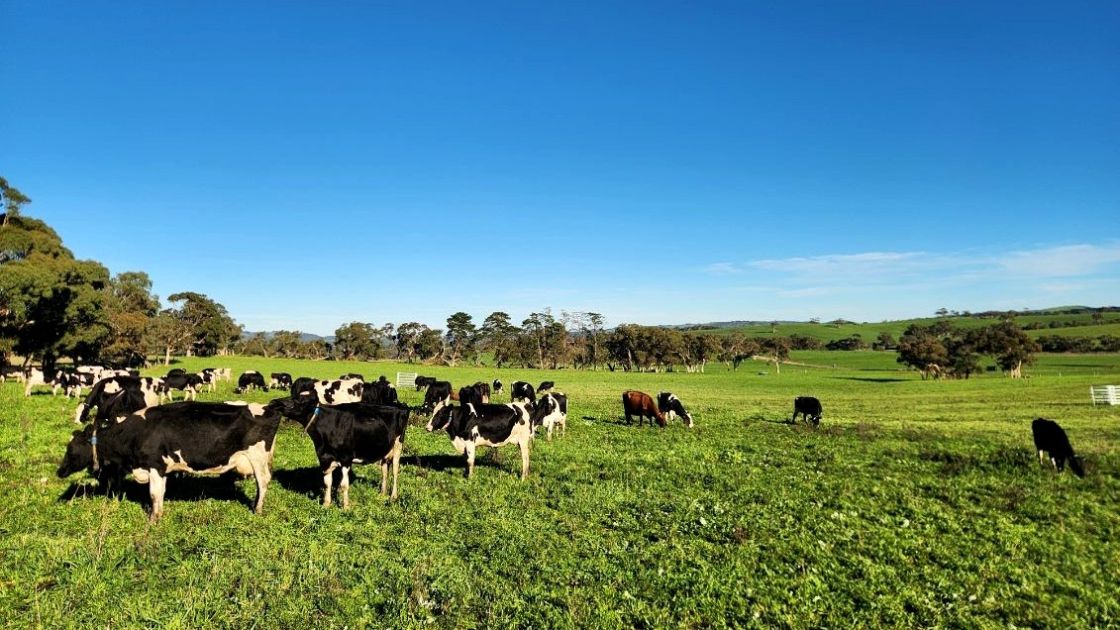
With the help of a national research project, South Australia’s dairy farming future could one day include rainfed pastures all year around despite a hotter, drier climate.
Pasture 365, a project coordinated by SARDI in partnership with lead organisation Deakin University and funded from the Australian Government’s Future Drought Fund, is trialling mixed-species pastures at nine long-term focal sites across the southern temperature grazing system in Western Australia, New South Wales, Victoria, Tasmania, and South Australia.
The goal is to define the optimal combination of pasture species to sustain a natural annual feed base in each unique dairying region to reduce the costly summer feed gap for farmers.
In 2024-25, the SA dairy industry produced 471 million litres of milk, delivering around $336 million in farmgate revenue. Around 40 per cent is typically sold as drinking milk with the remainder made into cheese, milk powder, yoghurt, butter, and other products.
However, keeping dairy cows fed amid hot summers and drought can be a challenge that impacts productivity and farmer wellbeing.
SARDI Principal Research Scientist Dr Alan Humphries is leading Pasture 365’s South Australian component on farm at Samantha Martin’s property ‘Bengowrie’ near Myponga, approximately 50 kilometres south of Adelaide.
Nestled on the Fleurieu Peninsula, the two-hectare research paddock is trialling combinations of Lucerne, Phalaris, Chicory, Cocksfoot, Ryegrass, and Clover to identify which mixtures remain productive and stable despite seasonal variability.
Dr Humphries said a key strength of the research is its scale using large, replicated paddock experiments that reflect commercial farming conditions.
“The trial was sown in spring 2025 and we’re evaluating how species interact under real dairy grazing conditions in a rainfed environment,” Dr Humphries said.
“This is all highly relevant to dairy systems on the Fleurieu and across South Australia where temperatures can exceed 40 degrees in summer, prompting producers to seek more resilient and input-efficient feed bases for their animals.
“We’re measuring pasture persistence, species composition over time, nutritive value, water-use efficiency, and overall productivity.
“Phalaris peaks in winter while Lucerne and Chicory are well-regarded summer perennials – all of this is accounted for in the research.
“Sam, as the host farmer, has direct exposure to new pasture options and insight into how mixtures perform in practice, leading the way for more producers to benefit from the research outcomes in the future.”
For Sam, whose family has farmed Bengowrie for more than a century, she’s aware her current herd of 220 Friesian dairy cows have high expectations for mealtimes.
South Australia’s average milk volume produced per cow was the highest in Australia in 2024-25.
“Each cow produces around 590 kilos of milk solids per year and they’re pretty fussy,” Sam said.
“If you put them in a paddock where everything has set seed, they’ll just walk out but if there’s still things growing around those species, they will tend to eat it.
“I’d been self-experimenting with multi-species pasture for a few years so when our agronomist told us about the research opportunity, it was right up my alley.
“The trial paddock is going well, and it looks good. It’s been green since it started growing.”
By the time Pasture 365 is due to conclude in 2028, Deakin University Lead Investigator, Professor Rebecca Lester, expects the project’s results to be accessible online.
“The legacy of Pasture 365 will be an online portal that can be accessed for free by farmers of all persuasions, dairy, beef, and sheep, to help them understand which species have worked well to close that summer feed gap under conditions similar to their own across the southern temperate region of Australia,” Prof Lester said.
“The long-term nature of this research, its depth, and wide geographical scope across five states means that the data will be incredibly insightful, helping producers to consider all kind of conditions relevant to them, like weather and soils, and in a changing climate.”
Looking ahead in South Australia, Dr Humphries’ work continues to expand the research outside of Bengowrie to include on-farm satellite sites at Meninge, Mount Compass, and Waitpinga.
“The Mount Compass site will be designed and established in collaboration with the SARDI Livestock team as a virtual fencing experiment to evaluate grazing preferences and how animals utilise diverse pasture mixtures,” he said.
“This builds on the current trial by linking pasture performance with grazing behaviour and exploring how grazing management can be better aligned with pasture composition and utilisation.
“The more sites we have, the richer the research.”
Pasture 365 received funding from the Australian Government’s Future Drought Fund.