Forgotten Carbon: Tracing Carbon from Coastal Habitats to the Deep Ocean 2025
Date
Thursday 8th May 2025 – Friday 13th February 2026 (multiple day trips)
Background
The purpose of this voyage was to collect water and sediment samples along the continental shelf and shelf break in the Perth Canyon region, targeting locations predicted to receive high inputs of kelp and other coastal‑derived carbon. The main objectives were to trace the movement of coastal-derived carbon offshore, assess its storage in continental shelf sediments, and generate data to improve models of coastal carbon transport and sequestration..
Australia has committed to reducing greenhouse gas emissions and is investing in blue carbon as part of its climate strategy. While mangroves and seagrasses are included in national carbon accounts, kelp forests, covering approximately 71,000 km² of the Australian coastline, remain excluded. Along Western Australia’s temperate coastline, , these highly ecosystems have been largely overlooked as a potential source of blue carbon, despite their capacity to capture, export and store carbon.
The data collected on this voyage contributes to a limited baseline of water column and seafloor sediment data for Western Australia, supporting future research and marine management. Specifically, the work focused on quantifying offshore transport of coastal‑derived carbon using water‑column environmental DNA (eDNA), and assessing carbon storage and burial in shelf sediments through carbon, eDNA and 210Pb dating analyses. The results providing a critical ground‑truth dataset to improve particle‑tracking models of coastal carbon export and sequestration.
Voyage
Sampling was conducted across multiple day trips on the RV Linnaeus between May 2025 and February 2026 along four inshore and offshore transects, ranging from 50 to 400 m depth on the Western Australian continental shelf. At each site, CTD casts and discrete water sampling for eDNA were carried out, supported by continuous vessel echosounder operations to ensure accurate depth targeting and positioning.
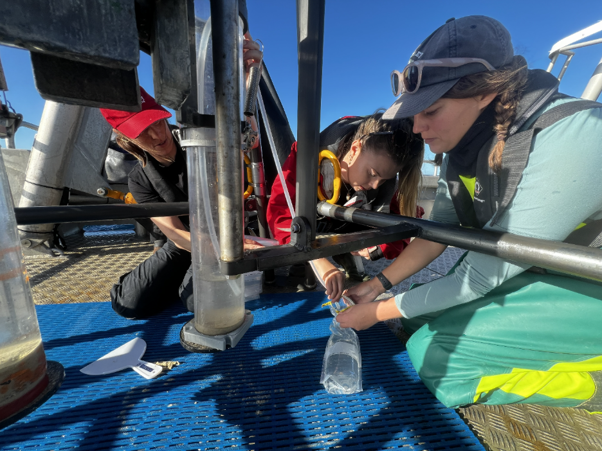
Sediment coring was conducted at sites with substrate conducive to sampling, helping characterise seabed composition and carbon storage potential. Cameras mounted on the corer were used to assess seabed conditions and guide sampling decisions.
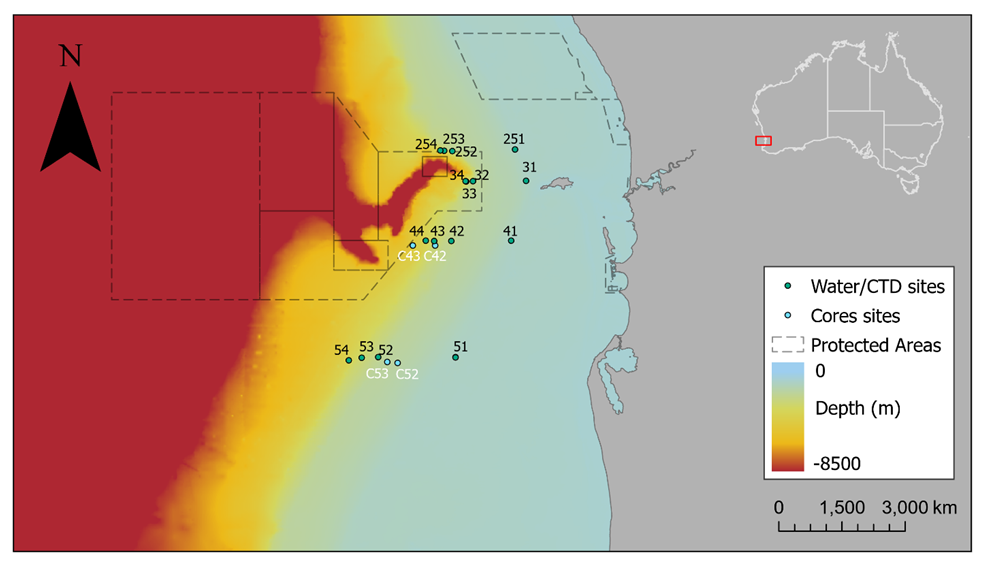
Visual map of sampling area highlighting locations of CTD profiler sites (green points) and successful coring sites (blue points) throughout the Perth Canyon region in Western Australia.
Outcomes
Field operations were completed efficiently across all four planned transects resulting in a total of 16 water eDNA sites and 4 coring sites across the Perth Canyon region. Video observations recorded kelp detritus at ~278 m depth, providing direct evidence of long‑distance offshore transport of carbon from nearshore habitats.
Next steps include eDNA sequencing, carbon content analysis, sediment dating, and model integration to refine estimates of kelp carbon export. The results will be communicated in a publication integrating eDNA and sediment carbon data to validate a coastal carbon export model, alongside the inclusion of the deep‑water kelp detritus observation in a PhD thesis and the associated publication.
All datasets will be made publicly available following analysis, including deposition of sediment metadata in the MARS database and eDNA sequences in NCBI GenBank and the UWA Institutional Research Data Store.
Sediment core deployment and sample collection during field operations onboard the MRV Linnaeus in the Perth Canyon region.
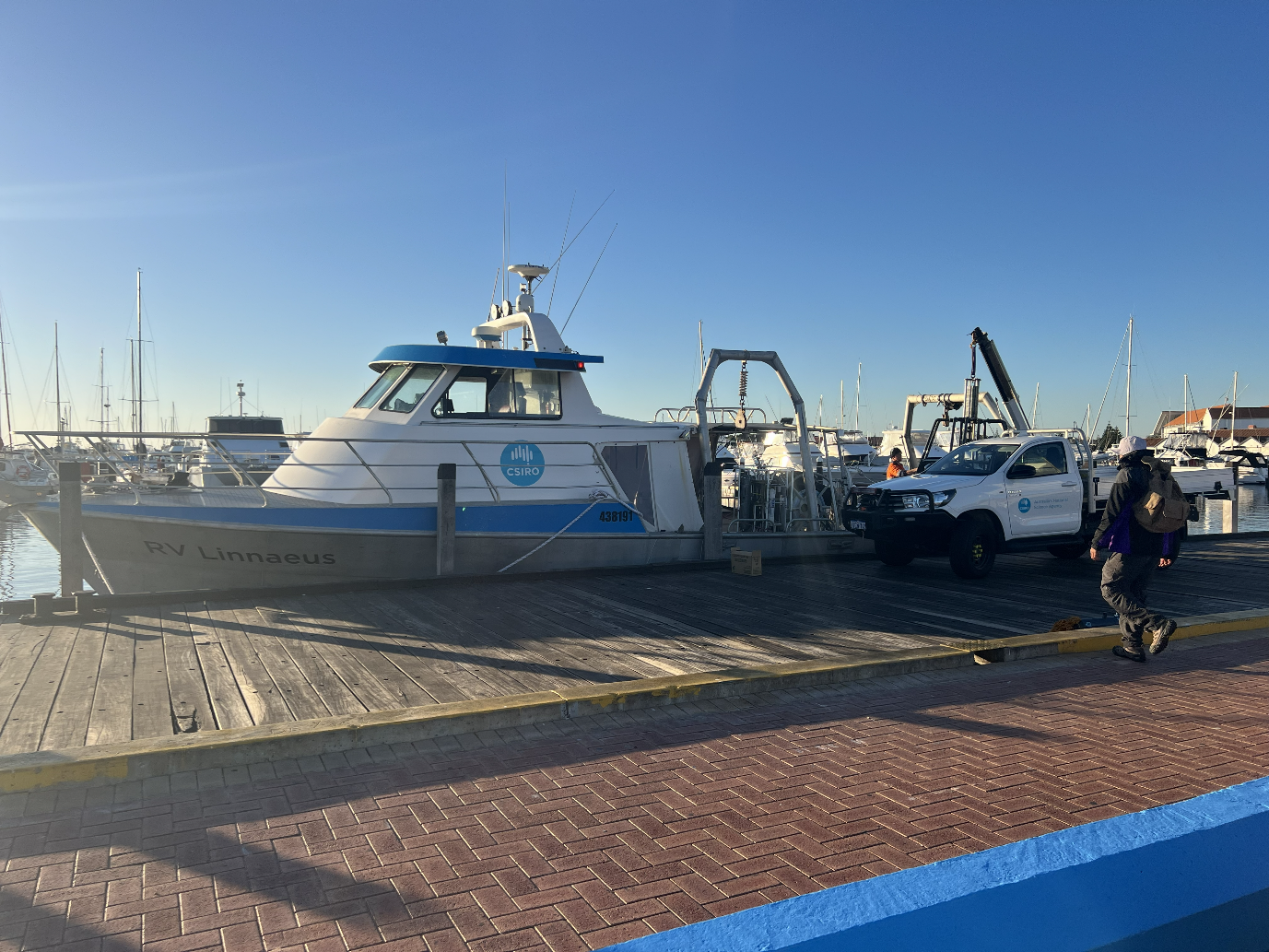
MRV Linnaeus at dock ready for upcoming voyage in the Perth Canyon region.