
Brown marmorated stink bug
The brown marmorated stink bug (BMSB; Halyomorpha halys) is an exotic pest that causes major damage to agricultural crops, nursery stock, and ornamental plants. It’s also a nuisance pest because it seeks shelter in large numbers in buildings and equipment during the winter months. When crushed or disturbed, it has a foul-smelling odour.
Background
In the northern hemisphere winter, BMSB seek places to shelter and can find their way into houses and other structures, including loaded containers for import to Australia. BMSB are known to hitchhike their way to Australia with cargo from the USA, Europe, and some Asian countries, and can survive for long periods by remaining dormant. BMSB stow away in crevices or protected areas of shipping containers, vehicles, boats, caravans, machinery, boxes and packaging, and stored personal items.
There is no evidence that BMSB is established in Australia.
The risk season for BMSB is between 1 September and 30 April, and the Australian Government conducts seasonal measures against BSMB by targeting high-risk imported items at this time.
PIRSA also maintains vigilance against the pest, with surveillance traps set up at high-risk locations during BMSB risk season.
Impacts
BMSB is known to feed on more than 300 hosts, including:
- nuts and grains
- apple
- bean
- berries
- citrus
- corn
- cotton
- fig
- grape
- peach
- pear
- raspberry
- soybean
- tomato
- nursery stock
- woody ornamental plants
- weed species.
Adults feed on mature and immature fruit, while the young (nymphs) feed on leaves, stems, and fruit. The bug’s saliva causes significant damage to plant tissues when feeding. It disfigures fruit which becomes unmarketable, resulting in control costs and production losses.
As well as posing a considerable risk to South Australia’s crops and gardens, these bugs are a nuisance pest as they can seek shelter in large numbers to overwinter in vehicles, homes and other buildings. They have along-lasting, foul odour when disturbed or crushed.
Impacts
BMSB is known to feed on more than 300 hosts, including nuts and grains, apple, bean, berries, citrus, corn, cotton, fig, grape, peach, pear, raspberry, soybean, tomato, nursery stock, woody ornamental plants, and weed species.
Adults feed on mature and immature fruit, while the young (nymphs) feed on leaves, stems, and fruit. The bug’s saliva causes significant damage to plant tissues when feeding. It disfigures fruit which becomes unmarketable, resulting in control costs and production losses.
As well as posing a considerable risk to South Australia’s crops and gardens, these bugs are a nuisance pest as they can seek shelter in large numbers to overwinter in vehicles, homes and other buildings. They have a long-lasting, foul odour when disturbed or crushed.
Identification
Adult BMSB are 12 to 17 mm long with a distinctive ‘shield’ shape. They are a mottled colour with a faint reddish tinge.
BMSB look like native Australian stink bugs, but adult BMSB have distinctive white bands on their antennae, and white banding around the edge of the abdomen. The underside of the body is white or pale tan, sometimes with grey or black markings. The legs are brown with faint white banding.
Juveniles and nymphs are similar to adults, only smaller and without fully developed wings.
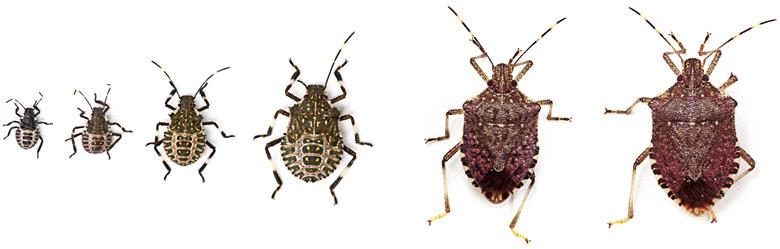
Four nymphal stages of BMSB, adult male, and adult female – photo: W. Hershberger. USDA, stopbmsb.org.
Learn more about identifying BMSB:
- NSW Government biosecurity video
- Plant Health Australia’s brown marmorated stink bug fact sheet
- Australian Government's guide to the identification of brown marmorated stink bug, Halyomorpha halys, and other similar bugs.
Help keep it out of SA
If you’re returning to South Australia from overseas, check your luggage to ensure you have not accidentally brought any pests with you, including BMSB.
If you receive goods from overseas, including from online shopping, look out for BMSB and other pests that may have stowed away in the contents or packaging.
If you work with or receive imported goods you should always keep an eye out for BMSB and other pests. Learn more about checking cargo, containers, and vessels for pests.
In your garden or crops, the most effective way to detect BMSB is by visually inspecting host plants. Learn more about the plants that can host BMSB.
Think you’ve seen BMSB?
If you think you have seen BMSB in your luggage, goods received from overseas, or in your garden or crops:
- try to catch and contain the pest in a sealed container, or re-seal the box or package to prevent more bugs escaping
- take one or more clear photos if possible
- immediately phone the Emergency Plant Pest Hotline on 1800 084 881 or submit a plant pest reporting form.