
Spotted latternfly
Spotted Laternfly (SLF) - Lycorma delicatula
Background
Background Spotted lanternfly (SLF) is an insect native to the subtropical regions of southeast Asia (China, India, Bangladesh, and Vietnam). Although not present in Australia, it is of increasing biosecurity concern due to its recent spread and invasion in South Korea and Japan and parts of the USA. Both nymphs and adults of spotted lanternfly cause damage when they feed, sucking sap from stems and leaves. This can reduce photosynthesis, weaken the plant, and eventually contribute to the plant’s death.
In addition, feeding can cause the plant to ooze or weep, resulting in a fermented odour, and the insects themselves excrete large amounts of fluid (honeydew). These fluids promote mould growth and attract other insects.
Spread
While the insect can walk, jump, or fly short distances, its ability to ‘hitchhike’ means that imported containers and their contents including, vehicles, machinery, equipment, nursery stock, fresh produce, cut flowers, foliage, forest products and passenger luggage are risk pathways into Australia.
Hosts
Spotted lanternfly has over 180 recorded host plants. The Tree of Heaven (Ailanthus altissima), a preferred host plant, is widely naturalised throughout the coastal and sub-coastal regions of southeastern Australia and is regarded as an environmental weed in most states and territories.
Should the pest incur, its potential host plant range is likely to expand due to the unique Australian flora that does not occur within its current distribution
Description
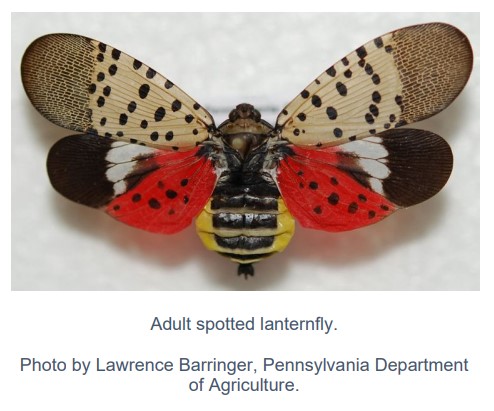
The spotted lanternfly adult is approximately 25 mm long and 12 mm wide. It has light brown forewings with black spots, and a speckled band at the outside edge The hindwings are bright red with black spots with a white and black band at the front. Nymphs (juvenile spotted lanternflies) are black with white spots and turn red as they develop.
Newly laid egg masses (holding 30-50 eggs) resemble wet, grey putty before turning dull and brown, mirroring a smear of cracked mud.
The Tree of Heaven, a favourite plant for spotted lanternflies has a rockmelon-like texture, with bark that appears light brown to grey. The leaves are large, 30 to 90 cm in length. These leaves are made up of many smaller leaflets on both sides of a central stem.
Reporting
If you suspect spotted lanternfly, you should immediately call the Exotic Plant Pest Hotline on 1800 084 881 or email pirsa.planthealth@sa.gov.au with a clear photo and your contact details.