
Demographic processes and stock structure for the West Coast of Eyre Peninsula population
This project aims to understand the contemporary demographic processes that maintain the West Coast Snapper population. It will:
- inform the stock structure of Snapper in the region
- identify the most appropriate spatial scale for fishery management.
Background
The population of Snapper on the West Coast of Eyre Peninsula is considered a regional component of the Spencer Gulf and West Coast stock (SGWCS), which includes Spencer Gulf and all waters westward to the WA-SA border.
This model of stock structure is based on the hypothesis that the West Coast population is replenished and maintained through local spawning and juvenile recruitment.
In years of exceptionally strong recruitment to northern Spencer Gulf, the West Coast population is also replenished by the movement of 2-3-year-old Snapper that originated in northern Spencer Gulf, and then emigrated through southern Spencer Gulf to the West Coast – see previous Snapper research.
Due to the prolonged period of poor recruitment in Spencer Gulf during the 2000s and 2010s, it is unlikely that fish have emigrated from Spencer Gulf to the West Coast in recent years.
Objectives
The project will analyse the relative contributions to Snapper population dynamics through local spawning and juvenile recruitment, as well as movement from adjacent populations. This will be investigated in 2 ways:
- Targeted sampling for different life stages of Snapper on the West Coast – adults, eggs and larvae, and juveniles.
- Comparing the biological characteristics of fish from the West Coast to other regions – length and age structures, otolith chemistry, and population genomics.
Project update
May 2024 – sample collection on the West Coast
Since the fishery closure was implemented in late 2019, representative samples of Snapper from the SGWCS and Gulf St Vincent stock have been undertaken through a biological sampling program – see monitoring and assessment. This involved periodic sample collection from across the state, including on the West Coast of Eyre Peninsula, to monitor populations.
A more targeted approach is needed to confirm the stock structure of Snapper on the West Coast. As each biological stock of Snapper is based around a primary spawning and juvenile recruitment area, this project investigated their life history through samples of adult fish, eggs and larvae, and juveniles. The sampling will be conducted in summer 2023-24 and 2024-25.
Samples of adult Snapper were collected from the West Coast in December 2023, February 2024, and May 2024. The locations were guided by local fishers in the region and included Murat Bay, Laura Bay, Haslam, and Nuyts Archipelago. Each fish was then processed for biological information, such as length, weight, sex, reproductive stage, and the removal of otoliths to estimate age.
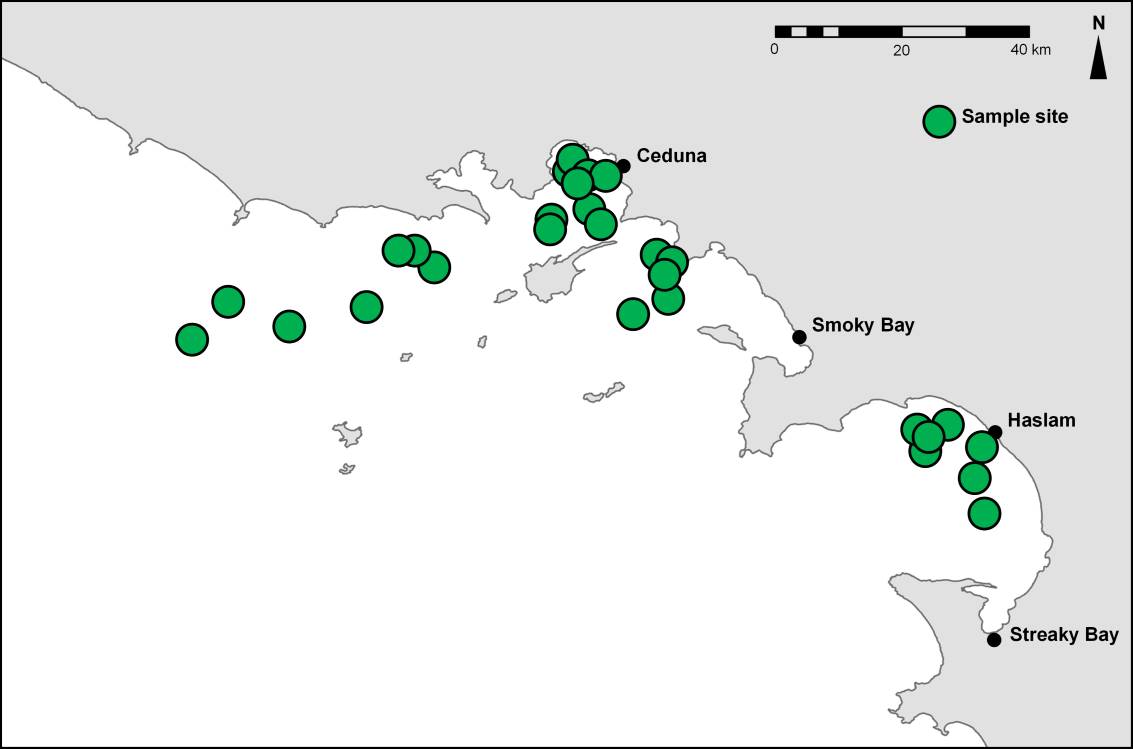
Locations of adult Snapper sampling along the West Coast of Eyre Peninsula, South Australia
The reproductive stage of adult Snapper was of interest in the summer months, as a high proportion of female fish sampled from inshore areas (Murat Bay, Laura Bay, and Haslam) were observed with hydrated eggs. This means they had either spawned recently or would have done in the next 24 hours, providing empirical evidence of spawning in the region.
Sampling for Snapper eggs and larvae was undertaken in February 2024. Targeted plankton tows occurred where spawning females had been identified in adult samples that were collected the previous evenings – near Murat Bay and Laura Bay. Due to the shallow depth of the bays, plankton samples were collected by surface tows of 5-minute duration. These were preserved in ethanol to be processed in the laboratory, to identify Snapper eggs and larvae.
Throughout its distribution, the preferred habitat for juvenile Snapper is areas of soft, muddy bottom. In May 2024, SARDI researchers teamed up with local fishers on the West Coast to identify suitable areas and target juvenile Snapper in the bays near Ceduna. Due to the small size of fish being targeted (3 to 10 cm), sampling was done with a series of baited traps that have previously captured juvenile Snapper. These were set both during the day and overnight. Juvenile Snapper ranging in size from 12 to 20 cm were captured, which will be processed to determine their age.