
Review of biological parameters in SA Snapper
This project compares the current biology of Snapper in South Australia with historical data. The findings will be used to develop a contemporary series of biological parameters for each stock, to be used as inputs into the stock assessment model.
Background
SARDI researchers have collected biological and fisheries data for Snapper in South Australia over the past 40 years, with particular focus on northern Spencer Gulf.
Long-term datasets have been developed throughout the state via routine commercial catch sampling over the past 25 years. These have been supplemented with data from targeted previous Snapper research projects and we have curated an overall database of:
- biological information for more than 27,000 Snapper – capture date, location, length, weight, sex, reproductive stage, and age
- length information for more than 75,000 individual Snapper.
Data from these studies and ongoing biological sampling are incorporated into stock assessments for Snapper. It is important that the biological parameters used as inputs are regularly reviewed and updated, so that stock assessment models are based on the best available information.
Objectives
The project investigates possible changes in key biological parameters of Snapper for each stock in SA, including:
- length
- age
- growth rates
- length and age at maturity
- natural mortality.
Variability in these characteristics may have been influenced by temporal changes in environmental conditions and stock abundance.
Collaboration
In other jurisdictions across Australia, long-term datasets for Snapper have been used to identify temporal shifts in biological parameters, such as growth and maturity.
This project has included collaboration with the Western Australia Department of Primary Industries and Regional Development (WA DPIRD). The WA DPIRD completed a similar analysis in a recent project ‘Where did the Snapper go?’ (FRDC Project No. 2018-050, Jackson et al. 2023), which:
- Identified spatial and temporal shifts in growth and maturity.
- Produced 2 data analysis packages that have been utilised for Snapper in SA.
Project update
February 2025 – spatial and temporal data analysis
The first step of this project was to synthesise the available datasets collected for Snapper over the past 40 years.
State-wide sampling of Snapper has occurred since 2000, primarily through the commercial market sampling program and regional catch sampling. Other datasets for SA included targeted research projects, trawl surveys for juvenile Snapper, and post-graduate studies.
This range has resulted in an extensive dataset with biological information for almost 30,000 Snapper, and lengths for over 75,000 individuals.
Analysis
Data analyses have been completed at several spatial and temporal scales. Spatially, the data were analysed at the regional population level in the:
- West Coast of Eyre Peninsula
- northern Spencer Gulf
- southern Spencer Gulf
- northern Gulf St Vincent
- southern Gulf St Vincent
- South-East Region.
Temporally, the data were analysed for the entire time series of data available, then by 12-year and 5-year blocks when sufficient data were available. Data were separated by sex. See the below examples of these analyses provided for northern Spencer Gulf.
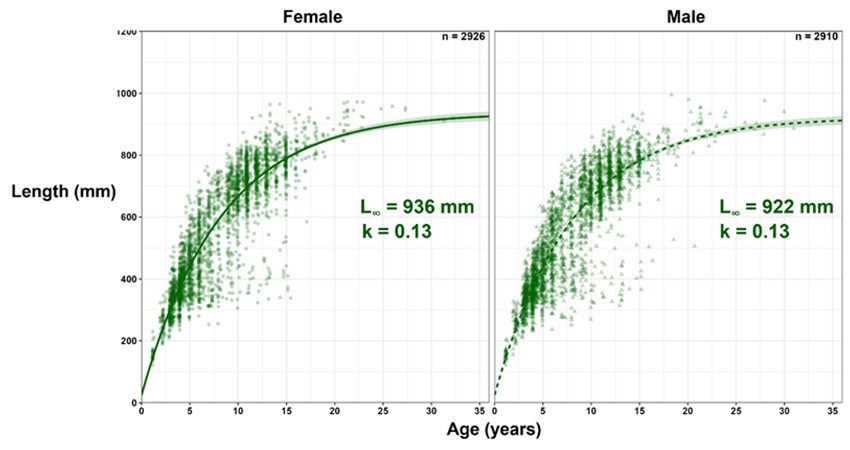
Von Bertalanffy growth curves for Snapper sampled from northern Spencer Gulf between 2000 and 2023
The age when 50% and 95% of fish were sexually mature was estimated for males and females. The data were separated into 2 time periods with different population structures for northern Spencer Gulf:
- 2000 to 2011 when the estimated biomass was high
- 2012 to 2023 when the estimated biomass was much lower.
The analysis identified that the age of 50% and 95% maturity for each sex was lower in the latter time period, which is a common characteristic of depleted populations.
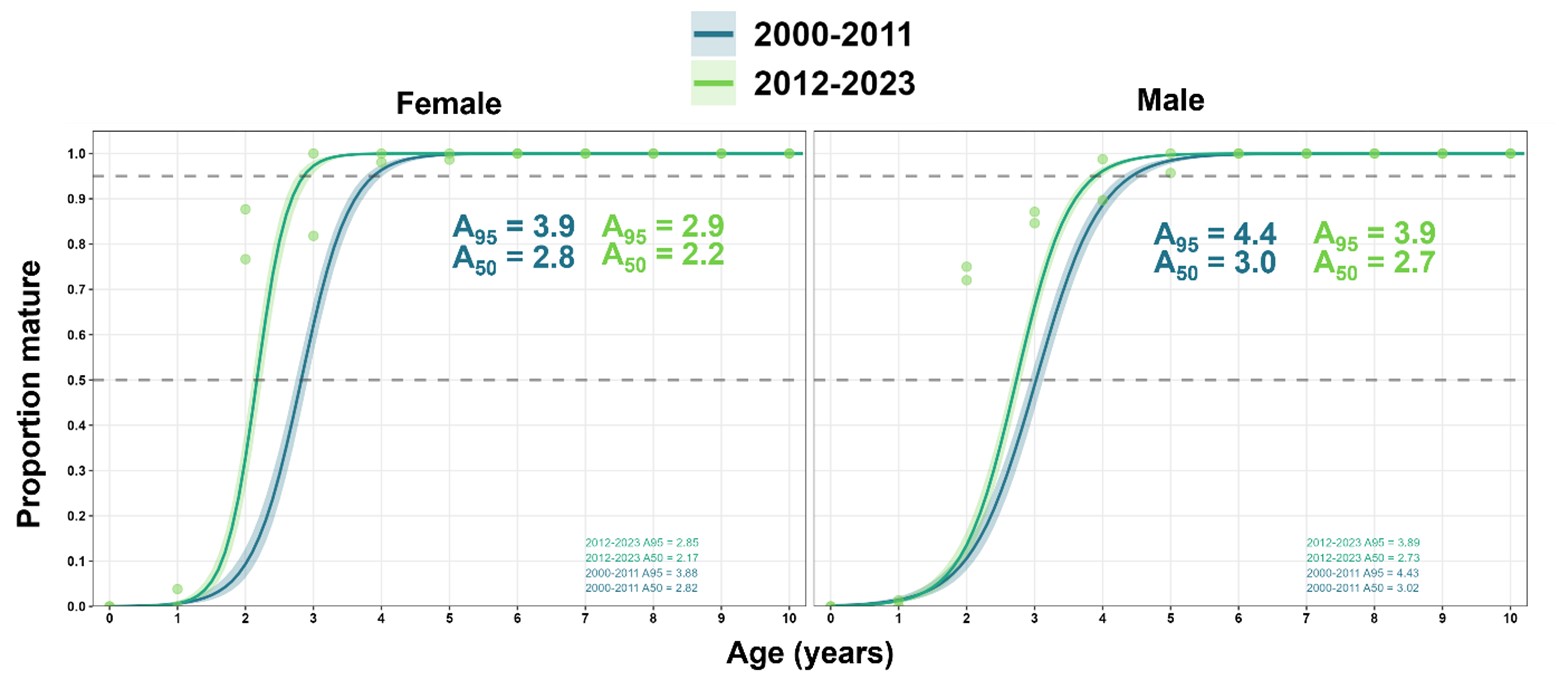
Age-at-maturity curve for Snapper in Northern Spencer Gulf split into two time periods: 2000–2011 and 2012–2023
The next stage of the study will use the individual biological characteristics to calculate population-level parameters, such as natural mortality.
September 2024 – data identified in each of the regions
Historical datasets encompassing studies from the 1980s to the early 2000s have been compiled to be incorporated with the existing SARDI Snapper database. The studies span a broad range of:
- targeted research projects
- surveys for juvenile Snapper
- post-graduate studies.
These data have undergone a rigorous quality control process, ensuring the highest quality is used to investigate temporal trends and summarise contemporary biological parameters for each stock of Snapper in South Australia.
The next step is using the cleaned data to estimate the growth, maturity, and mortality for Snapper in each of the stocks in SA over the past 40 years.
Length and age information will determine how fast and to what size Snapper are growing in each of the regions. Length, age, and reproductive data will determine what age and size Snapper are reaching maturity and contributing to the spawning population. Age compositions will be used with catch data to produce estimates of natural mortality.
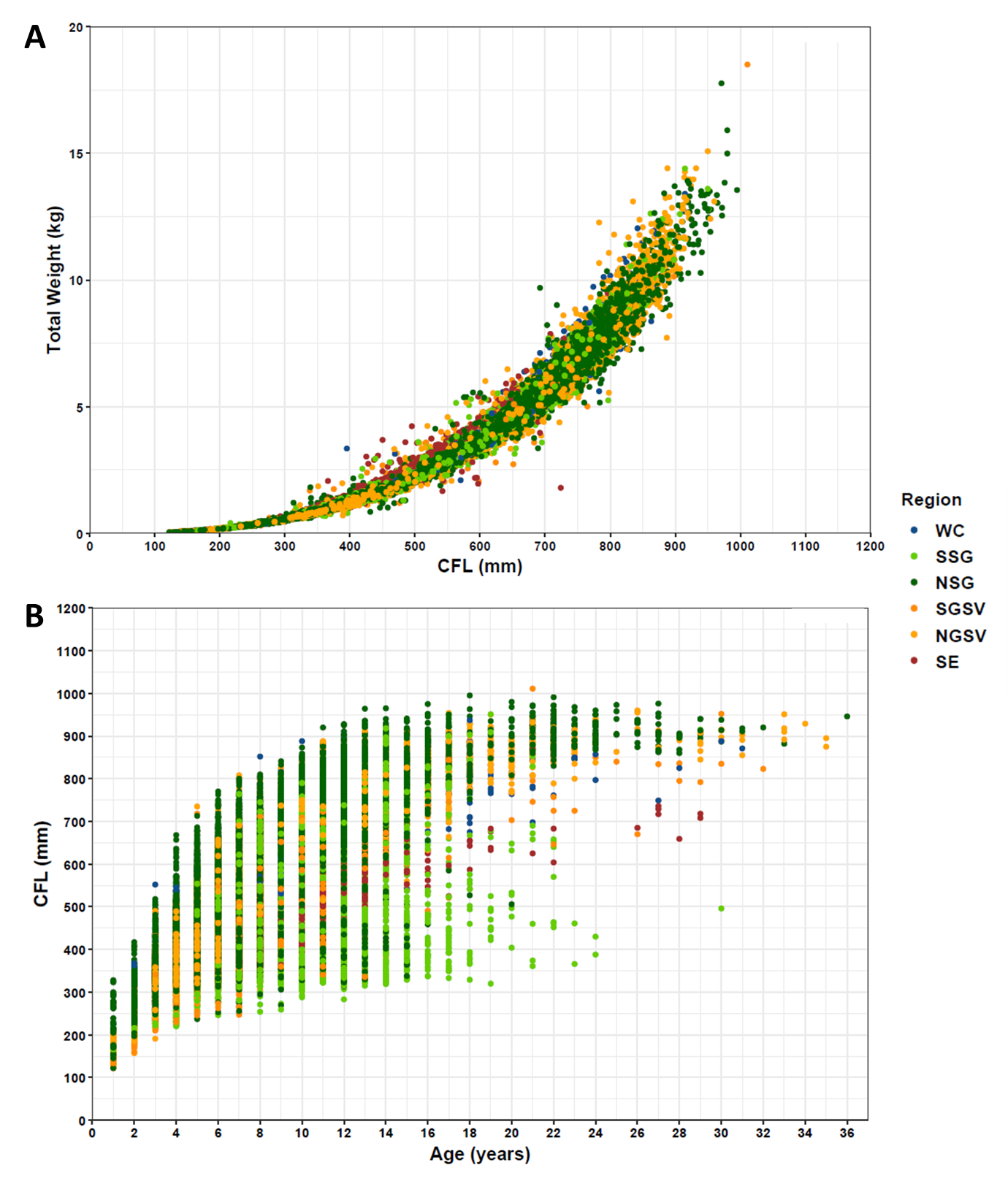
SARDI Snapper database showing biological parameters for each of the regions – West Coast (WC), Southern Spencer Gulf (SSG), Northern Spencer Gulf (NSG), Southern Spencer Gulf (SGSV), Northern Spencer Gulf (NGSV), South East (SE)
Graph A: Caudal Fork Length (CFL) compared to weight
Graph B: CFL compared to age