

PestFacts 19 August 2024
Slugs
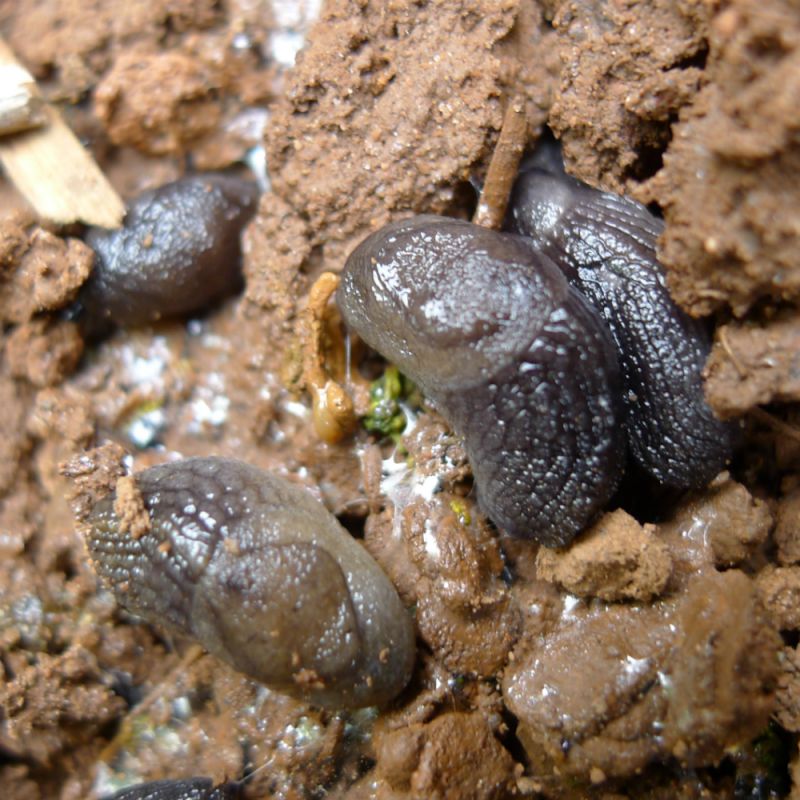
Slugs are emerging across SA, particularly across the South East and lower Eyre Peninsula after the late season break. Some black keeled slugs (Milax gagates) were observed under refuges that were put out as part of the GRDC Slug Modelling project.
Black keeled slugs are also appearing in the Mid and Upper North with minimal damage being observed, most likely because of the cold conditions. In crops such as cereals and even canola at the 4 to 6 leaf stage, the odd slug won't do much damage. As the weather becomes warmer, the plants will outgrow any damage.
Black keeled slugs are the dominant species in South Australia and are probably well suited to the environment because of their ability to burrow. Interestingly, we're starting to notice the odd brown field slug (Deroceras invadens) and grey field slug (D. reticulatum) on the Eyre Peninsula, which haven't been recorded before.
It will be interesting to see how slug numbers and activity progresses over the spring. Through the GRDC Slug Modelling project, we're aiming to learn more about:
- the damage caused by slugs
- the effect of temperature on slug feeding
- suitable management options for the spring season to help reduce numbers for following year.
Sources of reports: Angus (Nutrien Cummins), Thomas Heddle and Michael Nash.
Yellowheaded cockchafer reports
There has been a report of yellowheaded cockchafer (YHC, Sericesthis harti) in the soil of a clover and grass pasture on Kangaroo Island.
YHC is the main species of white curl grub affecting cereal crops across south-eastern Australia. However, there are many related Sericesthis spp. They are predominantly an issue in cereals and grass pastures. Spring-prepared fallows will help reduce damage in the following year. Intensive crop rotations and short pasture rotations can also be used to prevent future damage.
Identification
YHC is similar to other scarab beetles and cockchafers but difficult to tell apart as a larvae (grub) without a microscope. In adults, scarab beetles are smaller and rounded with shiny colours and club-shaped antennae, while cockchafers are larger, more elongated and brown or reddish-brown.
Monitoring and management
Unfortunately, effective control should occur pre-sowing. However, monitoring the affected paddock will help you understand the problem for next season.
Regular soil sampling helps detect larvae presence and assess factors like temperature and moisture, which affect their development. Wilting or stunted plants can indicate root damage from larvae.
Monitor susceptible paddocks prior to sowing and throughout winter. Inspect paddocks by digging to a depth of 10 to 20 cm with a spade and counting the number of larvae present. This should be repeated 10 to 20 times across paddocks to get an estimate of larval numbers. Four larvae per spade square is roughly equivalent to 100 larvae per square metre. Thirty larvae per square metre can potentially reduce yields by up to 1400 kg per hectare. Yellowheaded cockchafer numbers increase following dry springs and summers, particularly after a succession of dry years.
As the YHC larvae live underground they are unlikely to be affected by foliar applications of insecticides. Effective control can include:
- spring-prepared fallows
- crop rotation
- short pasture rotations
- cultivation including intense grazing over spring and summer to expose eggs and larvae to sun and predation.
More herringbone caterpillar reports
In the past week, several mixed populations of small caterpillars, approximately 10 mm in size, have been reported feeding in large numbers on wheat. Herringbone caterpillars (Proteuxoa atrisquamata, Proteuxoa spp.) have been observed in wheat crops between Wirrula and Ceduna on the Eyre Peninsula and also in cereals and some legumes northeast of Kimba.
How to recognise herringbone caterpillars
There is a range of species of caterpillars, broadly known as 'herringbone caterpillars', that can feed on grass pastures, cereals and to a lesser extent, legumes. They were previously known as white-tailed black cutworms. They do not cause the head-lopping damage that is sometimes associated with armyworm but the two often co-exist.
Herringbone caterpillar larvae usually display a light or dark band along the upper abdomen, with a characteristic herringbone or chevron-like pattern of diagonal pale markings on either side of this on many of the abdominal segments. Colouration patterns are more obvious in larger larvae, while smaller larvae are more uniformly dark.
Feeding habits
Most herringbone caterpillar feeding results in a low to moderate economic impact and occurs in late autumn and winter. Larvae most often feed on the lower parts of plants. Damage can be of greater significance in later sown crops that are less advanced.
Management
Regularly inspect crops for signs of caterpillar activity, especially during late autumn and winter. Early detection helps to implement timely control measures. Only spray if severe defoliation is occurring. There is only one generation of this caterpillar each year and they will no longer be a problem once pupated.
Source of reports: Josh Hollit, Maarten Van Helden (SARDI), Troy Maitland (EP Ag N’ Fert)
Pea weevil
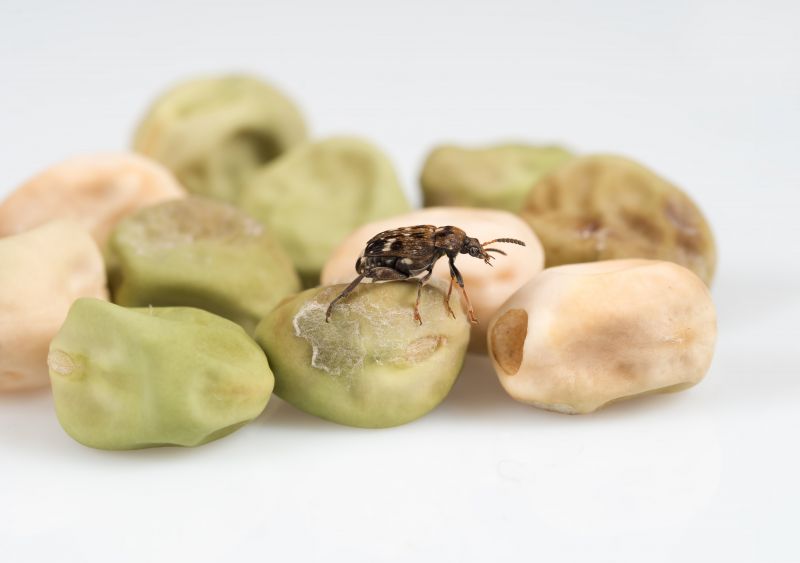
SARDI modelling predicts adult pea weevils (Bruchus pisorum) will have commenced their invasion of pea crops on 11 August 2024 following recent warm weather.
Start monitoring immediately
Sweep-net monitor every 5 to 7 days about 2 metres into pea crops from the edge. Concentrate near trees and other hibernation sites (sheds, etc.). Check the net every 25 sweeps. The spray threshold is at least 2 adults per 25 sweeps, averaged over 5 to 10 sampling sites.
To effectively control pea weevil, adults must be killed before they lay eggs. This means spray timing is essential to achieve good pea weevil control.
We estimate that egg-laying will commence around 25 August 2024 at which time about 75% or more of the weevil population is likely to have emerged and moved into crops. This estimate is based on the predicted:
- invasion start date of 11 August 2024
- maximum temperatures in the coming days.
If the spray threshold is reached, spray any podding pea crops around 25 August 2024. For crops where pods won't form until after this date, spray as the first flowers wither.
Border spraying
If thresholds are exceeded, a 20 to 40 metre width border spray is the most cost-effective way to control pea weevil, as adults will invade from the border.
However, if sweep-net monitoring reveals densities of native budworm (Helicoverpa punctigera) exceeding the threshold, then one whole-crop spray will control both pests – see native budworm to calculate the threshold.
After pea weevil treatment, monitoring and threshold-based treatment for native budworm should continue as normal.
Other management: early harvest
Good pea weevil management includes harvesting pea crops as early as seasonal conditions permit.
Early harvesting ensures that the pea weevil infestation is still immature, and adults aren't present to disperse during harvest. This will minimise pod and seed shatter, damage from pea weevil feeding, and the risk of grain rejection at delivery.
It also provides the long-term benefit of reducing the abundance of pea weevil in the same location next year.
Report to PestFacts
The PestFacts SA team always wants to know what invertebrates you find in your crops and pastures, whether it is a pest, beneficial or unknown – even the usual pests.
Please send your reports or identification requests via the PestFacts map.
Alternatively, please contact:
Maryam Ehsangar
Phone: 0448 010 339
Email: maryam.ehsangar@sa.gov.au
Maarten van Helden:
Phone: 0481 544 429
Email: maarten.vanhelden@sa.gov.au
Subscribe
The latest information for growers and advisors on the activity and management of pests in all broadacre crops during the winter growing season.