

PestFacts 29 July 2024
IPM checklist now available
The new and updated Integrated pest management (IPM) checklist is now available to help support grain growers make decisions about sustainable pest management in their crops. It provides an overview of IPM practices and highlights which activities to focus on throughout the season.
For tips on getting the most out of the IPM checklist, see Strategic pest management made simpler: Introducing the IPM checklist.
The IPM Checklist was produced as part of IPMforGrains, a Grains Research and Development Corporation (GRDC) investment delivered by Cesar Australia, in partnership with the Queensland Department of Agriculture and Fisheries (QDAF), the Department of Primary Industries and Regional Development (DPIRD), the South Australian Research and Development Institute (SARDI), and the New South Wales Department of Primary Industries (NSW DPI).
New PestFacts SA coordinator
 A new member has joined the PestFacts SA team: Maryam Ehsangar.
Maryam Ehsangar is an Agricultural Science professional with a master's degree and over 7 years of experience in the field, both in Australia and internationally.
In Australia, Maryam specialised in agronomy, focusing on optimising sustainable crop yields through customised farming techniques. Her expertise in soil nutrient management and proactive pest control enabled effective management of challenges while prioritising environmental preservation. Maryam actively collaborated with local agricultural groups and organisations to foster knowledge-sharing and promote the adoption of eco-friendly farming practices.
As an agricultural consultant in Iran, Maryam worked closely with farmers to introduce and refine broadacre farming methods. Her initiatives aimed to enhance land productivity while promoting soil health and biodiversity across diverse agricultural landscapes.
Maryam is a researcher at SARDI Entomology, contributing to the Beneficial Insects in Canola Project. This project aims to enhance ecological benefits in canola farming by advocating for the use of beneficial insects.
Maryam's contact details are below.
Mite activity
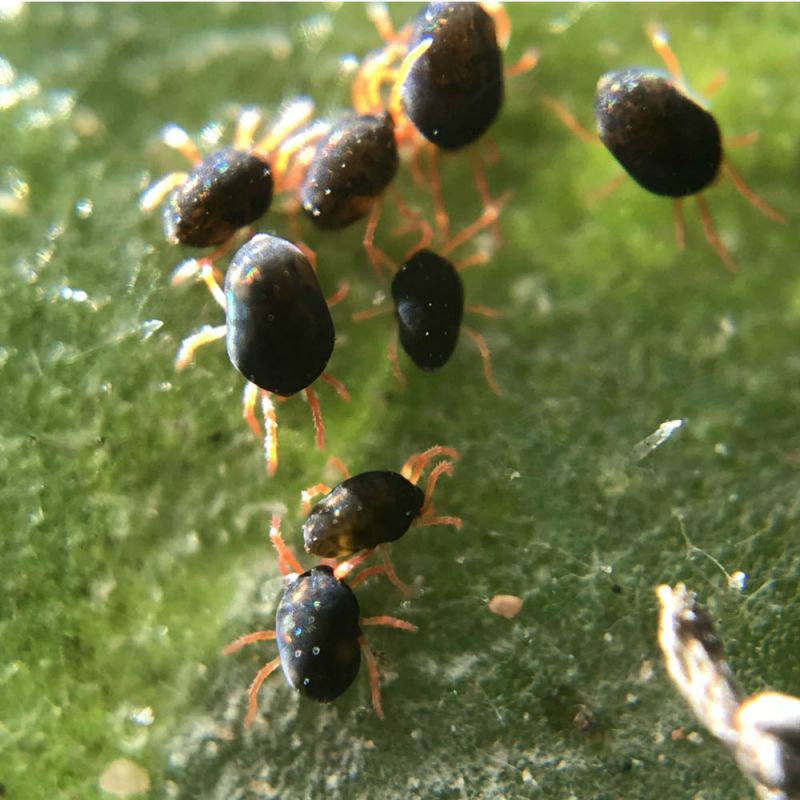
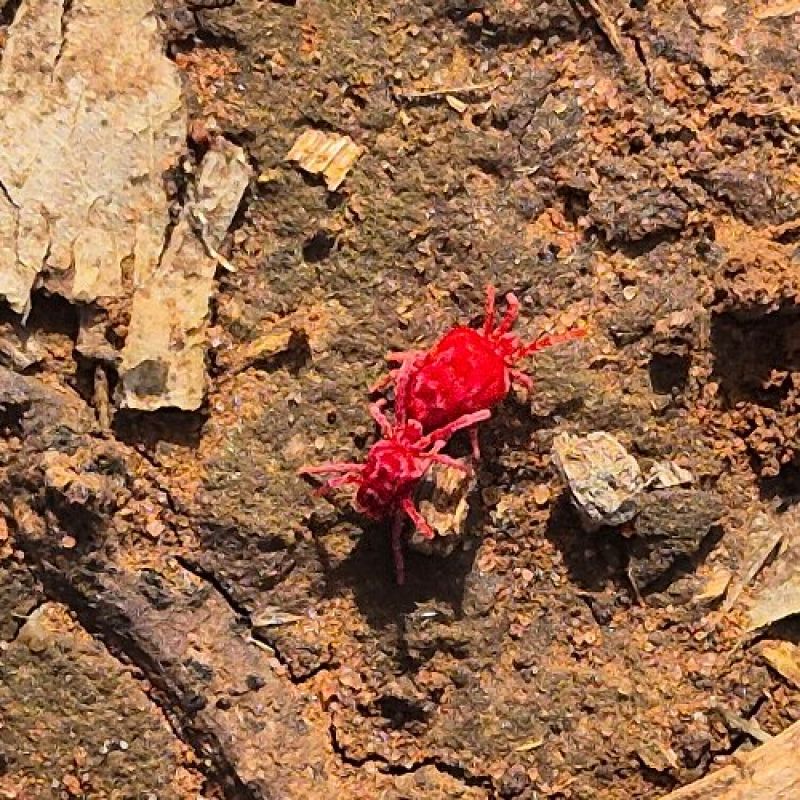
Recent field observations indicate significant activity of redlegged earth mite (RLEM, Halotydeus destructor), Bryobia mite (clover mite, Bryobia spp.) in the Mid North, and lots of predatory red velvet mite (Fam: Trombidiidae) activity. Conditions conducive to mite establishment have been particularly favourable over the last few weeks.
Redlegged earth mite
RLEM hatching occurs following autumn rainfall (greater than 5 mm) and cool temperatures (less than 20.5°C). RLEM often feed in groups. Resistance to synthetic pyrethroid and organophosphate insecticides has been detected in RLEM around the upper South East and Fleurieu Peninsula regions. To help manage resistance, see Resistance management strategy for the redlegged earth mite in Australian grains and pastures.
Bryobia mite
These mites have a flattened body and front legs up to 1.5 times their body length. They prefer warmer conditions and are often seen earlier in autumn than other species. If treatment is necessary, organophosphates may provide better control than synthetic pyrethroids. Populations decline during cold winter conditions.
Red velvet mite
There are many species of red velvet mites. Relative to other soil-dwelling mites, they are quite large – often more than 3 mm in length. Their common name is derived from their bright red colour and their velvety appearance, attributed to the covering of short stout hairs on their body. Interestingly, while red velvet mite nymphs and adults are predatory and will feed on small invertebrates living in the soil, the larval stage is parasitic on many different arthropods, including aphids – see Look out for beneficial mites.
Source of reports: Steve Richmond (Nutrien, Jamestown), Maryam Ehsangar (SARDI).
Caterpillar activity
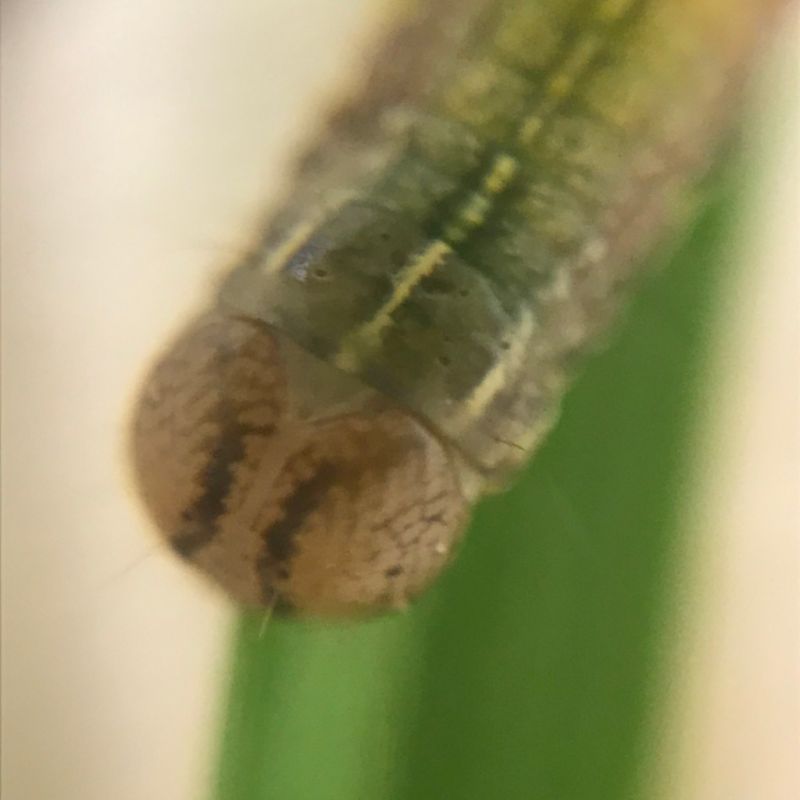
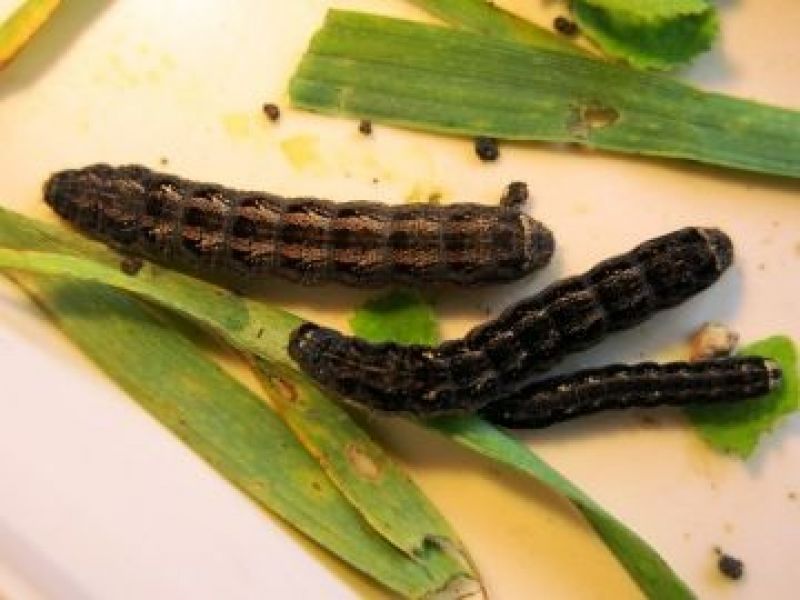
In the past week several mixed populations of small (around 10 mm) caterpillars have been reported feeding in large numbers on wheat. There were unusually dark armyworm caterpillars, but which still had the typical armyworm stripes, and some herringbone caterpillars.
How to recognise an armyworm
Armyworms are distinguishable from other noctuid caterpillar pests by the 3 distinct white parallel stripes on their cervical shield (neck), which typically run to the end of their body.
There are 3 commonly found species of armyworm in southern Australia, but they are difficult to distinguish in field and control methods are similar. Fall armyworm (FAW,) has not been detected in South Australia, but is identified by an inverted Y-shape on the head and four dark spots on the second to last body segment.
Herringbone caterpillars, which often co-exist with armyworms, have a distinctive herringbone pattern down their backs.
Assessing current armyworm risk
Armyworms feed mostly on leaves, but in crops close to maturity they will feed on the last remaining green section of the stem just below the head and resulting in head loss. The most critical risk period is 3 to 4 weeks prior to harvest. When determining the risk, consider the:
- timing of harvest
- green matter available in the crop
- expected return on the crop
- number of larvae
- larval development stage.
Like most caterpillar species, about 80% of the feeding is done in the last instar (large larvae, 30 to 40 mm) over a period of 3 to 7 days. The economic threshold for armyworms during crop ripening is 1 to 3 larvae per square metre.
Tips when looking for armyworm:
- Assessing armyworm numbers can be difficult because their behaviour can vary with weather conditions and feeding preferences.
- Armyworms are most active at night, but can sometimes be seen during the day feeding on the leaves and stems of cereal crops.
- Look for caterpillars on plants and on the ground, especially under leaf litter between the rows and on damaged plant heads.
- Caterpillars have been found sheltering inside stubble.
- Use of a sweep net in a crop in the early evening provides an indication of the relative densities and stages of armyworm.
- Check frequently for signs of head-lopping.
Helicoverpa spring moth trap network
This spring, SARDI will be running the Helicoverpa pheromone trap network again. Pheromone traps contain a species-specific female sex pheromone lure designed to attract and capture male Helicoverpa moths.
Understanding the timing of moth flights can provide early warning of potential larval activity in crops.
At each location, we will be separately trapping the two Helicoverpa species:
- native budworm (Helicoverpa punctigera)
- corn earworm or cotton bollworm (H. armigera).
These traps are kindly operated by collaborating field consultants. If you would like to be a part of this network, please email: maryam.ehsangar@sa.gov.au.
We will provide weekly updates of moth trapping data during spring – follow PestFactsSA on X for updates.
Helicoverpa behaviour
The native budworm breeds on inland flowering native plant species during winter. As vegetation dries off in late winter and early spring, moths exploit favourable weather systems to migrate into southern cropping areas, where females lay eggs into pulse and canola crops.
Larvae can cause economic damage through direct grain consumption and reduction of grain quality. Of all the Helicoverpa life-stages, mature larvae (approximately 30 to 40 mm in length) are responsible for 90% of the total grain consumption. Hence insecticide treatments, where warranted, should aim to target younger individuals (ideally less than 15 mm in length).
The native budworm is typically the predominant species found in the southern region during spring. However, the corn earworm has been commonly trapped at low numbers in South Australia in recent years. This is of interest because field populations of this species can evolve resistance to a range of insecticides that effectively control native budworm – see Resistance management strategy for Helicoverpa armigera in Australian grains.


Report to PestFacts
The PestFacts SA team always wants to know what invertebrates you find in your crops and pastures, whether it is a pest, beneficial or unknown – even the usual pests.
Please send your reports or identification requests via the PestFacts map.
Alternatively, please contact:
Maryam Ehsangar
Phone: 0448 010 339
Email: maryam.ehsangar@sa.gov.au
Maarten van Helden:
Phone: 0481 544 429
Email: maarten.vanhelden@sa.gov.au
Subscribe
The latest information for growers and advisors on the activity and management of pests in all broadacre crops during the winter growing season.