

PestFacts 23 October 2024
Spring is here – so are cabbage aphids
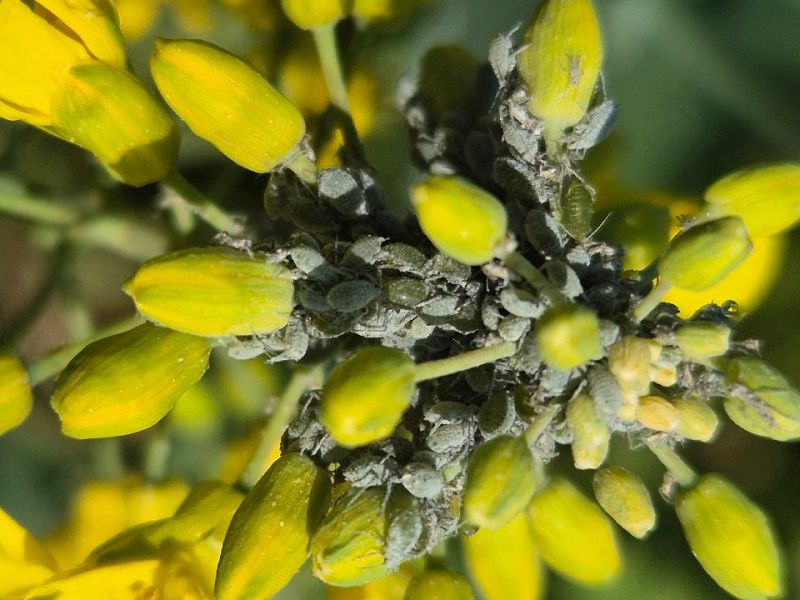
There have been recent reports of cabbage aphids (Brevicoryne brassicae) in dense colonies on canola.
Aphids often attack stressed plants, and after this year’s dryer winter weather conditions there are more cabbage aphids in stressed canola crops.
Cabbage aphids are a widespread pest and if colonies are dense enough, it can lead to decreased pod formation, lower pod development, and poor grain quality. They form distinctive colonies with a characteristic blue-grey appearance normally covered in a thick, whitish powder during flowering and pod-development stages.
Monitor your crop to prevent overcrowding
Monitor for cabbage aphids weekly from late winter onwards, but especially during flowering and grain fill. Generally, they will first appear at crop edges, and distribution may be patchy, so monitoring should include at least 5 sampling points across the paddock. Inspect at least 20 plants at each sampling point.
Get help from beneficial insects
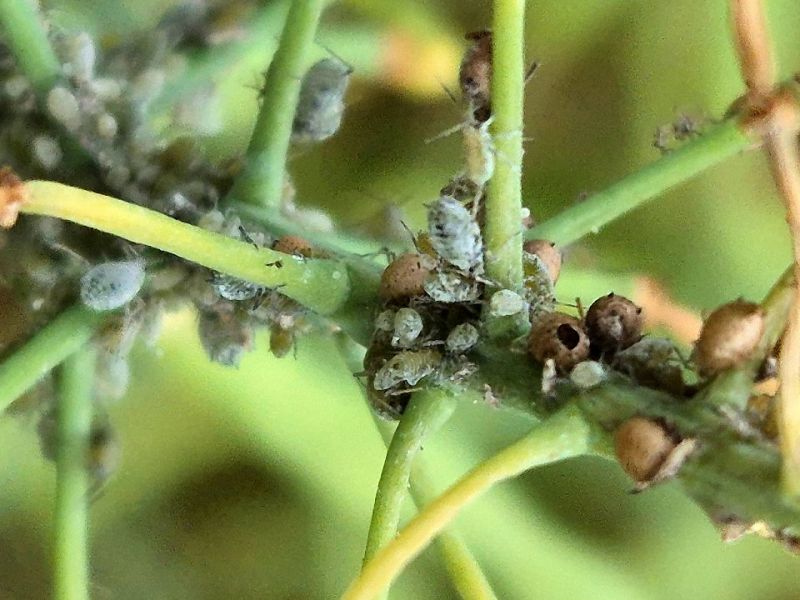
Beneficial insects are an important tool to manage aphids in the field. Keeping track of both aphids and their natural enemies over time is crucial for assessing the effectiveness of these beneficials. Parasitoid wasps are one of aphids’ most effective natural enemies. A female wasp will insert an egg into an aphid and the developing larvae feeds inside, eventually killing it. Infected aphids take up to 10 days to develop into 'mummies'. The adult wasp emerges from the mummy by cutting an exit hole in the skin.
Be mindful of harvest time before using insecticide
Besides allowing beneficial insects to control aphids, you might want to spray to get top off the cabbage aphids. It's crucial to recognise that harvest time is approaching fast, and you need to be mindful of the risk associated with residues. To ensure the safety and quality of produce, it's essential to manage the spray withholding period effectively.
Consider control where more than 20% of plants are infested, or more than 10% of plants with 25 millimetres of stem are infested. If close to harvest, that threshold will be even higher. When determining economic thresholds for aphids, it is vital you consider a number of factors including:
- when to harvest
- if large numbers of beneficials are visible – such as parasitised aphids (mummies), ladybeetles or lacewing larvae
- current growing conditions
- moisture availability
Corn earworms detected in canola crops
Corn earworms (cotton bollworms, Helicoverpa armigera) are more common in the warmer northern or coastal regions of eastern Australia and have been detected in canola crops.
How to identify corn earworm
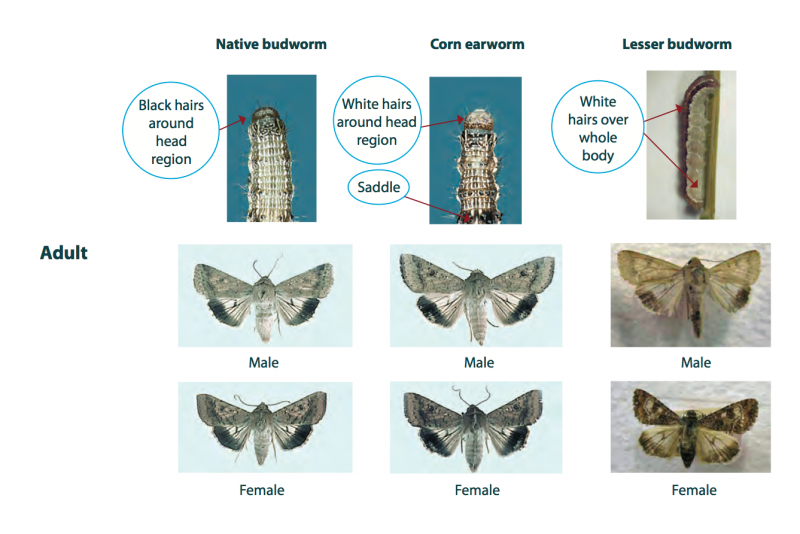
Adult moths have a wingspan of 30 to 45 millimetres with light brown to red-brown colouring and dark spots. Their hindwings are pale with a dark band. Larvae reach up to 40 millimetres, showing colour variations from brown to green and orange, marked by dark strips and bumpy skin with stiff hairs. They have a distinctive 'saddle' on the fourth segment and downward-angled rears. Corn earworm moths are less likely to fly long distances compared to native budworm moths. This means that problems in spring and summer usually come from local populations that survive the winter in crops as pupae.
Feeding habits
They attack the above-ground parts of mature plants, including pods and seeds, with most damage occurring in cereals, rice, and pastures in late spring and summer. They are especially harmful to the fruiting parts of plants, causing visible holes and chewing damage.
Management
Monitor crops for activity by taking a minimum of 5 sets of 10 sweeps and calculating the average number of larvae for every 10 sweeps. The use of pheromone traps (which attract male moths) can provide an early warning of moths arriving or emerging from local winter diapause.
Report to PestFacts
The PestFacts SA team always wants to know what invertebrates you find in your crops and pastures, whether it is a pest, beneficial or unknown – even the usual pests.
Please send your reports or identification requests via the PestFacts map.
Alternatively, please contact:
Maryam Ehsangar
Phone: 0448 010 339
Email: maryam.ehsangar@sa.gov.au
Maarten van Helden:
Phone: 0481 544 429
Email: maarten.vanhelden@sa.gov.au
Subscribe
The latest information for growers and advisors on the activity and management of pests in all broadacre crops during the winter growing season.